

colder body, i.e., heat lost = heat gained. Furthermore, body 1 is chosen as a
normal substance (e.g., water) of certain mass and that 1 is brought in contact with
body 2 and body 3 in two separate events, Event A and Event B. One can surmise
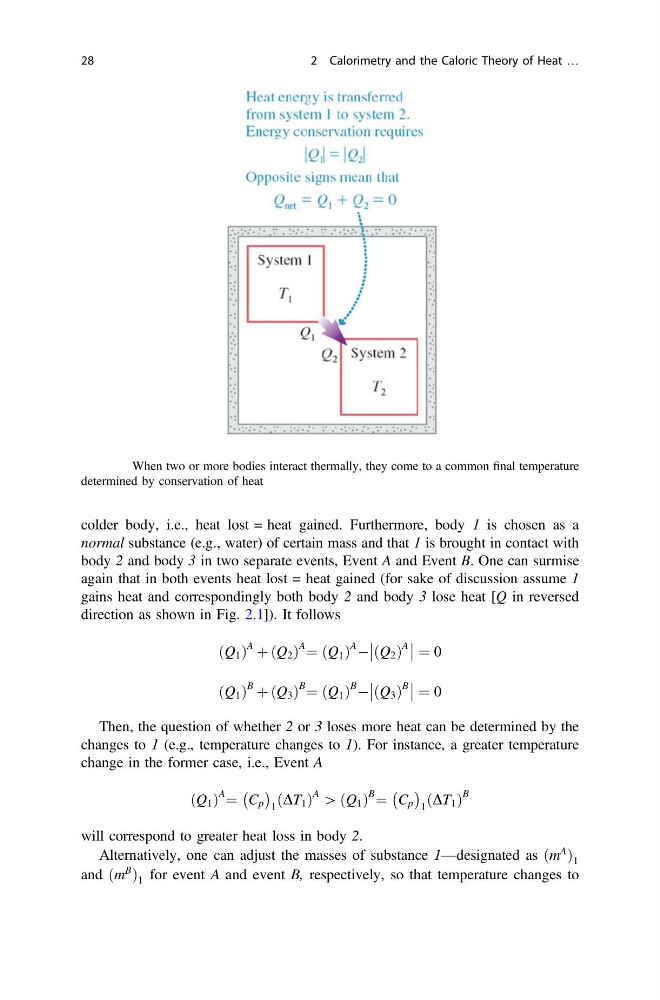
again that in both events heat lost = heat gained (for sake of discussion assume 1
gains heat and correspondingly both body 2 and body 3 lose heat [Q in reversed
direction as shown in Fig. 2.1]). It follows
Q 1
ð Þ
A þ Q 2
ð Þ
A ¼ Q 1
ð Þ
A À Q 2
ð Þ
A
¼ 0
Q 1
ð Þ
B þ Q 3
ð Þ
B ¼ Q 1
ð Þ
B À Q 3
ð Þ
B
¼ 0
Then, the question of whether 2 or 3 loses more heat can be determined by the
changes to 1 (e.g., temperature changes to 1). For instance, a greater temperature
change in the former case, i.e., Event A
Q 1
ð Þ
A ¼ C p
À Á
1
DT 1
ð
Þ
A [ Q 1
ð Þ
B ¼ C p
À Á
1
DT 1
ð
Þ
B
will correspond to greater heat loss in body 2.
Alternatively, one can adjust the masses of substance 1—designated as m
A
ð Þ 1
and m
B
ð Þ 1 for event A and event B, respectively, so that temperature changes to
Fig. 2.1 When two or more bodies interact thermally, they come to a common final temperature
determined by conservation of heat
28
2 Calorimetry and the Caloric Theory of Heat …
normal substance (e.g., water) of certain mass and that 1 is brought in contact with
body 2 and body 3 in two separate events, Event A and Event B. One can surmise
again that in both events heat lost = heat gained (for sake of discussion assume 1
gains heat and correspondingly both body 2 and body 3 lose heat [Q in reversed
direction as shown in Fig. 2.1]). It follows
Q 1
ð Þ
A þ Q 2
ð Þ
A ¼ Q 1
ð Þ
A À Q 2
ð Þ
A
¼ 0
Q 1
ð Þ
B þ Q 3
ð Þ
B ¼ Q 1
ð Þ
B À Q 3
ð Þ
B
¼ 0
Then, the question of whether 2 or 3 loses more heat can be determined by the
changes to 1 (e.g., temperature changes to 1). For instance, a greater temperature
change in the former case, i.e., Event A
Q 1
ð Þ
A ¼ C p
À Á
1
DT 1
ð
Þ
A [ Q 1
ð Þ
B ¼ C p
À Á
1
DT 1
ð
Þ
B
will correspond to greater heat loss in body 2.
Alternatively, one can adjust the masses of substance 1—designated as m
A
ð Þ 1
and m
B
ð Þ 1 for event A and event B, respectively, so that temperature changes to
Fig. 2.1 When two or more bodies interact thermally, they come to a common final temperature
determined by conservation of heat
28
2 Calorimetry and the Caloric Theory of Heat …