

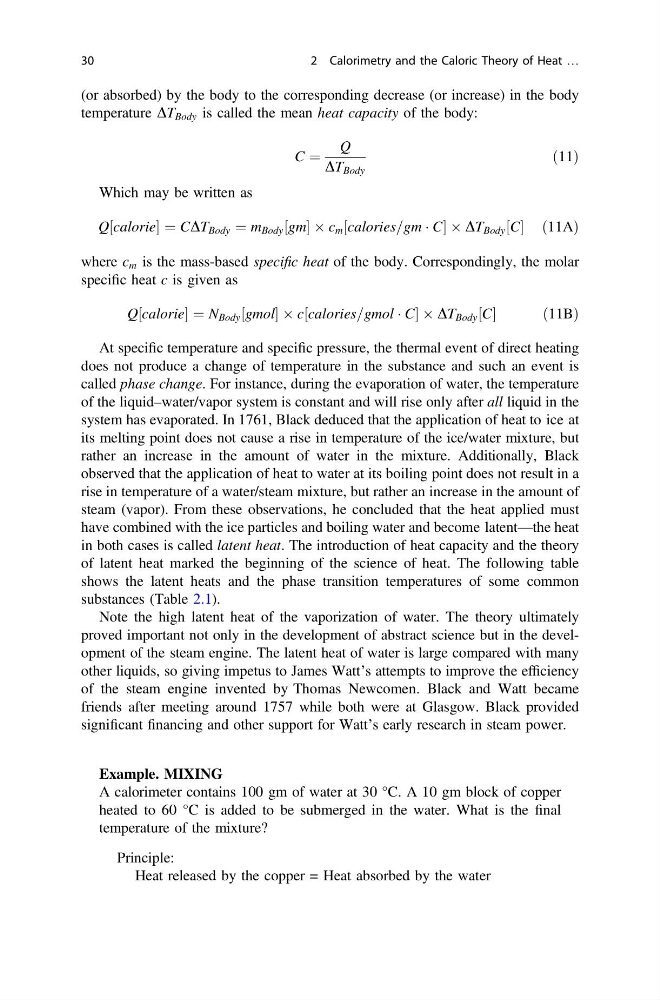
(or absorbed) by the body to the corresponding decrease (or increase) in the body
temperature DT Body is called the mean heat capacity of the body:
C ¼
Q
DT Body
ð11Þ
Which may be written as
Q calorie
½
¼CDT Body ¼ m Body gm
½ Â c m calories=gm Á C
½
 DT Body C
½ ð11AÞ
where c m is the mass-based specific heat of the body. Correspondingly, the molar
specific heat c is given as
Q calorie
½
¼N Body gmol
½
Âc calories=gmol Á C
½
 DT Body C
½
ð11BÞ
At specific temperature and specific pressure, the thermal event of direct heating
does not produce a change of temperature in the substance and such an event is
called phase change. For instance, during the evaporation of water, the temperature
of the liquid–water/vapor system is constant and will rise only after all liquid in the
system has evaporated. In 1761, Black deduced that the application of heat to ice at
its melting point does not cause a rise in temperature of the ice/water mixture, but
rather an increase in the amount of water in the mixture. Additionally, Black
observed that the application of heat to water at its boiling point does not result in a
rise in temperature of a water/steam mixture, but rather an increase in the amount of
steam (vapor). From these observations, he concluded that the heat applied must
have combined with the ice particles and boiling water and become latent—the heat
in both cases is called latent heat. The introduction of heat capacity and the theory
of latent heat marked the beginning of the science of heat. The following table
shows the latent heats and the phase transition temperatures of some common
substances (Table 2.1).
Note the high latent heat of the vaporization of water. The theory ultimately
proved important not only in the development of abstract science but in the development of the steam engine. The latent heat of water is large compared with many
other liquids, so giving impetus to James Watt’s attempts to improve the efficiency
of the steam engine invented by Thomas Newcomen. Black and Watt became
friends after meeting around 1757 while both were at Glasgow. Black provided
significant financing and other support for Watt’s early research in steam power.
Example. MIXING
A calorimeter contains 100 gm of water at 30 °C. A 10 gm block of copper
heated to 60 °C is added to be submerged in the water. What is the final
temperature of the mixture?
Principle:
Heat released by the copper = Heat absorbed by the water
30
2 Calorimetry and the Caloric Theory of Heat …
temperature DT Body is called the mean heat capacity of the body:
C ¼
Q
DT Body
ð11Þ
Which may be written as
Q calorie
½
¼CDT Body ¼ m Body gm
½ Â c m calories=gm Á C
½
 DT Body C
½ ð11AÞ
where c m is the mass-based specific heat of the body. Correspondingly, the molar
specific heat c is given as
Q calorie
½
¼N Body gmol
½
Âc calories=gmol Á C
½
 DT Body C
½
ð11BÞ
At specific temperature and specific pressure, the thermal event of direct heating
does not produce a change of temperature in the substance and such an event is
called phase change. For instance, during the evaporation of water, the temperature
of the liquid–water/vapor system is constant and will rise only after all liquid in the
system has evaporated. In 1761, Black deduced that the application of heat to ice at
its melting point does not cause a rise in temperature of the ice/water mixture, but
rather an increase in the amount of water in the mixture. Additionally, Black
observed that the application of heat to water at its boiling point does not result in a
rise in temperature of a water/steam mixture, but rather an increase in the amount of
steam (vapor). From these observations, he concluded that the heat applied must
have combined with the ice particles and boiling water and become latent—the heat
in both cases is called latent heat. The introduction of heat capacity and the theory
of latent heat marked the beginning of the science of heat. The following table
shows the latent heats and the phase transition temperatures of some common
substances (Table 2.1).
Note the high latent heat of the vaporization of water. The theory ultimately
proved important not only in the development of abstract science but in the development of the steam engine. The latent heat of water is large compared with many
other liquids, so giving impetus to James Watt’s attempts to improve the efficiency
of the steam engine invented by Thomas Newcomen. Black and Watt became
friends after meeting around 1757 while both were at Glasgow. Black provided
significant financing and other support for Watt’s early research in steam power.
Example. MIXING
A calorimeter contains 100 gm of water at 30 °C. A 10 gm block of copper
heated to 60 °C is added to be submerged in the water. What is the final
temperature of the mixture?
Principle:
Heat released by the copper = Heat absorbed by the water
30
2 Calorimetry and the Caloric Theory of Heat …