

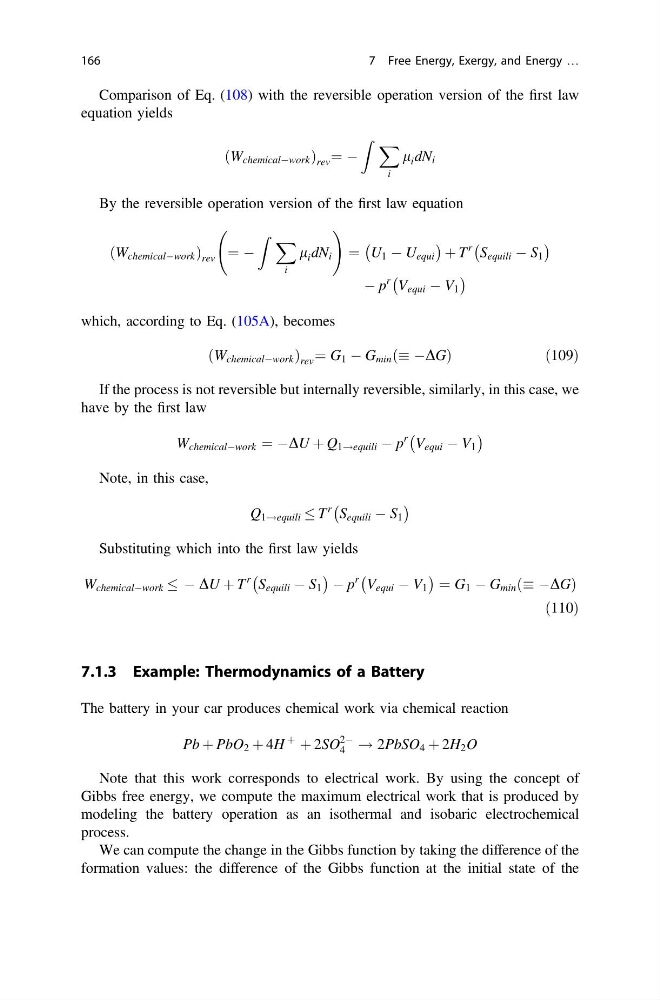
Comparison of Eq. (108) with the reversible operation version of the first law
equation yields
W chemicalÀwork
ð
Þ rev ¼ À
Z X
i
l i dN i
By the reversible operation version of the first law equation
W chemicalÀwork
ð
Þ rev ¼ À
Z X
i
l i dN i
!
¼ U 1 À U equi
À
Á þ T
r S equili À S 1
À
Á
À p
r V equi À V 1
À
Á
which, according to Eq. (105A), becomes
W chemicalÀwork
ð
Þ rev ¼ G 1 À G min ÀDG
ð
Þ
ð 109Þ
If the process is not reversible but internally reversible, similarly, in this case, we
have by the first law
W chemicalÀwork ¼ ÀDU þ Q 1!equili À p
r V equi À V 1
À
Á
Note, in this case,
Q 1!equili T
r S equili À S 1
À
Á
Substituting which into the first law yields
W chemicalÀwork À DU þ T
r S equili À S 1
À
Á À p
r V equi À V 1
À
Á ¼ G 1 À G min ÀDG
ð
Þ
ð110Þ
7.1.3 Example: Thermodynamics of a Battery
The battery in your car produces chemical work via chemical reaction
Pb þ PbO 2 þ 4H
þ
þ 2SO
2À
4 ! 2PbSO 4 þ 2H 2 O
Note that this work corresponds to electrical work. By using the concept of
Gibbs free energy, we compute the maximum electrical work that is produced by
modeling the battery operation as an isothermal and isobaric electrochemical
process.
We can compute the change in the Gibbs function by taking the difference of the
formation values: the difference of the Gibbs function at the initial state of the
166
7 Free Energy, Exergy, and Energy …
equation yields
W chemicalÀwork
ð
Þ rev ¼ À
Z X
i
l i dN i
By the reversible operation version of the first law equation
W chemicalÀwork
ð
Þ rev ¼ À
Z X
i
l i dN i
!
¼ U 1 À U equi
À
Á þ T
r S equili À S 1
À
Á
À p
r V equi À V 1
À
Á
which, according to Eq. (105A), becomes
W chemicalÀwork
ð
Þ rev ¼ G 1 À G min ÀDG
ð
Þ
ð 109Þ
If the process is not reversible but internally reversible, similarly, in this case, we
have by the first law
W chemicalÀwork ¼ ÀDU þ Q 1!equili À p
r V equi À V 1
À
Á
Note, in this case,
Q 1!equili T
r S equili À S 1
À
Á
Substituting which into the first law yields
W chemicalÀwork À DU þ T
r S equili À S 1
À
Á À p
r V equi À V 1
À
Á ¼ G 1 À G min ÀDG
ð
Þ
ð110Þ
7.1.3 Example: Thermodynamics of a Battery
The battery in your car produces chemical work via chemical reaction
Pb þ PbO 2 þ 4H
þ
þ 2SO
2À
4 ! 2PbSO 4 þ 2H 2 O
Note that this work corresponds to electrical work. By using the concept of
Gibbs free energy, we compute the maximum electrical work that is produced by
modeling the battery operation as an isothermal and isobaric electrochemical
process.
We can compute the change in the Gibbs function by taking the difference of the
formation values: the difference of the Gibbs function at the initial state of the
166
7 Free Energy, Exergy, and Energy …