

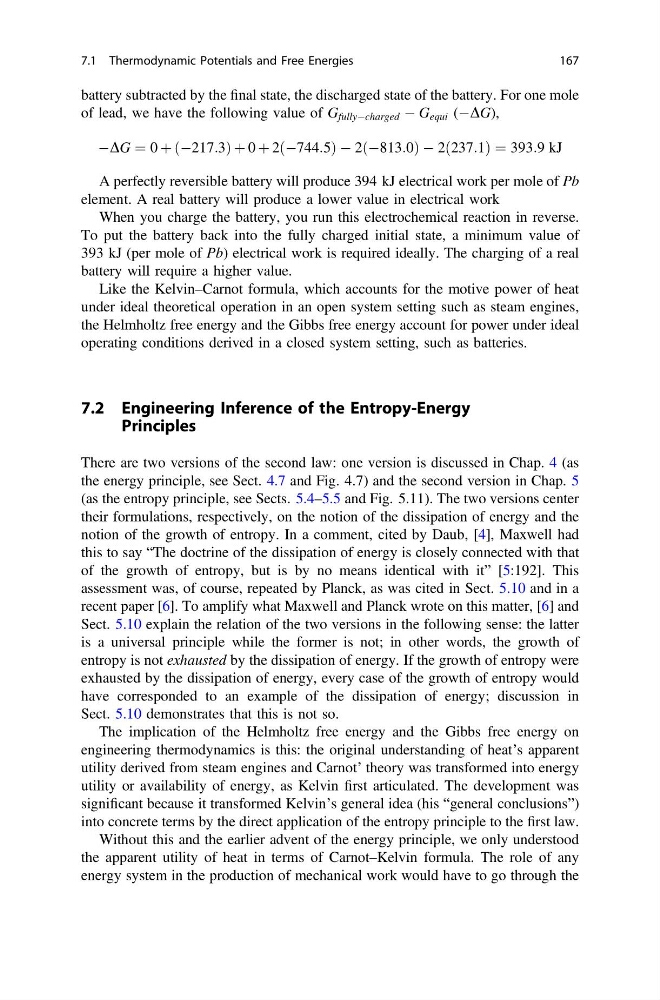
battery subtracted by the final state, the discharged state of the battery. For one mole
of lead, we have the following value of G fullyÀcharged À G equi (ÀDG),
ÀDG ¼ 0 þ À217:3
ð
Þþ0 þ 2 À744:5
ð
ÞÀ2 À813:0
ð
ÞÀ2 237:1
ð
Þ¼393:9 kJ
A perfectly reversible battery will produce 394 kJ electrical work per mole of Pb
element. A real battery will produce a lower value in electrical work
When you charge the battery, you run this electrochemical reaction in reverse.
To put the battery back into the fully charged initial state, a minimum value of
393 kJ (per mole of Pb) electrical work is required ideally. The charging of a real
battery will require a higher value.
Like the Kelvin–Carnot formula, which accounts for the motive power of heat
under ideal theoretical operation in an open system setting such as steam engines,
the Helmholtz free energy and the Gibbs free energy account for power under ideal
operating conditions derived in a closed system setting, such as batteries.
7.2 Engineering Inference of the Entropy-Energy
Principles
There are two versions of the second law: one version is discussed in Chap. 4 (as
the energy principle, see Sect. 4.7 and Fig. 4.7) and the second version in Chap. 5
(as the entropy principle, see Sects. 5.4–5.5 and Fig. 5.11). The two versions center
their formulations, respectively, on the notion of the dissipation of energy and the
notion of the growth of entropy. In a comment, cited by Daub, [4], Maxwell had
this to say “The doctrine of the dissipation of energy is closely connected with that
of the growth of entropy, but is by no means identical with it” [5:192]. This
assessment was, of course, repeated by Planck, as was cited in Sect. 5.10 and in a
recent paper [6]. To amplify what Maxwell and Planck wrote on this matter, [6] and
Sect. 5.10 explain the relation of the two versions in the following sense: the latter
is a universal principle while the former is not; in other words, the growth of
entropy is not exhausted by the dissipation of energy. If the growth of entropy were
exhausted by the dissipation of energy, every case of the growth of entropy would
have corresponded to an example of the dissipation of energy; discussion in
Sect. 5.10 demonstrates that this is not so.
The implication of the Helmholtz free energy and the Gibbs free energy on
engineering thermodynamics is this: the original understanding of heat’s apparent
utility derived from steam engines and Carnot’ theory was transformed into energy
utility or availability of energy, as Kelvin first articulated. The development was
significant because it transformed Kelvin’s general idea (his “general conclusions”)
into concrete terms by the direct application of the entropy principle to the first law.
Without this and the earlier advent of the energy principle, we only understood
the apparent utility of heat in terms of Carnot–Kelvin formula. The role of any
energy system in the production of mechanical work would have to go through the
7.1 Thermodynamic Potentials and Free Energies
167
of lead, we have the following value of G fullyÀcharged À G equi (ÀDG),
ÀDG ¼ 0 þ À217:3
ð
Þþ0 þ 2 À744:5
ð
ÞÀ2 À813:0
ð
ÞÀ2 237:1
ð
Þ¼393:9 kJ
A perfectly reversible battery will produce 394 kJ electrical work per mole of Pb
element. A real battery will produce a lower value in electrical work
When you charge the battery, you run this electrochemical reaction in reverse.
To put the battery back into the fully charged initial state, a minimum value of
393 kJ (per mole of Pb) electrical work is required ideally. The charging of a real
battery will require a higher value.
Like the Kelvin–Carnot formula, which accounts for the motive power of heat
under ideal theoretical operation in an open system setting such as steam engines,
the Helmholtz free energy and the Gibbs free energy account for power under ideal
operating conditions derived in a closed system setting, such as batteries.
7.2 Engineering Inference of the Entropy-Energy
Principles
There are two versions of the second law: one version is discussed in Chap. 4 (as
the energy principle, see Sect. 4.7 and Fig. 4.7) and the second version in Chap. 5
(as the entropy principle, see Sects. 5.4–5.5 and Fig. 5.11). The two versions center
their formulations, respectively, on the notion of the dissipation of energy and the
notion of the growth of entropy. In a comment, cited by Daub, [4], Maxwell had
this to say “The doctrine of the dissipation of energy is closely connected with that
of the growth of entropy, but is by no means identical with it” [5:192]. This
assessment was, of course, repeated by Planck, as was cited in Sect. 5.10 and in a
recent paper [6]. To amplify what Maxwell and Planck wrote on this matter, [6] and
Sect. 5.10 explain the relation of the two versions in the following sense: the latter
is a universal principle while the former is not; in other words, the growth of
entropy is not exhausted by the dissipation of energy. If the growth of entropy were
exhausted by the dissipation of energy, every case of the growth of entropy would
have corresponded to an example of the dissipation of energy; discussion in
Sect. 5.10 demonstrates that this is not so.
The implication of the Helmholtz free energy and the Gibbs free energy on
engineering thermodynamics is this: the original understanding of heat’s apparent
utility derived from steam engines and Carnot’ theory was transformed into energy
utility or availability of energy, as Kelvin first articulated. The development was
significant because it transformed Kelvin’s general idea (his “general conclusions”)
into concrete terms by the direct application of the entropy principle to the first law.
Without this and the earlier advent of the energy principle, we only understood
the apparent utility of heat in terms of Carnot–Kelvin formula. The role of any
energy system in the production of mechanical work would have to go through the
7.1 Thermodynamic Potentials and Free Energies
167