

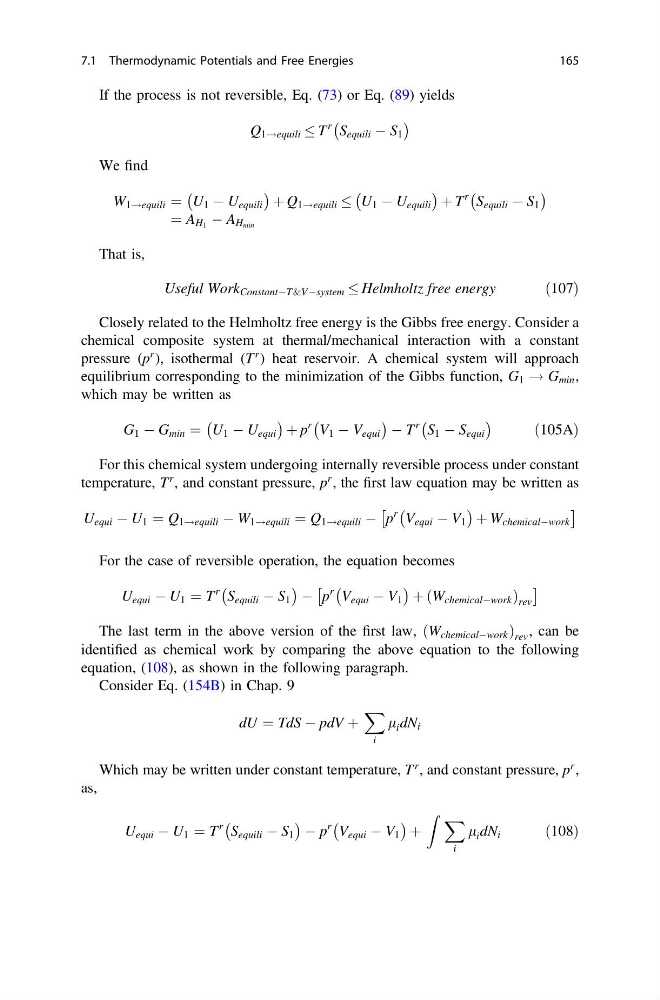
If the process is not reversible, Eq. (73) or Eq. (89) yields
Q 1!equili T
r S equili À S 1
À
Á
We find
W 1!equili ¼ U 1 À U equili
À
Á þ Q 1!equili
U 1 À U equili
À
Á þ T
r S equili À S 1
À
Á
¼ A H 1 À A H min
That is,
Useful Work ConstantÀT&VÀsystem Helmholtz free energy
ð107Þ
Closely related to the Helmholtz free energy is the Gibbs free energy. Consider a
chemical composite system at thermal/mechanical interaction with a constant
pressure (p
r ), isothermal (T
r ) heat reservoir. A chemical system will approach
equilibrium corresponding to the minimization of the Gibbs function, G 1 ! G min ,
which may be written as
G 1 À G min ¼ U 1 À U equi
À
Á þ p
r V 1 À V equi
À
Á À T
r S 1 À S equi
À
Á
ð105AÞ
For this chemical system undergoing internally reversible process under constant
temperature, T
r , and constant pressure, p
r , the first law equation may be written as
U equi À U 1 ¼ Q 1!equili À W 1!equili ¼ Q 1!equili À p
r V equi À V 1
À
Á þ W chemicalÀwork
Â
Ã
For the case of reversible operation, the equation becomes
U equi À U 1 ¼ T
r S equili À S 1
À
Á À p
r V equi À V 1
À
Á þ W chemicalÀwork
ð
Þ rev
Â
Ã
The last term in the above version of the first law, W chemicalÀwork
ð
Þ rev , can be
identified as chemical work by comparing the above equation to the following
equation, (108), as shown in the following paragraph.
Consider Eq. (154B) in Chap. 9
dU ¼ TdS À pdV þ
X
i
l i dN i
Which may be written under constant temperature, T
r , and constant pressure, p
r ,
as,
U equi À U 1 ¼ T
r S equili À S 1
À
Á À p
r V equi À V 1
À
Á þ
Z X
i
l i dN i
ð108Þ
7.1 Thermodynamic Potentials and Free Energies
165
Q 1!equili T
r S equili À S 1
À
Á
We find
W 1!equili ¼ U 1 À U equili
À
Á þ Q 1!equili
U 1 À U equili
À
Á þ T
r S equili À S 1
À
Á
¼ A H 1 À A H min
That is,
Useful Work ConstantÀT&VÀsystem Helmholtz free energy
ð107Þ
Closely related to the Helmholtz free energy is the Gibbs free energy. Consider a
chemical composite system at thermal/mechanical interaction with a constant
pressure (p
r ), isothermal (T
r ) heat reservoir. A chemical system will approach
equilibrium corresponding to the minimization of the Gibbs function, G 1 ! G min ,
which may be written as
G 1 À G min ¼ U 1 À U equi
À
Á þ p
r V 1 À V equi
À
Á À T
r S 1 À S equi
À
Á
ð105AÞ
For this chemical system undergoing internally reversible process under constant
temperature, T
r , and constant pressure, p
r , the first law equation may be written as
U equi À U 1 ¼ Q 1!equili À W 1!equili ¼ Q 1!equili À p
r V equi À V 1
À
Á þ W chemicalÀwork
Â
Ã
For the case of reversible operation, the equation becomes
U equi À U 1 ¼ T
r S equili À S 1
À
Á À p
r V equi À V 1
À
Á þ W chemicalÀwork
ð
Þ rev
Â
Ã
The last term in the above version of the first law, W chemicalÀwork
ð
Þ rev , can be
identified as chemical work by comparing the above equation to the following
equation, (108), as shown in the following paragraph.
Consider Eq. (154B) in Chap. 9
dU ¼ TdS À pdV þ
X
i
l i dN i
Which may be written under constant temperature, T
r , and constant pressure, p
r ,
as,
U equi À U 1 ¼ T
r S equili À S 1
À
Á À p
r V equi À V 1
À
Á þ
Z X
i
l i dN i
ð108Þ
7.1 Thermodynamic Potentials and Free Energies
165