

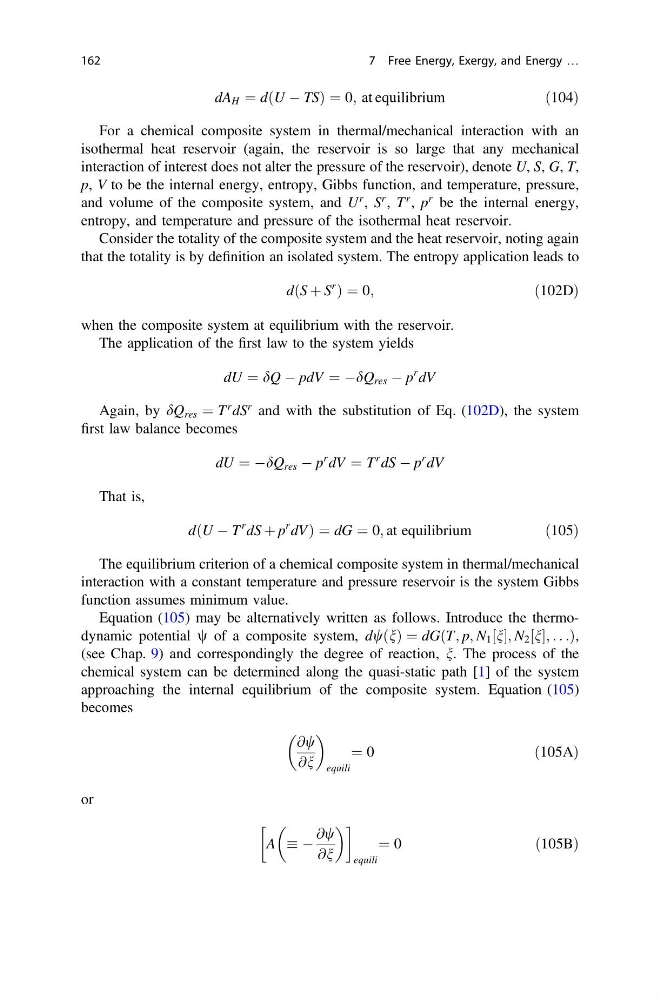
dA H ¼ d U À TS
ð
Þ¼0; at equilibrium
ð104Þ
For a chemical composite system in thermal/mechanical interaction with an
isothermal heat reservoir (again, the reservoir is so large that any mechanical
interaction of interest does not alter the pressure of the reservoir), denote U, S, G, T,
p, V to be the internal energy, entropy, Gibbs function, and temperature, pressure,
and volume of the composite system, and U
r , S
r , T
r , p
r be the internal energy,
entropy, and temperature and pressure of the isothermal heat reservoir.
Consider the totality of the composite system and the heat reservoir, noting again
that the totality is by definition an isolated system. The entropy application leads to
d S þ S
r
ð
Þ¼0;
ð102DÞ
when the composite system at equilibrium with the reservoir.
The application of the first law to the system yields
dU ¼ dQ À pdV ¼ ÀdQ res À p
r dV
Again, by dQ res ¼ T
r dS
r and with the substitution of Eq. (102D), the system
first law balance becomes
dU ¼ ÀdQ res À p
r dV ¼ T
r dS À p
r dV
That is,
d U À T
r dS þ p
r dV
ð
Þ ¼ dG ¼ 0; at equilibrium
ð105Þ
The equilibrium criterion of a chemical composite system in thermal/mechanical
interaction with a constant temperature and pressure reservoir is the system Gibbs
function assumes minimum value.
Equation (105) may be alternatively written as follows. Introduce the thermodynamic potential w of a composite system, dw n
ð Þ ¼ dG T; p; N 1 n
½ ; N 2 n
½ ; . . .
ð
Þ ,
(see Chap. 9) and correspondingly the degree of reaction, n. The process of the
chemical system can be determined along the quasi-static path [1] of the system
approaching the internal equilibrium of the composite system. Equation (105)
becomes
@w
@n
equili
¼ 0
ð105AÞ
or
A À
@w
@n
!
equili
¼ 0
ð105BÞ
162
7 Free Energy, Exergy, and Energy …
ð
Þ¼0; at equilibrium
ð104Þ
For a chemical composite system in thermal/mechanical interaction with an
isothermal heat reservoir (again, the reservoir is so large that any mechanical
interaction of interest does not alter the pressure of the reservoir), denote U, S, G, T,
p, V to be the internal energy, entropy, Gibbs function, and temperature, pressure,
and volume of the composite system, and U
r , S
r , T
r , p
r be the internal energy,
entropy, and temperature and pressure of the isothermal heat reservoir.
Consider the totality of the composite system and the heat reservoir, noting again
that the totality is by definition an isolated system. The entropy application leads to
d S þ S
r
ð
Þ¼0;
ð102DÞ
when the composite system at equilibrium with the reservoir.
The application of the first law to the system yields
dU ¼ dQ À pdV ¼ ÀdQ res À p
r dV
Again, by dQ res ¼ T
r dS
r and with the substitution of Eq. (102D), the system
first law balance becomes
dU ¼ ÀdQ res À p
r dV ¼ T
r dS À p
r dV
That is,
d U À T
r dS þ p
r dV
ð
Þ ¼ dG ¼ 0; at equilibrium
ð105Þ
The equilibrium criterion of a chemical composite system in thermal/mechanical
interaction with a constant temperature and pressure reservoir is the system Gibbs
function assumes minimum value.
Equation (105) may be alternatively written as follows. Introduce the thermodynamic potential w of a composite system, dw n
ð Þ ¼ dG T; p; N 1 n
½ ; N 2 n
½ ; . . .
ð
Þ ,
(see Chap. 9) and correspondingly the degree of reaction, n. The process of the
chemical system can be determined along the quasi-static path [1] of the system
approaching the internal equilibrium of the composite system. Equation (105)
becomes
@w
@n
equili
¼ 0
ð105AÞ
or
A À
@w
@n
!
equili
¼ 0
ð105BÞ
162
7 Free Energy, Exergy, and Energy …