

where A is affinity, which, in the case of chemical examples, is related to chemical
potential [2: Chap. 4].
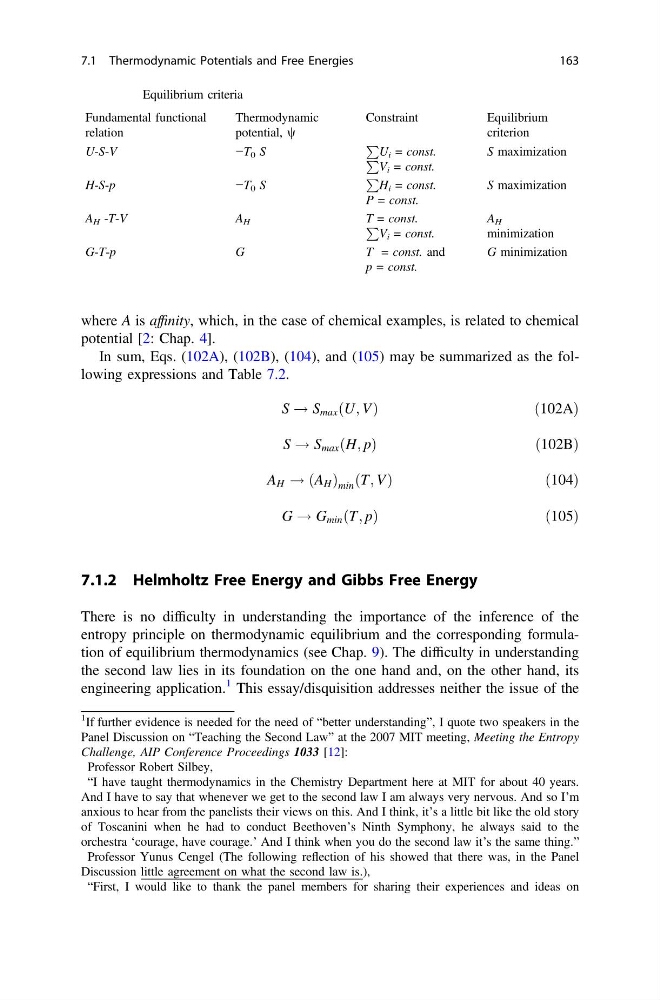
In sum, Eqs. (102A), (102B), (104), and (105) may be summarized as the following expressions and Table 7.2.
S ! S max U; V
ð
Þ
ð102AÞ
S ! S max H; p
ð
Þ
ð102BÞ
A H ! A H
ð Þ min T; V
ð
Þ
ð104Þ
G ! G min T; p
ð
Þ
ð105Þ
7.1.2 Helmholtz Free Energy and Gibbs Free Energy
There is no difficulty in understanding the importance of the inference of the
entropy principle on thermodynamic equilibrium and the corresponding formulation of equilibrium thermodynamics (see Chap. 9). The difficulty in understanding
the second law lies in its foundation on the one hand and, on the other hand, its
engineering application.
1 This essay/disquisition addresses neither the issue of the
Table 7.2 Equilibrium criteria
Fundamental functional
relation
Thermodynamic
potential, w
Constraint
Equilibrium
criterion
U-S-V
−T 0 S
P
U i = const.
P
V i = const.
S maximization
H-S-p
−T 0 S
P
H i = const.
P = const.
S maximization
A H -T-V
A H
T = const.
P
V i = const.
A H
minimization
G-T-p
G
T = const. and
p = const.
G minimization
1
If further evidence is needed for the need of “better understanding”, I quote two speakers in the
Panel Discussion on “Teaching the Second Law” at the 2007 MIT meeting, Meeting the Entropy
Challenge, AIP Conference Proceedings 1033 [12]:
Professor Robert Silbey,
“I have taught thermodynamics in the Chemistry Department here at MIT for about 40 years.
And I have to say that whenever we get to the second law I am always very nervous. And so I’m
anxious to hear from the panelists their views on this. And I think, it’s a little bit like the old story
of Toscanini when he had to conduct Beethoven’s Ninth Symphony, he always said to the
orchestra ‘courage, have courage.’ And I think when you do the second law it’s the same thing.”
Professor Yunus Cengel (The following reflection of his showed that there was, in the Panel
Discussion little agreement on what the second law is.),
“First, I would like to thank the panel members for sharing their experiences and ideas on
7.1 Thermodynamic Potentials and Free Energies
163
potential [2: Chap. 4].
In sum, Eqs. (102A), (102B), (104), and (105) may be summarized as the following expressions and Table 7.2.
S ! S max U; V
ð
Þ
ð102AÞ
S ! S max H; p
ð
Þ
ð102BÞ
A H ! A H
ð Þ min T; V
ð
Þ
ð104Þ
G ! G min T; p
ð
Þ
ð105Þ
7.1.2 Helmholtz Free Energy and Gibbs Free Energy
There is no difficulty in understanding the importance of the inference of the
entropy principle on thermodynamic equilibrium and the corresponding formulation of equilibrium thermodynamics (see Chap. 9). The difficulty in understanding
the second law lies in its foundation on the one hand and, on the other hand, its
engineering application.
1 This essay/disquisition addresses neither the issue of the
Table 7.2 Equilibrium criteria
Fundamental functional
relation
Thermodynamic
potential, w
Constraint
Equilibrium
criterion
U-S-V
−T 0 S
P
U i = const.
P
V i = const.
S maximization
H-S-p
−T 0 S
P
H i = const.
P = const.
S maximization
A H -T-V
A H
T = const.
P
V i = const.
A H
minimization
G-T-p
G
T = const. and
p = const.
G minimization
1
If further evidence is needed for the need of “better understanding”, I quote two speakers in the
Panel Discussion on “Teaching the Second Law” at the 2007 MIT meeting, Meeting the Entropy
Challenge, AIP Conference Proceedings 1033 [12]:
Professor Robert Silbey,
“I have taught thermodynamics in the Chemistry Department here at MIT for about 40 years.
And I have to say that whenever we get to the second law I am always very nervous. And so I’m
anxious to hear from the panelists their views on this. And I think, it’s a little bit like the old story
of Toscanini when he had to conduct Beethoven’s Ninth Symphony, he always said to the
orchestra ‘courage, have courage.’ And I think when you do the second law it’s the same thing.”
Professor Yunus Cengel (The following reflection of his showed that there was, in the Panel
Discussion little agreement on what the second law is.),
“First, I would like to thank the panel members for sharing their experiences and ideas on
7.1 Thermodynamic Potentials and Free Energies
163