

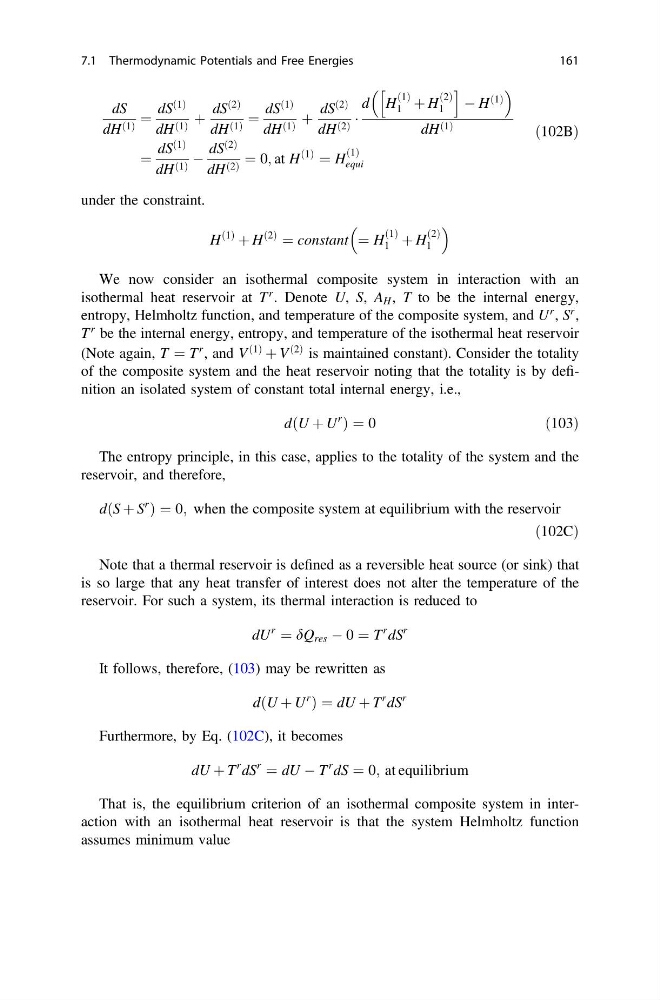
dS
dH 1
ð Þ
¼
dS
1
ð Þ
dH 1
ð Þ
þ
dS
2
ð Þ
dH 1
ð Þ
¼
dS
1
ð Þ
dH 1
ð Þ
þ
dS
2
ð Þ
dH 2
ð Þ
Á
d H
1
ð Þ
1 þ H
2
ð Þ
1
h
i
À H
1
ð Þ
dH 1
ð Þ
¼
dS
1
ð Þ
dH 1
ð Þ
À
dS
2
ð Þ
dH 2
ð Þ
¼ 0; at H
1
ð Þ
¼ H
1
ð Þ
equi
ð102BÞ
under the constraint.
H
1
ð Þ
þ H
2
ð Þ
¼ constant ¼ H
1
ð Þ
1 þ H
2
ð Þ
1
We now consider an isothermal composite system in interaction with an
isothermal heat reservoir at T
r . Denote U, S, A H , T to be the internal energy,
entropy, Helmholtz function, and temperature of the composite system, and U
r , S
r ,
T
r be the internal energy, entropy, and temperature of the isothermal heat reservoir
(Note again, T ¼ T
r , and V
1
ð Þ
þ V
2
ð Þ is maintained constant). Consider the totality
of the composite system and the heat reservoir noting that the totality is by definition an isolated system of constant total internal energy, i.e.,
d U þ U
r
ð
Þ¼0
ð103Þ
The entropy principle, in this case, applies to the totality of the system and the
reservoir, and therefore,
d S þ S
r
ð
Þ¼0; when the composite system at equilibrium with the reservoir
ð102CÞ
Note that a thermal reservoir is defined as a reversible heat source (or sink) that
is so large that any heat transfer of interest does not alter the temperature of the
reservoir. For such a system, its thermal interaction is reduced to
dU
r
¼ dQ res À 0 ¼ T
r dS
r
It follows, therefore, (103) may be rewritten as
d U þ U
r
ð
Þ¼dU þ T
r dS
r
Furthermore, by Eq. (102C), it becomes
dU þ T
r dS
r
¼ dU À T
r dS ¼ 0; at equilibrium
That is, the equilibrium criterion of an isothermal composite system in interaction with an isothermal heat reservoir is that the system Helmholtz function
assumes minimum value
7.1 Thermodynamic Potentials and Free Energies
161
dH 1
ð Þ
¼
dS
1
ð Þ
dH 1
ð Þ
þ
dS
2
ð Þ
dH 1
ð Þ
¼
dS
1
ð Þ
dH 1
ð Þ
þ
dS
2
ð Þ
dH 2
ð Þ
Á
d H
1
ð Þ
1 þ H
2
ð Þ
1
h
i
À H
1
ð Þ
dH 1
ð Þ
¼
dS
1
ð Þ
dH 1
ð Þ
À
dS
2
ð Þ
dH 2
ð Þ
¼ 0; at H
1
ð Þ
¼ H
1
ð Þ
equi
ð102BÞ
under the constraint.
H
1
ð Þ
þ H
2
ð Þ
¼ constant ¼ H
1
ð Þ
1 þ H
2
ð Þ
1
We now consider an isothermal composite system in interaction with an
isothermal heat reservoir at T
r . Denote U, S, A H , T to be the internal energy,
entropy, Helmholtz function, and temperature of the composite system, and U
r , S
r ,
T
r be the internal energy, entropy, and temperature of the isothermal heat reservoir
(Note again, T ¼ T
r , and V
1
ð Þ
þ V
2
ð Þ is maintained constant). Consider the totality
of the composite system and the heat reservoir noting that the totality is by definition an isolated system of constant total internal energy, i.e.,
d U þ U
r
ð
Þ¼0
ð103Þ
The entropy principle, in this case, applies to the totality of the system and the
reservoir, and therefore,
d S þ S
r
ð
Þ¼0; when the composite system at equilibrium with the reservoir
ð102CÞ
Note that a thermal reservoir is defined as a reversible heat source (or sink) that
is so large that any heat transfer of interest does not alter the temperature of the
reservoir. For such a system, its thermal interaction is reduced to
dU
r
¼ dQ res À 0 ¼ T
r dS
r
It follows, therefore, (103) may be rewritten as
d U þ U
r
ð
Þ¼dU þ T
r dS
r
Furthermore, by Eq. (102C), it becomes
dU þ T
r dS
r
¼ dU À T
r dS ¼ 0; at equilibrium
That is, the equilibrium criterion of an isothermal composite system in interaction with an isothermal heat reservoir is that the system Helmholtz function
assumes minimum value
7.1 Thermodynamic Potentials and Free Energies
161