

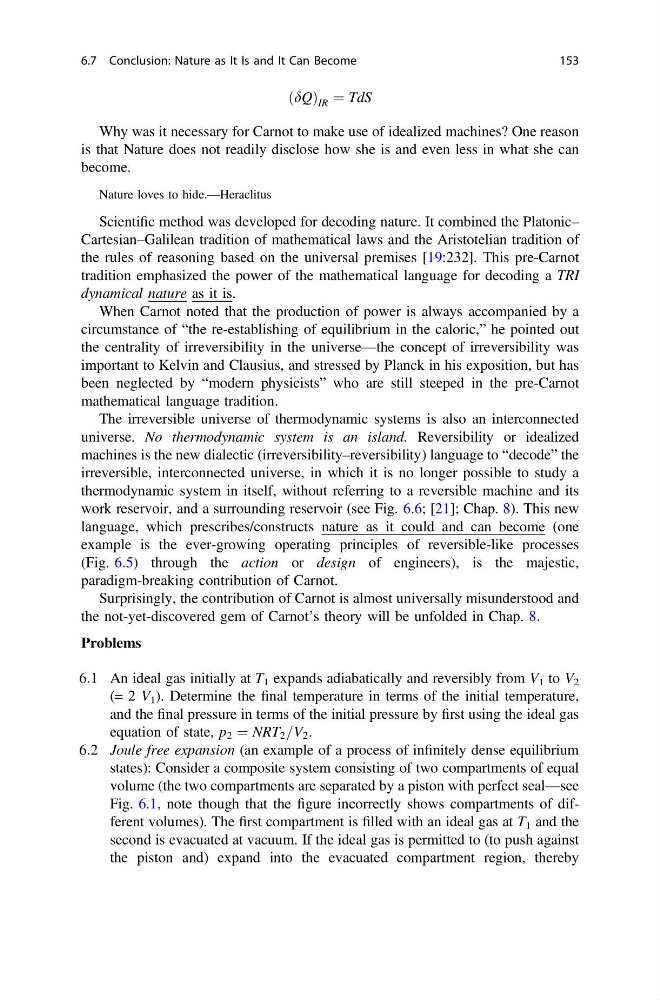
ðdQÞ IR ¼ TdS
Why was it necessary for Carnot to make use of idealized machines? One reason
is that Nature does not readily disclose how she is and even less in what she can
become.
Nature loves to hide.—Heraclitus
Scientific method was developed for decoding nature. It combined the Platonic–
Cartesian–Galilean tradition of mathematical laws and the Aristotelian tradition of
the rules of reasoning based on the universal premises [19:232]. This pre-Carnot
tradition emphasized the power of the mathematical language for decoding a TRI
dynamical nature as it is.
When Carnot noted that the production of power is always accompanied by a
circumstance of “the re-establishing of equilibrium in the caloric,” he pointed out
the centrality of irreversibility in the universe—the concept of irreversibility was
important to Kelvin and Clausius, and stressed by Planck in his exposition, but has
been neglected by “modern physicists” who are still steeped in the pre-Carnot
mathematical language tradition.
The irreversible universe of thermodynamic systems is also an interconnected
universe. No thermodynamic system is an island. Reversibility or idealized
machines is the new dialectic (irreversibility–reversibility) language to “decode” the
irreversible, interconnected universe, in which it is no longer possible to study a
thermodynamic system in itself, without referring to a reversible machine and its
work reservoir, and a surrounding reservoir (see Fig. 6.6; [21]; Chap. 8). This new
language, which prescribes/constructs nature as it could and can become (one
example is the ever-growing operating principles of reversible-like processes
(Fig. 6.5) through the action or design of engineers), is the majestic,
paradigm-breaking contribution of Carnot.
Surprisingly, the contribution of Carnot is almost universally misunderstood and
the not-yet-discovered gem of Carnot’s theory will be unfolded in Chap. 8.
Problems
6:1 An ideal gas initially at T 1 expands adiabatically and reversibly from V 1 to V 2
(= 2 V 1 ). Determine the final temperature in terms of the initial temperature,
and the final pressure in terms of the initial pressure by first using the ideal gas
equation of state, p 2 ¼ NRT 2 =V 2 .
6:2 Joule free expansion (an example of a process of infinitely dense equilibrium
states): Consider a composite system consisting of two compartments of equal
volume (the two compartments are separated by a piston with perfect seal—see
Fig. 6.1, note though that the figure incorrectly shows compartments of different volumes). The first compartment is filled with an ideal gas at T 1 and the
second is evacuated at vacuum. If the ideal gas is permitted to (to push against
the piston and) expand into the evacuated compartment region, thereby
6.7 Conclusion: Nature as It Is and It Can Become
153
Why was it necessary for Carnot to make use of idealized machines? One reason
is that Nature does not readily disclose how she is and even less in what she can
become.
Nature loves to hide.—Heraclitus
Scientific method was developed for decoding nature. It combined the Platonic–
Cartesian–Galilean tradition of mathematical laws and the Aristotelian tradition of
the rules of reasoning based on the universal premises [19:232]. This pre-Carnot
tradition emphasized the power of the mathematical language for decoding a TRI
dynamical nature as it is.
When Carnot noted that the production of power is always accompanied by a
circumstance of “the re-establishing of equilibrium in the caloric,” he pointed out
the centrality of irreversibility in the universe—the concept of irreversibility was
important to Kelvin and Clausius, and stressed by Planck in his exposition, but has
been neglected by “modern physicists” who are still steeped in the pre-Carnot
mathematical language tradition.
The irreversible universe of thermodynamic systems is also an interconnected
universe. No thermodynamic system is an island. Reversibility or idealized
machines is the new dialectic (irreversibility–reversibility) language to “decode” the
irreversible, interconnected universe, in which it is no longer possible to study a
thermodynamic system in itself, without referring to a reversible machine and its
work reservoir, and a surrounding reservoir (see Fig. 6.6; [21]; Chap. 8). This new
language, which prescribes/constructs nature as it could and can become (one
example is the ever-growing operating principles of reversible-like processes
(Fig. 6.5) through the action or design of engineers), is the majestic,
paradigm-breaking contribution of Carnot.
Surprisingly, the contribution of Carnot is almost universally misunderstood and
the not-yet-discovered gem of Carnot’s theory will be unfolded in Chap. 8.
Problems
6:1 An ideal gas initially at T 1 expands adiabatically and reversibly from V 1 to V 2
(= 2 V 1 ). Determine the final temperature in terms of the initial temperature,
and the final pressure in terms of the initial pressure by first using the ideal gas
equation of state, p 2 ¼ NRT 2 =V 2 .
6:2 Joule free expansion (an example of a process of infinitely dense equilibrium
states): Consider a composite system consisting of two compartments of equal
volume (the two compartments are separated by a piston with perfect seal—see
Fig. 6.1, note though that the figure incorrectly shows compartments of different volumes). The first compartment is filled with an ideal gas at T 1 and the
second is evacuated at vacuum. If the ideal gas is permitted to (to push against
the piston and) expand into the evacuated compartment region, thereby
6.7 Conclusion: Nature as It Is and It Can Become
153