

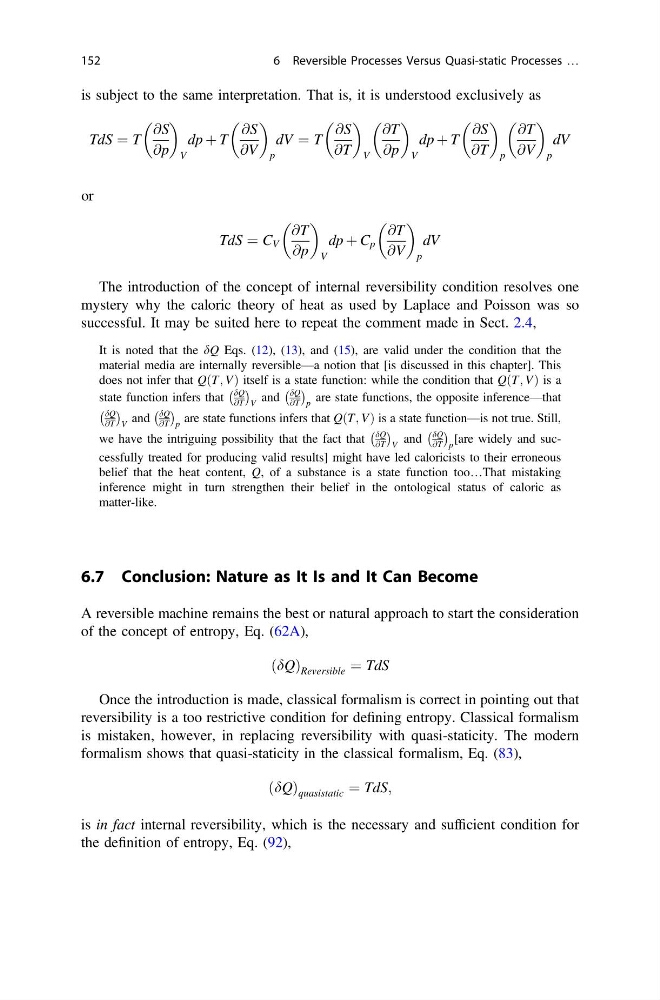
is subject to the same interpretation. That is, it is understood exclusively as
TdS ¼ T
@S
@p
V
dp þ T
@S
@V
p
dV ¼ T
@S
@T
V
@T
@p
V
dp þ T
@S
@T
p
@T
@V
p
dV
or
TdS ¼ C V
@T
@p
V
dp þ C p
@T
@V
p
dV
The introduction of the concept of internal reversibility condition resolves one
mystery why the caloric theory of heat as used by Laplace and Poisson was so
successful. It may be suited here to repeat the comment made in Sect. 2.4,
It is noted that the dQ Eqs. (12), (13), and (15), are valid under the condition that the
material media are internally reversible—a notion that [is discussed in this chapter]. This
does not infer that QðT; VÞ itself is a state function: while the condition that QðT; VÞ is a
state function infers that
dQ
@T
À Á
V
and
dQ
@T
À Á
p
are state functions, the opposite inference—that
dQ
@T
À Á
V
and
dQ
@T
À Á
p
are state functions infers that QðT; VÞ is a state function—is not true. Still,
we have the intriguing possibility that the fact that
dQ
@T
À Á
V
and
dQ
@T
À Á
p
[are widely and successfully treated for producing valid results] might have led caloricists to their erroneous
belief that the heat content, Q, of a substance is a state function too…That mistaking
inference might in turn strengthen their belief in the ontological status of caloric as
matter-like.
6.7 Conclusion: Nature as It Is and It Can Become
A reversible machine remains the best or natural approach to start the consideration
of the concept of entropy, Eq. (62A),
ðdQÞ Reversible ¼ TdS
Once the introduction is made, classical formalism is correct in pointing out that
reversibility is a too restrictive condition for defining entropy. Classical formalism
is mistaken, however, in replacing reversibility with quasi-staticity. The modern
formalism shows that quasi-staticity in the classical formalism, Eq. (83),
ðdQÞ quasistatic ¼ TdS;
is in fact internal reversibility, which is the necessary and sufficient condition for
the definition of entropy, Eq. (92),
152
6 Reversible Processes Versus Quasi-static Processes …
TdS ¼ T
@S
@p
V
dp þ T
@S
@V
p
dV ¼ T
@S
@T
V
@T
@p
V
dp þ T
@S
@T
p
@T
@V
p
dV
or
TdS ¼ C V
@T
@p
V
dp þ C p
@T
@V
p
dV
The introduction of the concept of internal reversibility condition resolves one
mystery why the caloric theory of heat as used by Laplace and Poisson was so
successful. It may be suited here to repeat the comment made in Sect. 2.4,
It is noted that the dQ Eqs. (12), (13), and (15), are valid under the condition that the
material media are internally reversible—a notion that [is discussed in this chapter]. This
does not infer that QðT; VÞ itself is a state function: while the condition that QðT; VÞ is a
state function infers that
dQ
@T
À Á
V
and
dQ
@T
À Á
p
are state functions, the opposite inference—that
dQ
@T
À Á
V
and
dQ
@T
À Á
p
are state functions infers that QðT; VÞ is a state function—is not true. Still,
we have the intriguing possibility that the fact that
dQ
@T
À Á
V
and
dQ
@T
À Á
p
[are widely and successfully treated for producing valid results] might have led caloricists to their erroneous
belief that the heat content, Q, of a substance is a state function too…That mistaking
inference might in turn strengthen their belief in the ontological status of caloric as
matter-like.
6.7 Conclusion: Nature as It Is and It Can Become
A reversible machine remains the best or natural approach to start the consideration
of the concept of entropy, Eq. (62A),
ðdQÞ Reversible ¼ TdS
Once the introduction is made, classical formalism is correct in pointing out that
reversibility is a too restrictive condition for defining entropy. Classical formalism
is mistaken, however, in replacing reversibility with quasi-staticity. The modern
formalism shows that quasi-staticity in the classical formalism, Eq. (83),
ðdQÞ quasistatic ¼ TdS;
is in fact internal reversibility, which is the necessary and sufficient condition for
the definition of entropy, Eq. (92),
152
6 Reversible Processes Versus Quasi-static Processes …