

5.10.3 Reversible Mixing of the 1:5 m
3 Oxygen and the 1:5 m
3
Nitrogen Systems
Reversible mixing of the 1:5 m
3 oxygen and the 1:5 m
3 nitrogen systems results in
the creation of a vacuum system of 1:5 m
3 as shown in Fig. 5.10. This is exactly the
same process shown in Fig. 5.6, where the created vacuum space is the final
d-space.
5.10.4 In Sum
The change of the above processes associated with Figs. 5.8, 5.9, and 5.10 collectively corresponds to change from the initial oxygen and the initial nitrogen
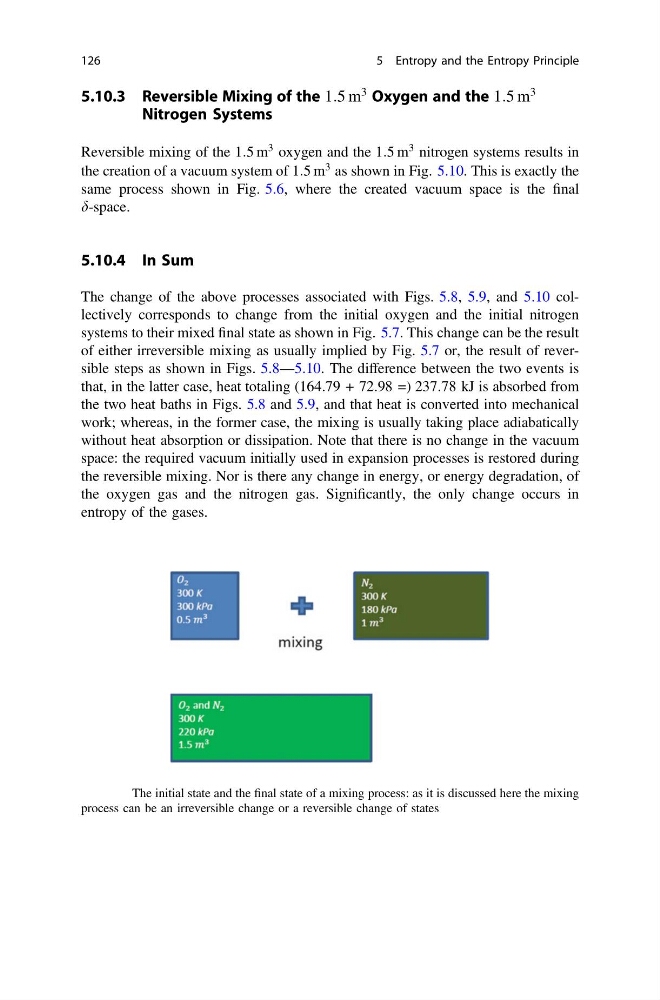
systems to their mixed final state as shown in Fig. 5.7. This change can be the result
of either irreversible mixing as usually implied by Fig. 5.7 or, the result of reversible steps as shown in Figs. 5.8––5.10. The difference between the two events is
that, in the latter case, heat totaling (164.79 + 72.98 =) 237.78 kJ is absorbed from
the two heat baths in Figs. 5.8 and 5.9, and that heat is converted into mechanical
work; whereas, in the former case, the mixing is usually taking place adiabatically
without heat absorption or dissipation. Note that there is no change in the vacuum
space: the required vacuum initially used in expansion processes is restored during
the reversible mixing. Nor is there any change in energy, or energy degradation, of
the oxygen gas and the nitrogen gas. Significantly, the only change occurs in
entropy of the gases.
Fig. 5.7 The initial state and the final state of a mixing process: as it is discussed here the mixing
process can be an irreversible change or a reversible change of states
126
5 Entropy and the Entropy Principle
3 Oxygen and the 1:5 m
3
Nitrogen Systems
Reversible mixing of the 1:5 m
3 oxygen and the 1:5 m
3 nitrogen systems results in
the creation of a vacuum system of 1:5 m
3 as shown in Fig. 5.10. This is exactly the
same process shown in Fig. 5.6, where the created vacuum space is the final
d-space.
5.10.4 In Sum
The change of the above processes associated with Figs. 5.8, 5.9, and 5.10 collectively corresponds to change from the initial oxygen and the initial nitrogen
systems to their mixed final state as shown in Fig. 5.7. This change can be the result
of either irreversible mixing as usually implied by Fig. 5.7 or, the result of reversible steps as shown in Figs. 5.8––5.10. The difference between the two events is
that, in the latter case, heat totaling (164.79 + 72.98 =) 237.78 kJ is absorbed from
the two heat baths in Figs. 5.8 and 5.9, and that heat is converted into mechanical
work; whereas, in the former case, the mixing is usually taking place adiabatically
without heat absorption or dissipation. Note that there is no change in the vacuum
space: the required vacuum initially used in expansion processes is restored during
the reversible mixing. Nor is there any change in energy, or energy degradation, of
the oxygen gas and the nitrogen gas. Significantly, the only change occurs in
entropy of the gases.
Fig. 5.7 The initial state and the final state of a mixing process: as it is discussed here the mixing
process can be an irreversible change or a reversible change of states
126
5 Entropy and the Entropy Principle