

106
7 Virtual testing approach for sandwich panel joints
The four phases relate to the nine steps of Ashby’s flowchart [Ash92], while each phase
integrates multiple steps of Ashby. In Phase 1, the field of application for the virtual test
is defined. Based on this, the requirements are derived before the relevant mechanical
effects of the reference physical test are identified. In Phase 2, the model framework is
defined. This includes the definition of the level of detail which enables to capture the
relevant mechanical effects. In conjunction, the time integration method and hence the
solver is selected. The most extensive part of the virtual testing approach is the following
hierarchical model development in Phase 3, which generally follows the Building Block
Approach. In the final Phase 4 the developed models are applied for design studies, according to the initially defined field of application. Depending on the performance of the
virtual test method additional iteration loops are required, which lead back to Phase 2.
In the following sections, the four phases are described in detail based on an integrated
example, which is subsequently introduced.
Demonstration example
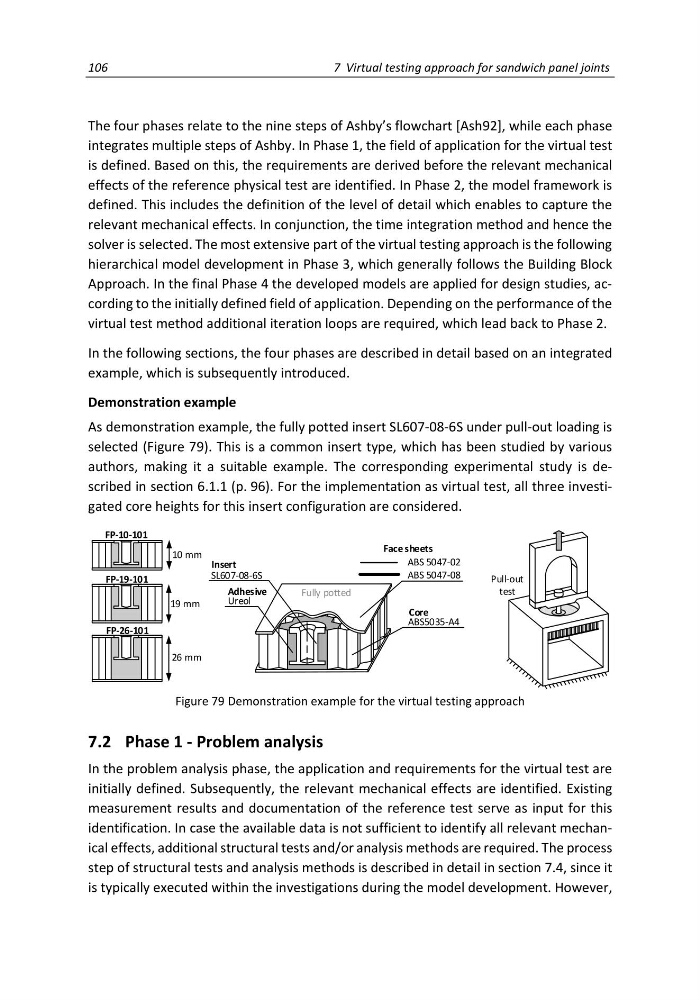
As demonstration example, the fully potted insert SL607-08-6S under pull-out loading is
selected (Figure 79). This is a common insert type, which has been studied by various
authors, making it a suitable example. The corresponding experimental study is described in section 6.1.1 (p. 96). For the implementation as virtual test, all three investigated core heights for this insert configuration are considered.
7.2 Phase 1 - Problem analysis
In the problem analysis phase, the application and requirements for the virtual test are
initially defined. Subsequently, the relevant mechanical effects are identified. Existing
measurement results and documentation of the reference test serve as input for this
identification. In case the available data is not sufficient to identify all relevant mechanical effects, additional structural tests and/or analysis methods are required. The process
step of structural tests and analysis methods is described in detail in section 7.4, since it
is typically executed within the investigations during the model development. However,
SL607-08-6S
Ureol
ABS 5047-02
Fully potted
ABS5035-A4
ABS 5047-08
Insert
Adhesive
Face sheets
Core
10 mm
19 mm
26 mm
FP-10-101
FP-19-101
FP-26-101
Pull-out
test
Figure 79 Demonstration example for the virtual testing approach
7 Virtual testing approach for sandwich panel joints
The four phases relate to the nine steps of Ashby’s flowchart [Ash92], while each phase
integrates multiple steps of Ashby. In Phase 1, the field of application for the virtual test
is defined. Based on this, the requirements are derived before the relevant mechanical
effects of the reference physical test are identified. In Phase 2, the model framework is
defined. This includes the definition of the level of detail which enables to capture the
relevant mechanical effects. In conjunction, the time integration method and hence the
solver is selected. The most extensive part of the virtual testing approach is the following
hierarchical model development in Phase 3, which generally follows the Building Block
Approach. In the final Phase 4 the developed models are applied for design studies, according to the initially defined field of application. Depending on the performance of the
virtual test method additional iteration loops are required, which lead back to Phase 2.
In the following sections, the four phases are described in detail based on an integrated
example, which is subsequently introduced.
Demonstration example
As demonstration example, the fully potted insert SL607-08-6S under pull-out loading is
selected (Figure 79). This is a common insert type, which has been studied by various
authors, making it a suitable example. The corresponding experimental study is described in section 6.1.1 (p. 96). For the implementation as virtual test, all three investigated core heights for this insert configuration are considered.
7.2 Phase 1 - Problem analysis
In the problem analysis phase, the application and requirements for the virtual test are
initially defined. Subsequently, the relevant mechanical effects are identified. Existing
measurement results and documentation of the reference test serve as input for this
identification. In case the available data is not sufficient to identify all relevant mechanical effects, additional structural tests and/or analysis methods are required. The process
step of structural tests and analysis methods is described in detail in section 7.4, since it
is typically executed within the investigations during the model development. However,
SL607-08-6S
Ureol
ABS 5047-02
Fully potted
ABS5035-A4
ABS 5047-08
Insert
Adhesive
Face sheets
Core
10 mm
19 mm
26 mm
FP-10-101
FP-19-101
FP-26-101
Pull-out
test
Figure 79 Demonstration example for the virtual testing approach