

7 Virtual testing approach for sandwich panel joints
This chapter describes the developed approach for virtual testing of sandwich panel
joints using the sub-component tests of chapter 6 as example and for validation. The
investigations in chapter 4 and 5 are integral parts of this approach. Therefore, aspects
of these chapters are revisited and put into perspective of the approach. In the following,
an overview over the approach and it’s four phases is given in section 7.1. Then each
phase is described in section 7.2, 7.3, 7.4 and 7.5 using a demonstration example. Sections 7.6 and 7.7 summarize and conclude with additional case studies as validation.
7.1 Overview
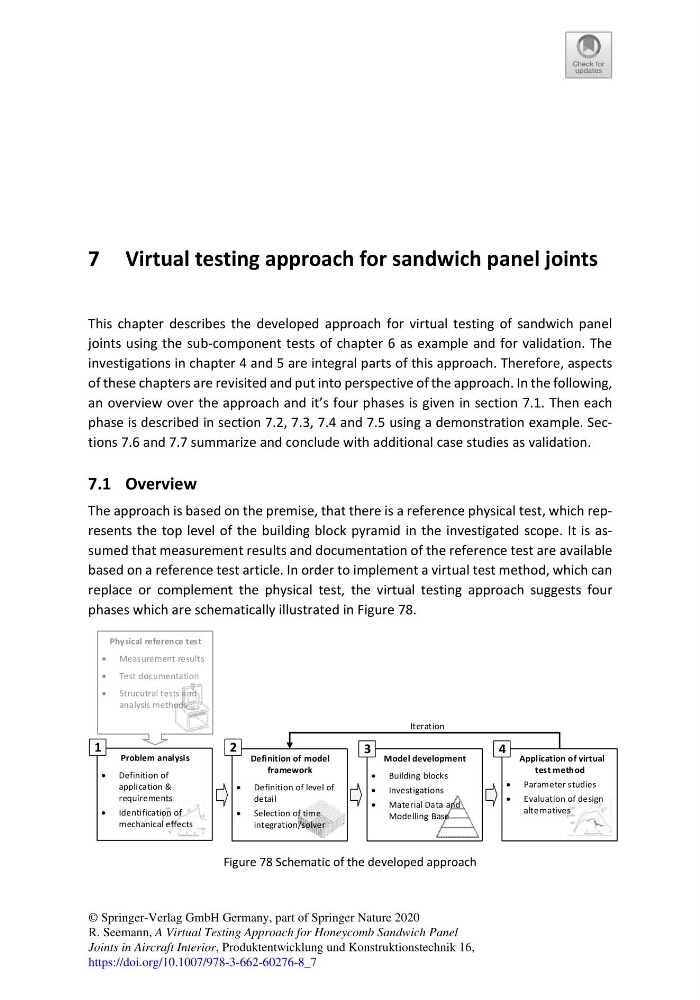
The approach is based on the premise, that there is a reference physical test, which represents the top level of the building block pyramid in the investigated scope. It is assumed that measurement results and documentation of the reference test are available
based on a reference test article. In order to implement a virtual test method, which can
replace or complement the physical test, the virtual testing approach suggests four
phases which are schematically illustrated in Figure 78.
© Springer-Verlag GmbH Germany, part of Springer Nature 2020
R. Seemann, A Virtual Testing Approach for Honeycomb Sandwich Panel
Joints in Aircraft Interior, Produktentwicklung und Konstruktionstechnik 16,
https://doi.org/10.1007/978-3-662-60276-8_7
Definition of model
framework
Definition of level of
detail
Selection of time
integration/solver
Problem analysis
Definition of
application &
requirements
Identification of
mechanical effects
Model development
Building blocks
Investigations
Material Data and
Modelling Base
Application of virtual
test method
Parameter studies
Evaluation of design
alternatives
Iteration
1
2
3
4
Physical reference test
Measurement results
Test documentation
Strucutral tests and
analysis methods
Figure 78 Schematic of the developed approach
This chapter describes the developed approach for virtual testing of sandwich panel
joints using the sub-component tests of chapter 6 as example and for validation. The
investigations in chapter 4 and 5 are integral parts of this approach. Therefore, aspects
of these chapters are revisited and put into perspective of the approach. In the following,
an overview over the approach and it’s four phases is given in section 7.1. Then each
phase is described in section 7.2, 7.3, 7.4 and 7.5 using a demonstration example. Sections 7.6 and 7.7 summarize and conclude with additional case studies as validation.
7.1 Overview
The approach is based on the premise, that there is a reference physical test, which represents the top level of the building block pyramid in the investigated scope. It is assumed that measurement results and documentation of the reference test are available
based on a reference test article. In order to implement a virtual test method, which can
replace or complement the physical test, the virtual testing approach suggests four
phases which are schematically illustrated in Figure 78.
© Springer-Verlag GmbH Germany, part of Springer Nature 2020
R. Seemann, A Virtual Testing Approach for Honeycomb Sandwich Panel
Joints in Aircraft Interior, Produktentwicklung und Konstruktionstechnik 16,
https://doi.org/10.1007/978-3-662-60276-8_7
Definition of model
framework
Definition of level of
detail
Selection of time
integration/solver
Problem analysis
Definition of
application &
requirements
Identification of
mechanical effects
Model development
Building blocks
Investigations
Material Data and
Modelling Base
Application of virtual
test method
Parameter studies
Evaluation of design
alternatives
Iteration
1
2
3
4
Physical reference test
Measurement results
Test documentation
Strucutral tests and
analysis methods
Figure 78 Schematic of the developed approach