

7.2 Phase 1 - Problem analysis
107
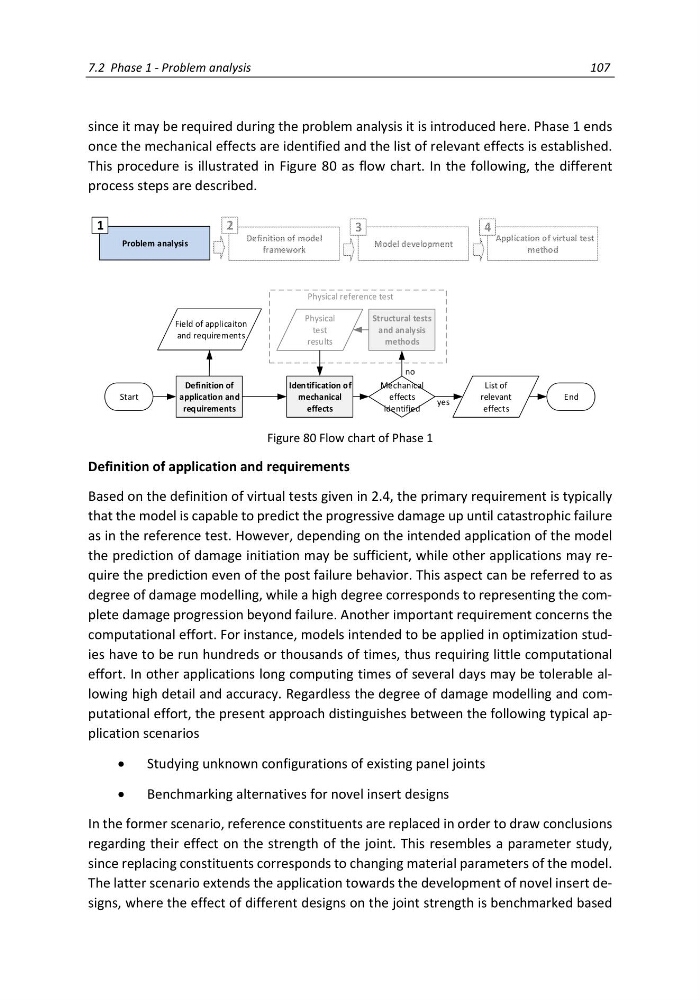
since it may be required during the problem analysis it is introduced here. Phase 1 ends
once the mechanical effects are identified and the list of relevant effects is established.
This procedure is illustrated in Figure 80 as flow chart. In the following, the different
process steps are described.
Mechanical
effects
identified
Physical
test
results
Definition of
application and
requirements
Identification of
mechanical
effects
Start
no
yes
Physical reference test
End
Structural tests
and analysis
methods
List of
relevant
effects
Problem analysis
Definition of model
framework
Model development
Application of virtual test
method
1
2
3
4
Field of applicaiton
and requirements
Figure 80 Flow chart of Phase 1
Definition of application and requirements
Based on the definition of virtual tests given in 2.4, the primary requirement is typically
that the model is capable to predict the progressive damage up until catastrophic failure
as in the reference test. However, depending on the intended application of the model
the prediction of damage initiation may be sufficient, while other applications may require the prediction even of the post failure behavior. This aspect can be referred to as
degree of damage modelling, while a high degree corresponds to representing the complete damage progression beyond failure. Another important requirement concerns the
computational effort. For instance, models intended to be applied in optimization studies have to be run hundreds or thousands of times, thus requiring little computational
effort. In other applications long computing times of several days may be tolerable allowing high detail and accuracy. Regardless the degree of damage modelling and computational effort, the present approach distinguishes between the following typical application scenarios
Studying unknown configurations of existing panel joints
Benchmarking alternatives for novel insert designs
In the former scenario, reference constituents are replaced in order to draw conclusions
regarding their effect on the strength of the joint. This resembles a parameter study,
since replacing constituents corresponds to changing material parameters of the model.
The latter scenario extends the application towards the development of novel insert designs, where the effect of different designs on the joint strength is benchmarked based
107
since it may be required during the problem analysis it is introduced here. Phase 1 ends
once the mechanical effects are identified and the list of relevant effects is established.
This procedure is illustrated in Figure 80 as flow chart. In the following, the different
process steps are described.
Mechanical
effects
identified
Physical
test
results
Definition of
application and
requirements
Identification of
mechanical
effects
Start
no
yes
Physical reference test
End
Structural tests
and analysis
methods
List of
relevant
effects
Problem analysis
Definition of model
framework
Model development
Application of virtual test
method
1
2
3
4
Field of applicaiton
and requirements
Figure 80 Flow chart of Phase 1
Definition of application and requirements
Based on the definition of virtual tests given in 2.4, the primary requirement is typically
that the model is capable to predict the progressive damage up until catastrophic failure
as in the reference test. However, depending on the intended application of the model
the prediction of damage initiation may be sufficient, while other applications may require the prediction even of the post failure behavior. This aspect can be referred to as
degree of damage modelling, while a high degree corresponds to representing the complete damage progression beyond failure. Another important requirement concerns the
computational effort. For instance, models intended to be applied in optimization studies have to be run hundreds or thousands of times, thus requiring little computational
effort. In other applications long computing times of several days may be tolerable allowing high detail and accuracy. Regardless the degree of damage modelling and computational effort, the present approach distinguishes between the following typical application scenarios
Studying unknown configurations of existing panel joints
Benchmarking alternatives for novel insert designs
In the former scenario, reference constituents are replaced in order to draw conclusions
regarding their effect on the strength of the joint. This resembles a parameter study,
since replacing constituents corresponds to changing material parameters of the model.
The latter scenario extends the application towards the development of novel insert designs, where the effect of different designs on the joint strength is benchmarked based