

496
8 Morphogenesis
increases (with a fixed), the target stress decreases at a relatively faster rate, leading
to increased compression at the new equilibrium (Fig. 8.73a).
Thus, the initial tension is converted to compression in the new homeostatic state,
while an initial compression would be transformed into tension. These responses are
consistent with the HR hypothesis.
In the second case, beam 2 is twice as stiff as beam 1 (c 2 = 2c 1 ), but the rate
constants are the same (a 1 = a 2 = b 1 = b 2 = 1). Therefore, for λ = 1.2, bar 1
initially stretches and thins slightly more than bar 2, and the slightly larger tensile
(Cauchy) stress in bar 1 causes its target stress to initially drop somewhat faster.
Being constrained by equilibrium, however, the actual stresses in the bars differ
relatively little and remain between the two diverging target stresses (Fig. 8.73c).
Thus, both bars cannot simultaneously meet their respective targets, and they grow
without bound. Bar 1 grows longer while bar 2 grows shorter as they try to lower
and raise their axial stresses, respectively (Fig. 8.73c, d).
Of course, unbounded growth is not realistic. To limit growth, the coefficients
a i and b i in the morphomechanical laws can be taken as functions of the G i , as in
Eq. (6.95).
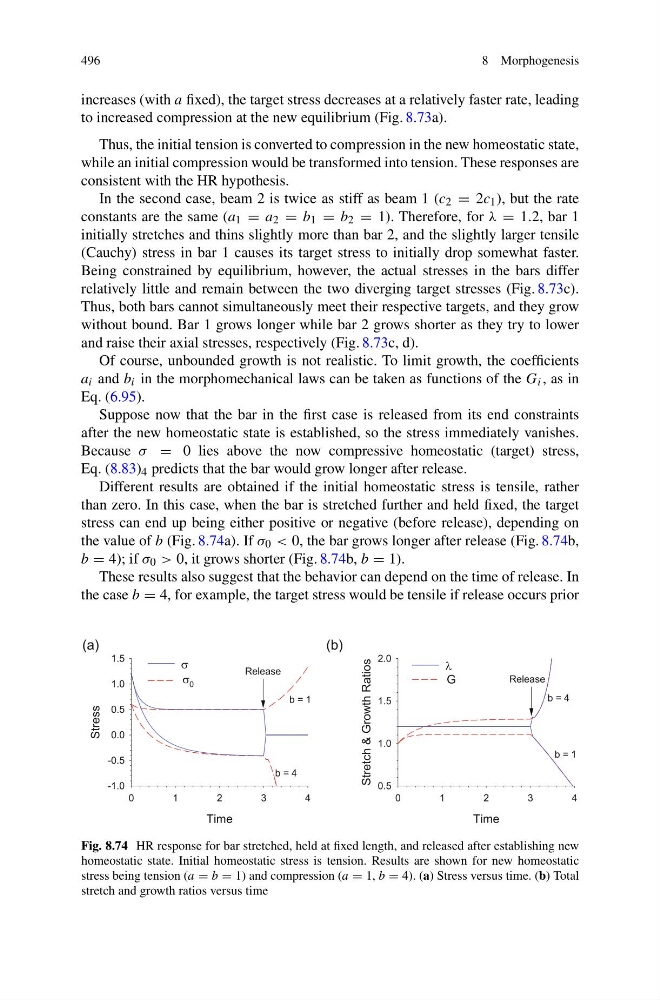
Suppose now that the bar in the first case is released from its end constraints
after the new homeostatic state is established, so the stress immediately vanishes.
Because σ = 0 lies above the now compressive homeostatic (target) stress,
Eq. (8.83) 4 predicts that the bar would grow longer after release.
Different results are obtained if the initial homeostatic stress is tensile, rather
than zero. In this case, when the bar is stretched further and held fixed, the target
stress can end up being either positive or negative (before release), depending on
the value of b (Fig. 8.74a). If σ 0 < 0, the bar grows longer after release (Fig. 8.74b,
b = 4); if σ 0 > 0, it grows shorter (Fig. 8.74b, b = 1).
These results also suggest that the behavior can depend on the time of release. In
the case b = 4, for example, the target stress would be tensile if release occurs prior
Fig. 8.74 HR response for bar stretched, held at fixed length, and released after establishing new
homeostatic state. Initial homeostatic stress is tension. Results are shown for new homeostatic
stress being tension (a = b = 1) and compression (a = 1, b = 4). (a) Stress versus time. (b) Total
stretch and growth ratios versus time
8 Morphogenesis
increases (with a fixed), the target stress decreases at a relatively faster rate, leading
to increased compression at the new equilibrium (Fig. 8.73a).
Thus, the initial tension is converted to compression in the new homeostatic state,
while an initial compression would be transformed into tension. These responses are
consistent with the HR hypothesis.
In the second case, beam 2 is twice as stiff as beam 1 (c 2 = 2c 1 ), but the rate
constants are the same (a 1 = a 2 = b 1 = b 2 = 1). Therefore, for λ = 1.2, bar 1
initially stretches and thins slightly more than bar 2, and the slightly larger tensile
(Cauchy) stress in bar 1 causes its target stress to initially drop somewhat faster.
Being constrained by equilibrium, however, the actual stresses in the bars differ
relatively little and remain between the two diverging target stresses (Fig. 8.73c).
Thus, both bars cannot simultaneously meet their respective targets, and they grow
without bound. Bar 1 grows longer while bar 2 grows shorter as they try to lower
and raise their axial stresses, respectively (Fig. 8.73c, d).
Of course, unbounded growth is not realistic. To limit growth, the coefficients
a i and b i in the morphomechanical laws can be taken as functions of the G i , as in
Eq. (6.95).
Suppose now that the bar in the first case is released from its end constraints
after the new homeostatic state is established, so the stress immediately vanishes.
Because σ = 0 lies above the now compressive homeostatic (target) stress,
Eq. (8.83) 4 predicts that the bar would grow longer after release.
Different results are obtained if the initial homeostatic stress is tensile, rather
than zero. In this case, when the bar is stretched further and held fixed, the target
stress can end up being either positive or negative (before release), depending on
the value of b (Fig. 8.74a). If σ 0 < 0, the bar grows longer after release (Fig. 8.74b,
b = 4); if σ 0 > 0, it grows shorter (Fig. 8.74b, b = 1).
These results also suggest that the behavior can depend on the time of release. In
the case b = 4, for example, the target stress would be tensile if release occurs prior
Fig. 8.74 HR response for bar stretched, held at fixed length, and released after establishing new
homeostatic state. Initial homeostatic stress is tension. Results are shown for new homeostatic
stress being tension (a = b = 1) and compression (a = 1, b = 4). (a) Stress versus time. (b) Total
stretch and growth ratios versus time