

8.9 Mechanical Regulation of Morphogenesis
495
Here, we assume that the homeostatic state corresponds to the unloaded, stress-free
configuration. Consequently, the initial conditions for the differential equations are
G 1 (0) = G 2 (0) = 1 and σ 10 = σ 20 = 0.
The solution can be computed by stepping in time. At t = 0, the first two of
Eqs. (8.83) are solved for λ 1 and λ 2 , the third provides the initial stresses, and then
the last two relations give ˙
G i and ˙
σ i0 to be used in computing G i and σ i0 for the
next time step via numerical integration. This process continues at each subsequent
time step.
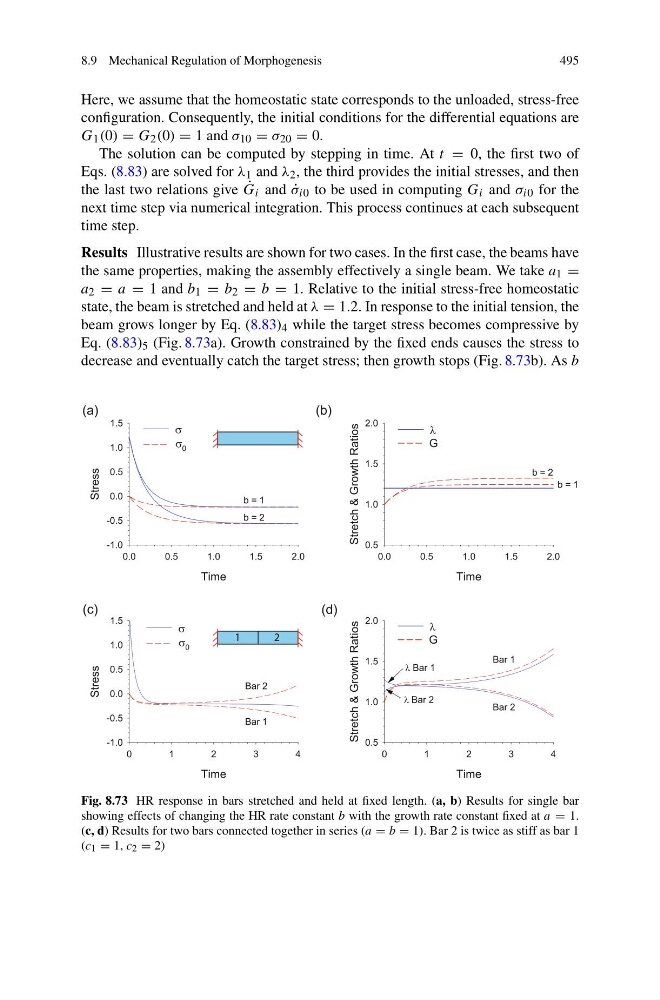
Results Illustrative results are shown for two cases. In the first case, the beams have
the same properties, making the assembly effectively a single beam. We take a 1 =
a 2 = a = 1 and b 1 = b 2 = b = 1. Relative to the initial stress-free homeostatic
state, the beam is stretched and held at λ = 1.2. In response to the initial tension, the
beam grows longer by Eq. (8.83) 4 while the target stress becomes compressive by
Eq. (8.83) 5 (Fig. 8.73a). Growth constrained by the fixed ends causes the stress to
decrease and eventually catch the target stress; then growth stops (Fig. 8.73b). As b
1
2
Fig. 8.73 HR response in bars stretched and held at fixed length. (a, b) Results for single bar
showing effects of changing the HR rate constant b with the growth rate constant fixed at a = 1.
(c, d) Results for two bars connected together in series (a = b = 1). Bar 2 is twice as stiff as bar 1
(c 1 = 1, c 2 = 2)
495
Here, we assume that the homeostatic state corresponds to the unloaded, stress-free
configuration. Consequently, the initial conditions for the differential equations are
G 1 (0) = G 2 (0) = 1 and σ 10 = σ 20 = 0.
The solution can be computed by stepping in time. At t = 0, the first two of
Eqs. (8.83) are solved for λ 1 and λ 2 , the third provides the initial stresses, and then
the last two relations give ˙
G i and ˙
σ i0 to be used in computing G i and σ i0 for the
next time step via numerical integration. This process continues at each subsequent
time step.
Results Illustrative results are shown for two cases. In the first case, the beams have
the same properties, making the assembly effectively a single beam. We take a 1 =
a 2 = a = 1 and b 1 = b 2 = b = 1. Relative to the initial stress-free homeostatic
state, the beam is stretched and held at λ = 1.2. In response to the initial tension, the
beam grows longer by Eq. (8.83) 4 while the target stress becomes compressive by
Eq. (8.83) 5 (Fig. 8.73a). Growth constrained by the fixed ends causes the stress to
decrease and eventually catch the target stress; then growth stops (Fig. 8.73b). As b
1
2
Fig. 8.73 HR response in bars stretched and held at fixed length. (a, b) Results for single bar
showing effects of changing the HR rate constant b with the growth rate constant fixed at a = 1.
(c, d) Results for two bars connected together in series (a = b = 1). Bar 2 is twice as stiff as bar 1
(c 1 = 1, c 2 = 2)