

494
8 Morphogenesis
λ =
L 1 + Ł 2
2L 0
=
1
2 (λ 1 + λ 2 ),
(8.79)
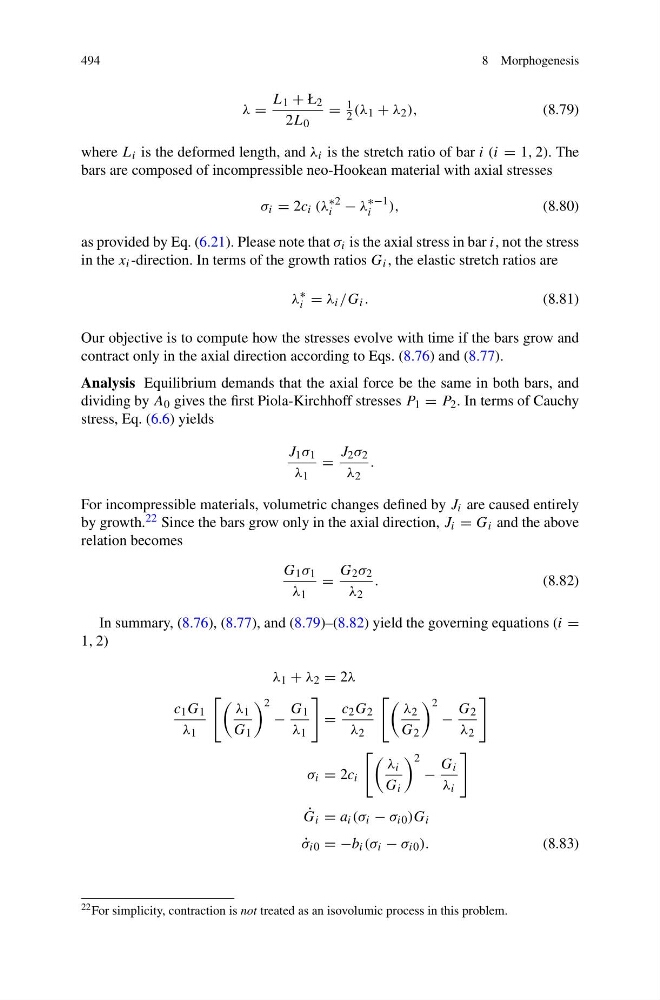
where L i is the deformed length, and λ i is the stretch ratio of bar i (i = 1, 2). The
bars are composed of incompressible neo-Hookean material with axial stresses
σ i = 2c i (λ
∗2
i − λ
∗−1
i
),
(8.80)
as provided by Eq. (6.21). Please note that σ i is the axial stress in bar i, not the stress
in the x i -direction. In terms of the growth ratios G i , the elastic stretch ratios are
λ
∗
i = λ i /G i .
(8.81)
Our objective is to compute how the stresses evolve with time if the bars grow and
contract only in the axial direction according to Eqs. (8.76) and (8.77).
Analysis Equilibrium demands that the axial force be the same in both bars, and
dividing by A 0 gives the first Piola-Kirchhoff stresses P 1 = P 2 . In terms of Cauchy
stress, Eq. (6.6) yields
J 1 σ 1
λ 1
=
J 2 σ 2
λ 2
.
For incompressible materials, volumetric changes defined by J i are caused entirely
by growth. 22 Since the bars grow only in the axial direction, J i = G i and the above
relation becomes
G 1 σ 1
λ 1
=
G 2 σ 2
λ 2
.
(8.82)
In summary, (8.76), (8.77), and (8.79)–(8.82) yield the governing equations (i =
1, 2)
λ 1 + λ 2 = 2λ
c 1 G 1
λ 1
λ 1
G 1
2
−
G 1
λ 1
=
c 2 G 2
λ 2
λ 2
G 2
2
−
G 2
λ 2
σ i = 2c i
λ i
G i
2
−
G i
λ i
˙
G i = a i (σ i − σ i0 )G i
˙
σ i0 = −b i (σ i − σ i0 ).
(8.83)
22 For simplicity, contraction is not treated as an isovolumic process in this problem.
8 Morphogenesis
λ =
L 1 + Ł 2
2L 0
=
1
2 (λ 1 + λ 2 ),
(8.79)
where L i is the deformed length, and λ i is the stretch ratio of bar i (i = 1, 2). The
bars are composed of incompressible neo-Hookean material with axial stresses
σ i = 2c i (λ
∗2
i − λ
∗−1
i
),
(8.80)
as provided by Eq. (6.21). Please note that σ i is the axial stress in bar i, not the stress
in the x i -direction. In terms of the growth ratios G i , the elastic stretch ratios are
λ
∗
i = λ i /G i .
(8.81)
Our objective is to compute how the stresses evolve with time if the bars grow and
contract only in the axial direction according to Eqs. (8.76) and (8.77).
Analysis Equilibrium demands that the axial force be the same in both bars, and
dividing by A 0 gives the first Piola-Kirchhoff stresses P 1 = P 2 . In terms of Cauchy
stress, Eq. (6.6) yields
J 1 σ 1
λ 1
=
J 2 σ 2
λ 2
.
For incompressible materials, volumetric changes defined by J i are caused entirely
by growth. 22 Since the bars grow only in the axial direction, J i = G i and the above
relation becomes
G 1 σ 1
λ 1
=
G 2 σ 2
λ 2
.
(8.82)
In summary, (8.76), (8.77), and (8.79)–(8.82) yield the governing equations (i =
1, 2)
λ 1 + λ 2 = 2λ
c 1 G 1
λ 1
λ 1
G 1
2
−
G 1
λ 1
=
c 2 G 2
λ 2
λ 2
G 2
2
−
G 2
λ 2
σ i = 2c i
λ i
G i
2
−
G i
λ i
˙
G i = a i (σ i − σ i0 )G i
˙
σ i0 = −b i (σ i − σ i0 ).
(8.83)
22 For simplicity, contraction is not treated as an isovolumic process in this problem.