

8.9 Mechanical Regulation of Morphogenesis
497
to about t = 0.4 (Fig. 8.74a), so we would expect it to grow shorter after release. In
contrast, if the bar is released at a later time, it should grow longer. These results can
be confirmed using the model. The alternative HR model of Logvenkov and Stein
(2015) yields similar behavior.
8.9.4 HR: Cylindrical Bending of a Plate
Next, we consider cylindrical bending of an epithelium modeled as a plate using
finite elements (Taber 2008). The left end of the plate is fixed, and the right end is
attached to a rigid block. With the axial stresses σ = σ 0 = 0 at t = 0, equal and
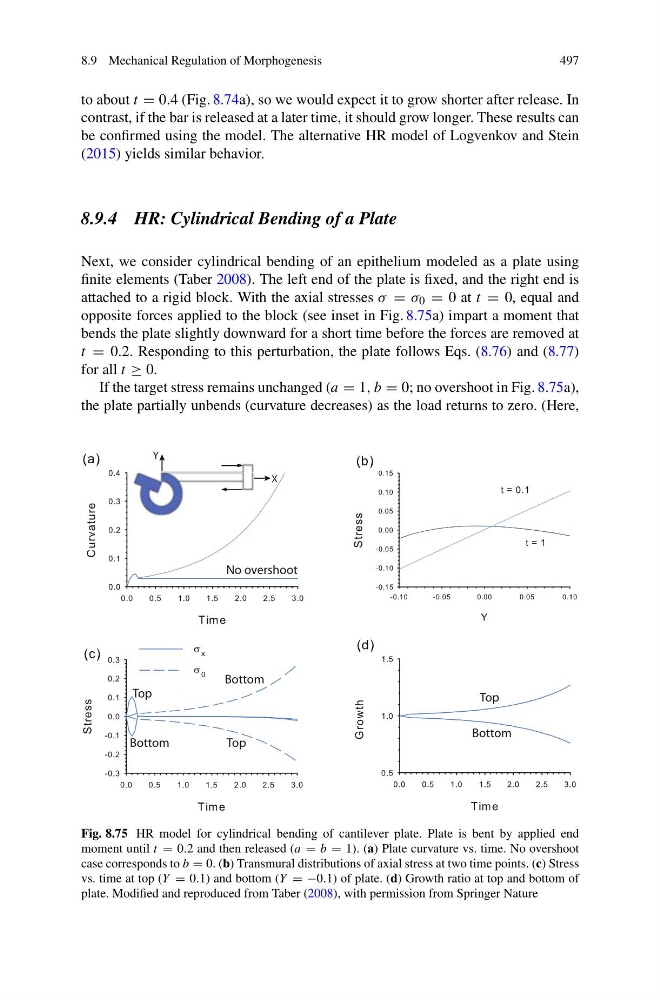
opposite forces applied to the block (see inset in Fig. 8.75a) impart a moment that
bends the plate slightly downward for a short time before the forces are removed at
t = 0.2. Responding to this perturbation, the plate follows Eqs. (8.76) and (8.77)
for all t ≥ 0.
If the target stress remains unchanged (a = 1, b = 0; no overshoot in Fig. 8.75a),
the plate partially unbends (curvature decreases) as the load returns to zero. (Here,
Bottom
Top
Bottom
Top
No overshoot
Top
Bottom
X
Y
Fig. 8.75 HR model for cylindrical bending of cantilever plate. Plate is bent by applied end
moment until t = 0.2 and then released (a = b = 1). (a) Plate curvature vs. time. No overshoot
case corresponds to b = 0. (b) Transmural distributions of axial stress at two time points. (c) Stress
vs. time at top (Y = 0.1) and bottom (Y = −0.1) of plate. (d) Growth ratio at top and bottom of
plate. Modified and reproduced from Taber (2008), with permission from Springer Nature
497
to about t = 0.4 (Fig. 8.74a), so we would expect it to grow shorter after release. In
contrast, if the bar is released at a later time, it should grow longer. These results can
be confirmed using the model. The alternative HR model of Logvenkov and Stein
(2015) yields similar behavior.
8.9.4 HR: Cylindrical Bending of a Plate
Next, we consider cylindrical bending of an epithelium modeled as a plate using
finite elements (Taber 2008). The left end of the plate is fixed, and the right end is
attached to a rigid block. With the axial stresses σ = σ 0 = 0 at t = 0, equal and
opposite forces applied to the block (see inset in Fig. 8.75a) impart a moment that
bends the plate slightly downward for a short time before the forces are removed at
t = 0.2. Responding to this perturbation, the plate follows Eqs. (8.76) and (8.77)
for all t ≥ 0.
If the target stress remains unchanged (a = 1, b = 0; no overshoot in Fig. 8.75a),
the plate partially unbends (curvature decreases) as the load returns to zero. (Here,
Bottom
Top
Bottom
Top
No overshoot
Top
Bottom
X
Y
Fig. 8.75 HR model for cylindrical bending of cantilever plate. Plate is bent by applied end
moment until t = 0.2 and then released (a = b = 1). (a) Plate curvature vs. time. No overshoot
case corresponds to b = 0. (b) Transmural distributions of axial stress at two time points. (c) Stress
vs. time at top (Y = 0.1) and bottom (Y = −0.1) of plate. (d) Growth ratio at top and bottom of
plate. Modified and reproduced from Taber (2008), with permission from Springer Nature