

470
8 Morphogenesis
P
P
P
k
P
'
P
A
~L
'
L
(a)
(b)
(c)
(d)
(e)
P
P
A
A
A
A
c
k''c'
.
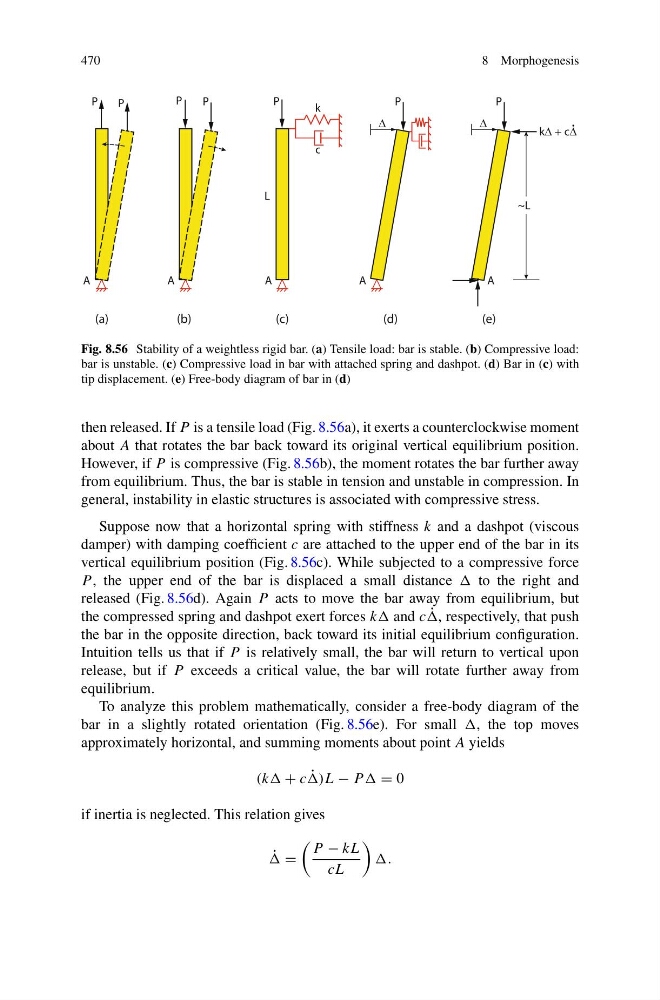
Fig. 8.56 Stability of a weightless rigid bar. (a) Tensile load: bar is stable. (b) Compressive load:
bar is unstable. (c) Compressive load in bar with attached spring and dashpot. (d) Bar in (c) with
tip displacement. (e) Free-body diagram of bar in (d)
then released. If P is a tensile load (Fig. 8.56a), it exerts a counterclockwise moment
about A that rotates the bar back toward its original vertical equilibrium position.
However, if P is compressive (Fig. 8.56b), the moment rotates the bar further away
from equilibrium. Thus, the bar is stable in tension and unstable in compression. In
general, instability in elastic structures is associated with compressive stress.
Suppose now that a horizontal spring with stiffness k and a dashpot (viscous
damper) with damping coefficient c are attached to the upper end of the bar in its
vertical equilibrium position (Fig. 8.56c). While subjected to a compressive force
P , the upper end of the bar is displaced a small distance to the right and
released (Fig. 8.56d). Again P acts to move the bar away from equilibrium, but
the compressed spring and dashpot exert forces kk and c ˙
, respectively, that push
the bar in the opposite direction, back toward its initial equilibrium configuration.
Intuition tells us that if P is relatively small, the bar will return to vertical upon
release, but if P exceeds a critical value, the bar will rotate further away from
equilibrium.
To analyze this problem mathematically, consider a free-body diagram of the
bar in a slightly rotated orientation (Fig. 8.56e). For small , the top moves
approximately horizontal, and summing moments about point A yields
(kk + c ˙
)L − P P = 0
if inertia is neglected. This relation gives
˙
=
P − kL
cL
.
8 Morphogenesis
P
P
P
k
P
'
P
A
~L
'
L
(a)
(b)
(c)
(d)
(e)
P
P
A
A
A
A
c
k''c'
.
Fig. 8.56 Stability of a weightless rigid bar. (a) Tensile load: bar is stable. (b) Compressive load:
bar is unstable. (c) Compressive load in bar with attached spring and dashpot. (d) Bar in (c) with
tip displacement. (e) Free-body diagram of bar in (d)
then released. If P is a tensile load (Fig. 8.56a), it exerts a counterclockwise moment
about A that rotates the bar back toward its original vertical equilibrium position.
However, if P is compressive (Fig. 8.56b), the moment rotates the bar further away
from equilibrium. Thus, the bar is stable in tension and unstable in compression. In
general, instability in elastic structures is associated with compressive stress.
Suppose now that a horizontal spring with stiffness k and a dashpot (viscous
damper) with damping coefficient c are attached to the upper end of the bar in its
vertical equilibrium position (Fig. 8.56c). While subjected to a compressive force
P , the upper end of the bar is displaced a small distance to the right and
released (Fig. 8.56d). Again P acts to move the bar away from equilibrium, but
the compressed spring and dashpot exert forces kk and c ˙
, respectively, that push
the bar in the opposite direction, back toward its initial equilibrium configuration.
Intuition tells us that if P is relatively small, the bar will return to vertical upon
release, but if P exceeds a critical value, the bar will rotate further away from
equilibrium.
To analyze this problem mathematically, consider a free-body diagram of the
bar in a slightly rotated orientation (Fig. 8.56e). For small , the top moves
approximately horizontal, and summing moments about point A yields
(kk + c ˙
)L − P P = 0
if inertia is neglected. This relation gives
˙
=
P − kL
cL
.