

8.6 Neural Development
471
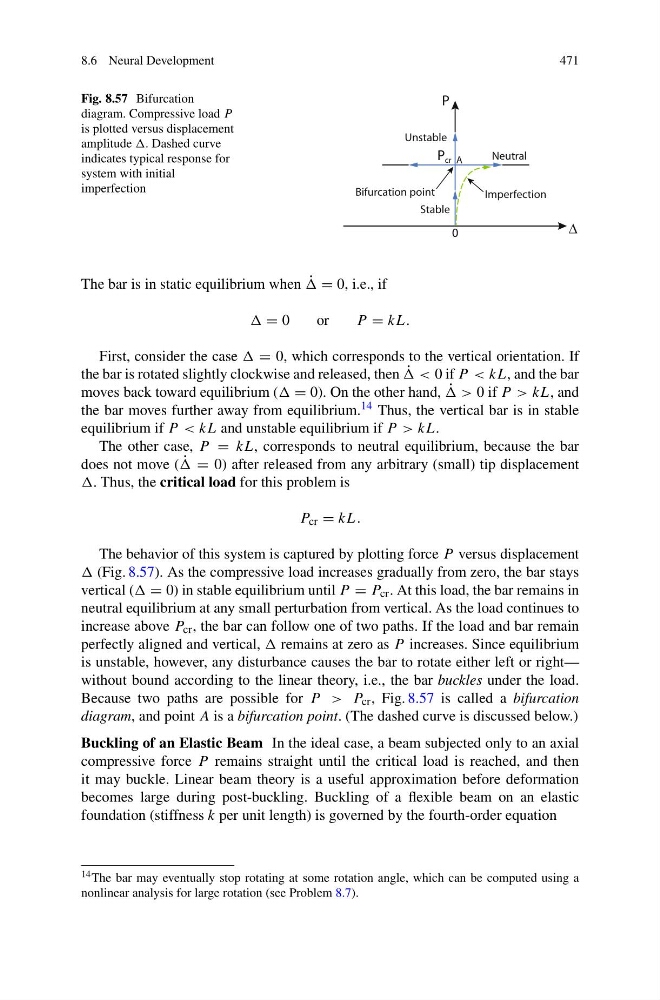
Fig. 8.57 Bifurcation
diagram. Compressive load P
is plotted versus displacement
amplitude . Dashed curve
indicates typical response for
system with initial
imperfection
P
'
0
P cr
Bifurcation point
Imperfection
Stable
Unstable
Neutral
A
The bar is in static equilibrium when ˙
= 0, i.e., if
= 0
or
P = kL.
First, consider the case = 0, which corresponds to the vertical orientation. If
the bar is rotated slightly clockwise and released, then ˙
< 0 if P < kL, and the bar
moves back toward equilibrium ( = 0). On the other hand, ˙
> 0 if P > kL, and
the bar moves further away from equilibrium. 14 Thus, the vertical bar is in stable
equilibrium if P < kL and unstable equilibrium if P > kL.
The other case, P = kL, corresponds to neutral equilibrium, because the bar
does not move ( ˙
= 0) after released from any arbitrary (small) tip displacement
. Thus, the critical load for this problem is
P cr = kL.
The behavior of this system is captured by plotting force P versus displacement
(Fig. 8.57). As the compressive load increases gradually from zero, the bar stays
vertical ( = 0) in stable equilibrium until P = P cr . At this load, the bar remains in
neutral equilibrium at any small perturbation from vertical. As the load continues to
increase above P cr , the bar can follow one of two paths. If the load and bar remain
perfectly aligned and vertical, remains at zero as P increases. Since equilibrium
is unstable, however, any disturbance causes the bar to rotate either left or right—
without bound according to the linear theory, i.e., the bar buckles under the load.
Because two paths are possible for P > P cr , Fig. 8.57 is called a bifurcation
diagram, and point A is a bifurcation point. (The dashed curve is discussed below.)
Buckling of an Elastic Beam In the ideal case, a beam subjected only to an axial
compressive force P remains straight until the critical load is reached, and then
it may buckle. Linear beam theory is a useful approximation before deformation
becomes large during post-buckling. Buckling of a flexible beam on an elastic
foundation (stiffness k per unit length) is governed by the fourth-order equation
14 The bar may eventually stop rotating at some rotation angle, which can be computed using a
nonlinear analysis for large rotation (see Problem 8.7).
471
Fig. 8.57 Bifurcation
diagram. Compressive load P
is plotted versus displacement
amplitude . Dashed curve
indicates typical response for
system with initial
imperfection
P
'
0
P cr
Bifurcation point
Imperfection
Stable
Unstable
Neutral
A
The bar is in static equilibrium when ˙
= 0, i.e., if
= 0
or
P = kL.
First, consider the case = 0, which corresponds to the vertical orientation. If
the bar is rotated slightly clockwise and released, then ˙
< 0 if P < kL, and the bar
moves back toward equilibrium ( = 0). On the other hand, ˙
> 0 if P > kL, and
the bar moves further away from equilibrium. 14 Thus, the vertical bar is in stable
equilibrium if P < kL and unstable equilibrium if P > kL.
The other case, P = kL, corresponds to neutral equilibrium, because the bar
does not move ( ˙
= 0) after released from any arbitrary (small) tip displacement
. Thus, the critical load for this problem is
P cr = kL.
The behavior of this system is captured by plotting force P versus displacement
(Fig. 8.57). As the compressive load increases gradually from zero, the bar stays
vertical ( = 0) in stable equilibrium until P = P cr . At this load, the bar remains in
neutral equilibrium at any small perturbation from vertical. As the load continues to
increase above P cr , the bar can follow one of two paths. If the load and bar remain
perfectly aligned and vertical, remains at zero as P increases. Since equilibrium
is unstable, however, any disturbance causes the bar to rotate either left or right—
without bound according to the linear theory, i.e., the bar buckles under the load.
Because two paths are possible for P > P cr , Fig. 8.57 is called a bifurcation
diagram, and point A is a bifurcation point. (The dashed curve is discussed below.)
Buckling of an Elastic Beam In the ideal case, a beam subjected only to an axial
compressive force P remains straight until the critical load is reached, and then
it may buckle. Linear beam theory is a useful approximation before deformation
becomes large during post-buckling. Buckling of a flexible beam on an elastic
foundation (stiffness k per unit length) is governed by the fourth-order equation
14 The bar may eventually stop rotating at some rotation angle, which can be computed using a
nonlinear analysis for large rotation (see Problem 8.7).