

8.6 Neural Development
469
predicts unrealistic shapes (Fig. 8.54b, left). The model based on Eqs. (8.56) also
yields qualitative agreement with certain experimental perturbations (Garcia et al.
2019). Nevertheless, additional studies are needed to further test the validity of the
proposed growth laws. In general, the mathematical form of growth laws remains a
hotly debated topic (Goriely 2017).
8.6.4 Detour to Buckling
The surface of the human brain undergoes folding during the third trimester (see
Fig. 1.6). Recent studies suggest that growth-induced buckling plays a major role in
creating the characteristic folding pattern.
Before tackling this problem, we introduce the fundamental mechanics of
buckling, which is characterized by out-of-plane bending caused by in-plane
compression. For load-bearing structures, buckling generally leads to failure. A
buckled column can cause a building to collapse; a buckled bone may fracture. In
morphogenesis, however, buckling can be a good way to generate certain shapes.
Besides the brain, it plays a major role in morphogenesis of the gut, lungs, kidneys,
and fingerprints (Nelson 2016).
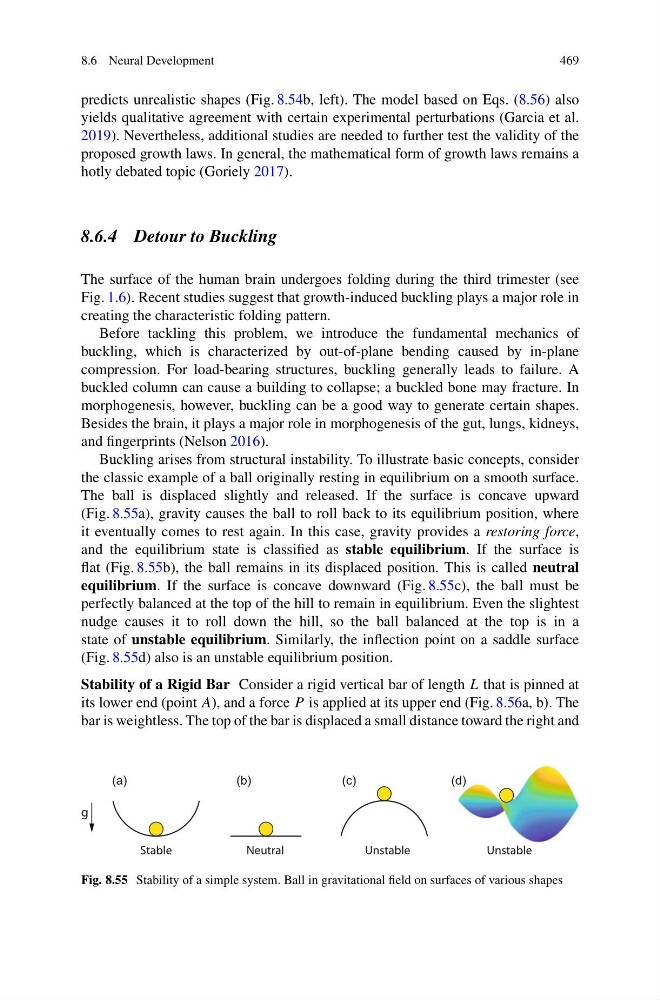
Buckling arises from structural instability. To illustrate basic concepts, consider
the classic example of a ball originally resting in equilibrium on a smooth surface.
The ball is displaced slightly and released. If the surface is concave upward
(Fig. 8.55a), gravity causes the ball to roll back to its equilibrium position, where
it eventually comes to rest again. In this case, gravity provides a restoring force,
and the equilibrium state is classified as stable equilibrium. If the surface is
flat (Fig. 8.55b), the ball remains in its displaced position. This is called neutral
equilibrium. If the surface is concave downward (Fig. 8.55c), the ball must be
perfectly balanced at the top of the hill to remain in equilibrium. Even the slightest
nudge causes it to roll down the hill, so the ball balanced at the top is in a
state of unstable equilibrium. Similarly, the inflection point on a saddle surface
(Fig. 8.55d) also is an unstable equilibrium position.
Stability of a Rigid Bar Consider a rigid vertical bar of length L that is pinned at
its lower end (point A), and a force P is applied at its upper end (Fig. 8.56a, b). The
bar is weightless. The top of the bar is displaced a small distance toward the right and
g
Stable
Neutral
Unstable
Unstable
(a)
(b)
(c)
(d)
Fig. 8.55 Stability of a simple system. Ball in gravitational field on surfaces of various shapes
469
predicts unrealistic shapes (Fig. 8.54b, left). The model based on Eqs. (8.56) also
yields qualitative agreement with certain experimental perturbations (Garcia et al.
2019). Nevertheless, additional studies are needed to further test the validity of the
proposed growth laws. In general, the mathematical form of growth laws remains a
hotly debated topic (Goriely 2017).
8.6.4 Detour to Buckling
The surface of the human brain undergoes folding during the third trimester (see
Fig. 1.6). Recent studies suggest that growth-induced buckling plays a major role in
creating the characteristic folding pattern.
Before tackling this problem, we introduce the fundamental mechanics of
buckling, which is characterized by out-of-plane bending caused by in-plane
compression. For load-bearing structures, buckling generally leads to failure. A
buckled column can cause a building to collapse; a buckled bone may fracture. In
morphogenesis, however, buckling can be a good way to generate certain shapes.
Besides the brain, it plays a major role in morphogenesis of the gut, lungs, kidneys,
and fingerprints (Nelson 2016).
Buckling arises from structural instability. To illustrate basic concepts, consider
the classic example of a ball originally resting in equilibrium on a smooth surface.
The ball is displaced slightly and released. If the surface is concave upward
(Fig. 8.55a), gravity causes the ball to roll back to its equilibrium position, where
it eventually comes to rest again. In this case, gravity provides a restoring force,
and the equilibrium state is classified as stable equilibrium. If the surface is
flat (Fig. 8.55b), the ball remains in its displaced position. This is called neutral
equilibrium. If the surface is concave downward (Fig. 8.55c), the ball must be
perfectly balanced at the top of the hill to remain in equilibrium. Even the slightest
nudge causes it to roll down the hill, so the ball balanced at the top is in a
state of unstable equilibrium. Similarly, the inflection point on a saddle surface
(Fig. 8.55d) also is an unstable equilibrium position.
Stability of a Rigid Bar Consider a rigid vertical bar of length L that is pinned at
its lower end (point A), and a force P is applied at its upper end (Fig. 8.56a, b). The
bar is weightless. The top of the bar is displaced a small distance toward the right and
g
Stable
Neutral
Unstable
Unstable
(a)
(b)
(c)
(d)
Fig. 8.55 Stability of a simple system. Ball in gravitational field on surfaces of various shapes