

466
8 Morphogenesis
1. The internal pressure is ramped up to 30 Pa and held constant after HH12 + .
Experimental results indicate that lumen pressure plays a crucial role in the later
stages of BT morphogenesis. For example, during the 36-h period between HH18
and HH24, the total volume of the forebrain and midbrain, including lumen and
wall, increases about six times, and then about five more times in the next 12 h
from HH24 to HH26 (Desmond and Jacobson 1977). Relieving eCSF pressure
via intubation dramatically decreases this expansion, as well as the amount of
bending (Desmond and Jacobson 1977; Garcia et al. 2017).
2. A relatively stiff nongrowing region representing the notochord is included
along the ventral side of the BT. Differential growth between the notochord and
attached tissue has been implicated in BT bending (Takamatsu and Fujita 1987).
3. Mechanical feedback is included through the growth law
˙
G = (a 0 + a σ ¯
σ ) G,
(8.54)
where
¯
σ =
1
4c
(σ φ + σ θ )
(8.55)
is a nondimensional average stress, with c being the passive modulus. The
growth-rate coefficients, a 0 and a σ , were determined using geometric measurements from control and intubated brains at stages HH12 and HH17 (Garcia et al.
2017).
The model produces realistic BT morphology. The shapes of the vesicles and
the amount of bending agree reasonably well with observations from HH17 chick
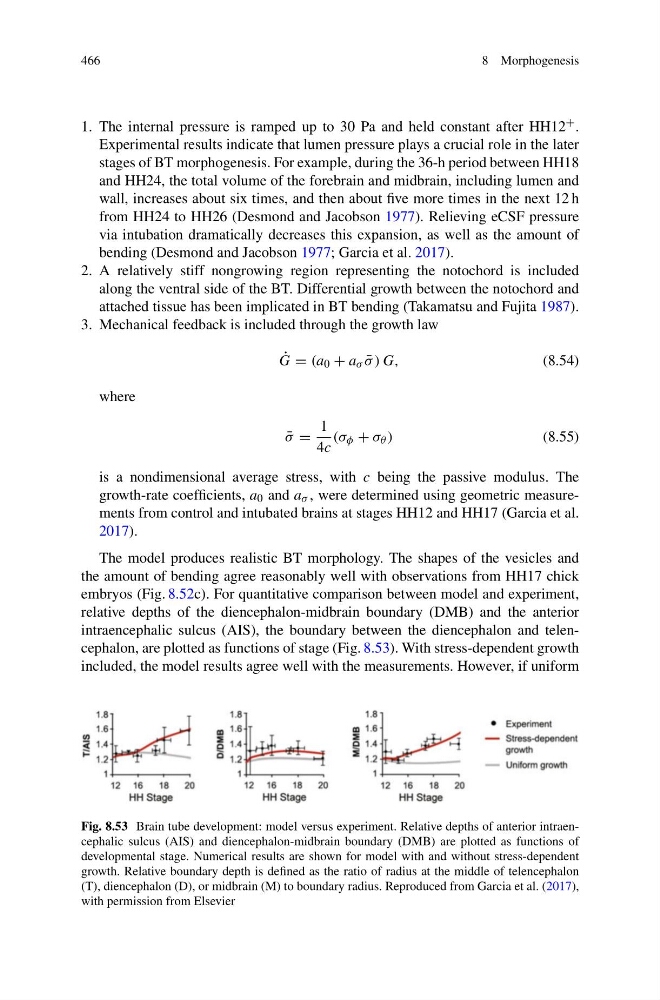
embryos (Fig. 8.52c). For quantitative comparison between model and experiment,
relative depths of the diencephalon-midbrain boundary (DMB) and the anterior
intraencephalic sulcus (AIS), the boundary between the diencephalon and telencephalon, are plotted as functions of stage (Fig. 8.53). With stress-dependent growth
included, the model results agree well with the measurements. However, if uniform
Fig. 8.53 Brain tube development: model versus experiment. Relative depths of anterior intraencephalic sulcus (AIS) and diencephalon-midbrain boundary (DMB) are plotted as functions of
developmental stage. Numerical results are shown for model with and without stress-dependent
growth. Relative boundary depth is defined as the ratio of radius at the middle of telencephalon
(T), diencephalon (D), or midbrain (M) to boundary radius. Reproduced from Garcia et al. (2017),
with permission from Elsevier
8 Morphogenesis
1. The internal pressure is ramped up to 30 Pa and held constant after HH12 + .
Experimental results indicate that lumen pressure plays a crucial role in the later
stages of BT morphogenesis. For example, during the 36-h period between HH18
and HH24, the total volume of the forebrain and midbrain, including lumen and
wall, increases about six times, and then about five more times in the next 12 h
from HH24 to HH26 (Desmond and Jacobson 1977). Relieving eCSF pressure
via intubation dramatically decreases this expansion, as well as the amount of
bending (Desmond and Jacobson 1977; Garcia et al. 2017).
2. A relatively stiff nongrowing region representing the notochord is included
along the ventral side of the BT. Differential growth between the notochord and
attached tissue has been implicated in BT bending (Takamatsu and Fujita 1987).
3. Mechanical feedback is included through the growth law
˙
G = (a 0 + a σ ¯
σ ) G,
(8.54)
where
¯
σ =
1
4c
(σ φ + σ θ )
(8.55)
is a nondimensional average stress, with c being the passive modulus. The
growth-rate coefficients, a 0 and a σ , were determined using geometric measurements from control and intubated brains at stages HH12 and HH17 (Garcia et al.
2017).
The model produces realistic BT morphology. The shapes of the vesicles and
the amount of bending agree reasonably well with observations from HH17 chick
embryos (Fig. 8.52c). For quantitative comparison between model and experiment,
relative depths of the diencephalon-midbrain boundary (DMB) and the anterior
intraencephalic sulcus (AIS), the boundary between the diencephalon and telencephalon, are plotted as functions of stage (Fig. 8.53). With stress-dependent growth
included, the model results agree well with the measurements. However, if uniform
Fig. 8.53 Brain tube development: model versus experiment. Relative depths of anterior intraencephalic sulcus (AIS) and diencephalon-midbrain boundary (DMB) are plotted as functions of
developmental stage. Numerical results are shown for model with and without stress-dependent
growth. Relative boundary depth is defined as the ratio of radius at the middle of telencephalon
(T), diencephalon (D), or midbrain (M) to boundary radius. Reproduced from Garcia et al. (2017),
with permission from Elsevier