

8.6 Neural Development
467
growth is specified throughout the brain tube (no feedback), the results show poor
agreement with the data. These results suggest that mechanical feedback is essential
for proper morphogenesis during the early stages of brain development.
Note that the boundaries continue to deepen and become more distinct as the BT
expands (Fig. 8.53). Because stress increases with radius according to Laplace’s law,
average circumferential wall stress is higher in the vesicles than in the boundaries.
Consequently, if the material properties are similar, the vesicles should inflate more
than the boundaries, causing the boundaries to become deeper as eCSF pressure
increases. However, measurements on inflated and deflated brains reveal that most
of the expansion of the BT is caused by growth, rather than elastic inflation
(Garcia et al. 2017). Thus, regional differences in wall stress indirectly cause vesicle
boundaries to deepen by fostering an increase in the relative growth rate between the
boundaries and vesicles as the pressure rises.
Formation of Cerebral Hemispheres As the forebrain continues to grow and
develop, the cerebral hemispheres expand outward from the left and right sides of
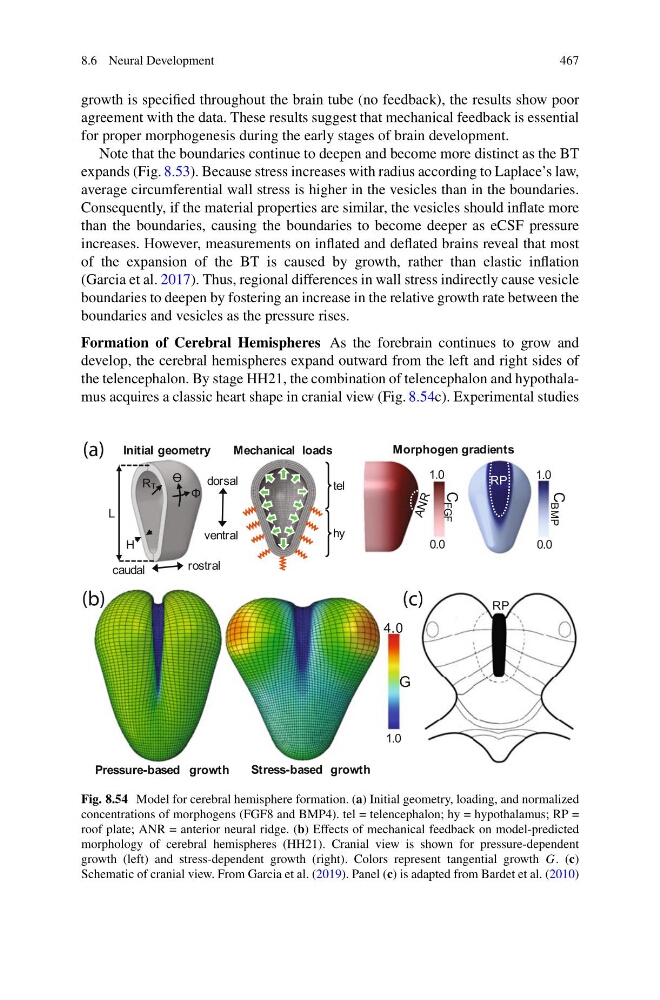
the telencephalon. By stage HH21, the combination of telencephalon and hypothalamus acquires a classic heart shape in cranial view (Fig. 8.54c). Experimental studies
Fig. 8.54 Model for cerebral hemisphere formation. (a) Initial geometry, loading, and normalized
concentrations of morphogens (FGF8 and BMP4). tel = telencephalon; hy = hypothalamus; RP =
roof plate; ANR = anterior neural ridge. (b) Effects of mechanical feedback on model-predicted
morphology of cerebral hemispheres (HH21). Cranial view is shown for pressure-dependent
growth (left) and stress-dependent growth (right). Colors represent tangential growth G. (c)
Schematic of cranial view. From Garcia et al. (2019). Panel (c) is adapted from Bardet et al. (2010)
467
growth is specified throughout the brain tube (no feedback), the results show poor
agreement with the data. These results suggest that mechanical feedback is essential
for proper morphogenesis during the early stages of brain development.
Note that the boundaries continue to deepen and become more distinct as the BT
expands (Fig. 8.53). Because stress increases with radius according to Laplace’s law,
average circumferential wall stress is higher in the vesicles than in the boundaries.
Consequently, if the material properties are similar, the vesicles should inflate more
than the boundaries, causing the boundaries to become deeper as eCSF pressure
increases. However, measurements on inflated and deflated brains reveal that most
of the expansion of the BT is caused by growth, rather than elastic inflation
(Garcia et al. 2017). Thus, regional differences in wall stress indirectly cause vesicle
boundaries to deepen by fostering an increase in the relative growth rate between the
boundaries and vesicles as the pressure rises.
Formation of Cerebral Hemispheres As the forebrain continues to grow and
develop, the cerebral hemispheres expand outward from the left and right sides of
the telencephalon. By stage HH21, the combination of telencephalon and hypothalamus acquires a classic heart shape in cranial view (Fig. 8.54c). Experimental studies
Fig. 8.54 Model for cerebral hemisphere formation. (a) Initial geometry, loading, and normalized
concentrations of morphogens (FGF8 and BMP4). tel = telencephalon; hy = hypothalamus; RP =
roof plate; ANR = anterior neural ridge. (b) Effects of mechanical feedback on model-predicted
morphology of cerebral hemispheres (HH21). Cranial view is shown for pressure-dependent
growth (left) and stress-dependent growth (right). Colors represent tangential growth G. (c)
Schematic of cranial view. From Garcia et al. (2019). Panel (c) is adapted from Bardet et al. (2010)