

462
8 Morphogenesis
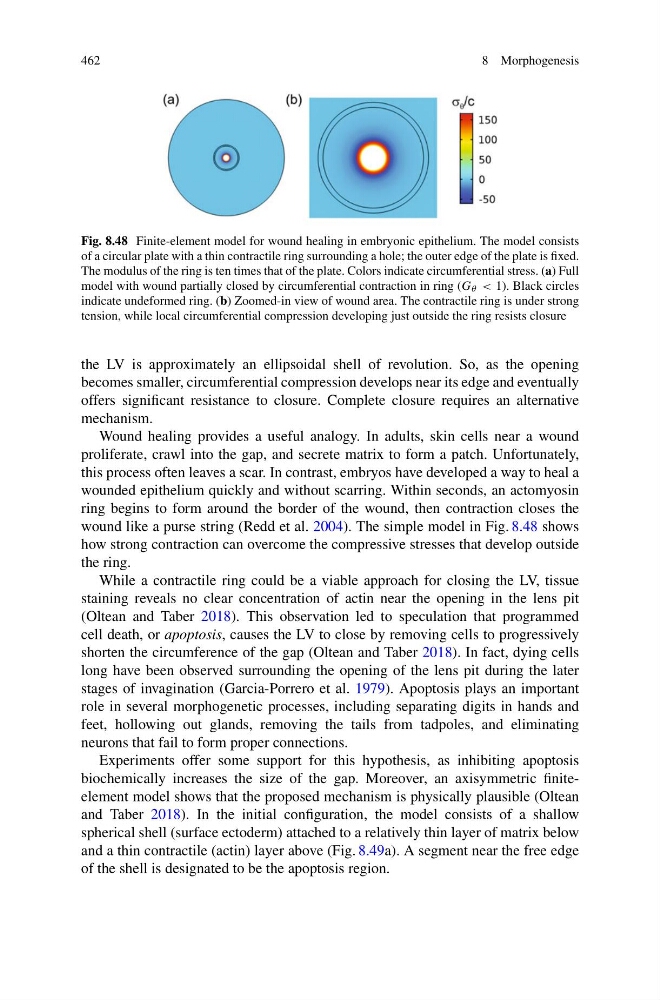
Fig. 8.48 Finite-element model for wound healing in embryonic epithelium. The model consists
of a circular plate with a thin contractile ring surrounding a hole; the outer edge of the plate is fixed.
The modulus of the ring is ten times that of the plate. Colors indicate circumferential stress. (a) Full
model with wound partially closed by circumferential contraction in ring (G θ < 1). Black circles
indicate undeformed ring. (b) Zoomed-in view of wound area. The contractile ring is under strong
tension, while local circumferential compression developing just outside the ring resists closure
the LV is approximately an ellipsoidal shell of revolution. So, as the opening
becomes smaller, circumferential compression develops near its edge and eventually
offers significant resistance to closure. Complete closure requires an alternative
mechanism.
Wound healing provides a useful analogy. In adults, skin cells near a wound
proliferate, crawl into the gap, and secrete matrix to form a patch. Unfortunately,
this process often leaves a scar. In contrast, embryos have developed a way to heal a
wounded epithelium quickly and without scarring. Within seconds, an actomyosin
ring begins to form around the border of the wound, then contraction closes the
wound like a purse string (Redd et al. 2004). The simple model in Fig. 8.48 shows
how strong contraction can overcome the compressive stresses that develop outside
the ring.
While a contractile ring could be a viable approach for closing the LV, tissue
staining reveals no clear concentration of actin near the opening in the lens pit
(Oltean and Taber 2018). This observation led to speculation that programmed
cell death, or apoptosis, causes the LV to close by removing cells to progressively
shorten the circumference of the gap (Oltean and Taber 2018). In fact, dying cells
long have been observed surrounding the opening of the lens pit during the later
stages of invagination (Garcia-Porrero et al. 1979). Apoptosis plays an important
role in several morphogenetic processes, including separating digits in hands and
feet, hollowing out glands, removing the tails from tadpoles, and eliminating
neurons that fail to form proper connections.
Experiments offer some support for this hypothesis, as inhibiting apoptosis
biochemically increases the size of the gap. Moreover, an axisymmetric finiteelement model shows that the proposed mechanism is physically plausible (Oltean
and Taber 2018). In the initial configuration, the model consists of a shallow
spherical shell (surface ectoderm) attached to a relatively thin layer of matrix below
and a thin contractile (actin) layer above (Fig. 8.49a). A segment near the free edge
of the shell is designated to be the apoptosis region.
8 Morphogenesis
Fig. 8.48 Finite-element model for wound healing in embryonic epithelium. The model consists
of a circular plate with a thin contractile ring surrounding a hole; the outer edge of the plate is fixed.
The modulus of the ring is ten times that of the plate. Colors indicate circumferential stress. (a) Full
model with wound partially closed by circumferential contraction in ring (G θ < 1). Black circles
indicate undeformed ring. (b) Zoomed-in view of wound area. The contractile ring is under strong
tension, while local circumferential compression developing just outside the ring resists closure
the LV is approximately an ellipsoidal shell of revolution. So, as the opening
becomes smaller, circumferential compression develops near its edge and eventually
offers significant resistance to closure. Complete closure requires an alternative
mechanism.
Wound healing provides a useful analogy. In adults, skin cells near a wound
proliferate, crawl into the gap, and secrete matrix to form a patch. Unfortunately,
this process often leaves a scar. In contrast, embryos have developed a way to heal a
wounded epithelium quickly and without scarring. Within seconds, an actomyosin
ring begins to form around the border of the wound, then contraction closes the
wound like a purse string (Redd et al. 2004). The simple model in Fig. 8.48 shows
how strong contraction can overcome the compressive stresses that develop outside
the ring.
While a contractile ring could be a viable approach for closing the LV, tissue
staining reveals no clear concentration of actin near the opening in the lens pit
(Oltean and Taber 2018). This observation led to speculation that programmed
cell death, or apoptosis, causes the LV to close by removing cells to progressively
shorten the circumference of the gap (Oltean and Taber 2018). In fact, dying cells
long have been observed surrounding the opening of the lens pit during the later
stages of invagination (Garcia-Porrero et al. 1979). Apoptosis plays an important
role in several morphogenetic processes, including separating digits in hands and
feet, hollowing out glands, removing the tails from tadpoles, and eliminating
neurons that fail to form proper connections.
Experiments offer some support for this hypothesis, as inhibiting apoptosis
biochemically increases the size of the gap. Moreover, an axisymmetric finiteelement model shows that the proposed mechanism is physically plausible (Oltean
and Taber 2018). In the initial configuration, the model consists of a shallow
spherical shell (surface ectoderm) attached to a relatively thin layer of matrix below
and a thin contractile (actin) layer above (Fig. 8.49a). A segment near the free edge
of the shell is designated to be the apoptosis region.