

8.4 Gastrulation
437
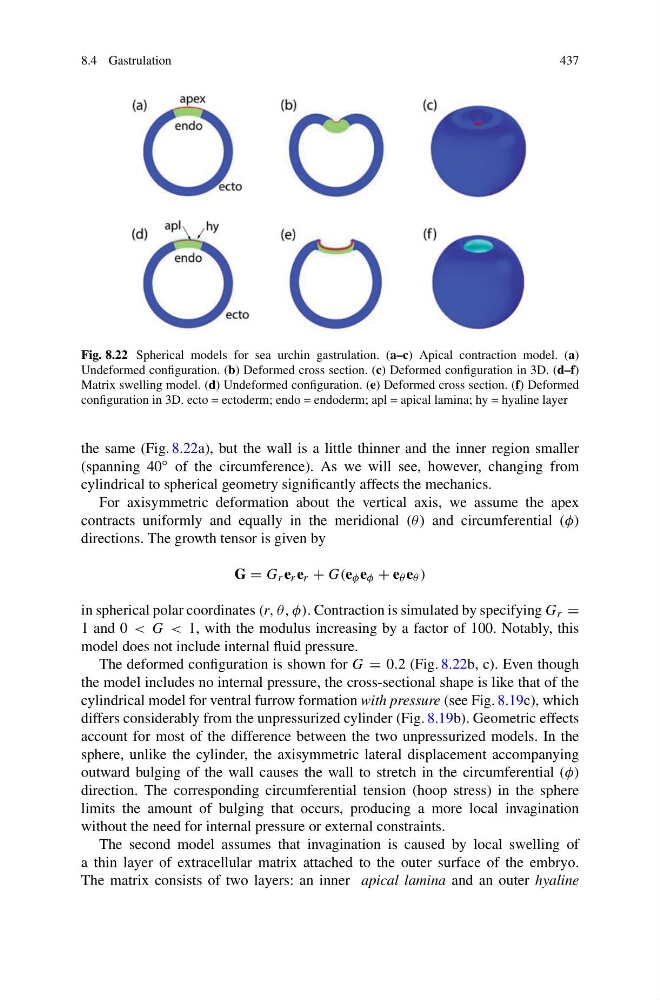
Fig. 8.22 Spherical models for sea urchin gastrulation. (a–c) Apical contraction model. (a)
Undeformed configuration. (b) Deformed cross section. (c) Deformed configuration in 3D. (d–f)
Matrix swelling model. (d) Undeformed configuration. (e) Deformed cross section. (f) Deformed
configuration in 3D. ecto = ectoderm; endo = endoderm; apl = apical lamina; hy = hyaline layer
the same (Fig. 8.22a), but the wall is a little thinner and the inner region smaller
(spanning 40 ◦ of the circumference). As we will see, however, changing from
cylindrical to spherical geometry significantly affects the mechanics.
For axisymmetric deformation about the vertical axis, we assume the apex
contracts uniformly and equally in the meridional (θ ) and circumferential (φ)
directions. The growth tensor is given by
G = G r e r e r + G(e φ e φ + e θ e θ )
in spherical polar coordinates (r, θ, φ). Contraction is simulated by specifying G r =
1 and 0 < G < 1, with the modulus increasing by a factor of 100. Notably, this
model does not include internal fluid pressure.
The deformed configuration is shown for G = 0.2 (Fig. 8.22b, c). Even though
the model includes no internal pressure, the cross-sectional shape is like that of the
cylindrical model for ventral furrow formation with pressure (see Fig. 8.19c), which
differs considerably from the unpressurized cylinder (Fig. 8.19b). Geometric effects
account for most of the difference between the two unpressurized models. In the
sphere, unlike the cylinder, the axisymmetric lateral displacement accompanying
outward bulging of the wall causes the wall to stretch in the circumferential (φ)
direction. The corresponding circumferential tension (hoop stress) in the sphere
limits the amount of bulging that occurs, producing a more local invagination
without the need for internal pressure or external constraints.
The second model assumes that invagination is caused by local swelling of
a thin layer of extracellular matrix attached to the outer surface of the embryo.
The matrix consists of two layers: an inner apical lamina and an outer hyaline
437
Fig. 8.22 Spherical models for sea urchin gastrulation. (a–c) Apical contraction model. (a)
Undeformed configuration. (b) Deformed cross section. (c) Deformed configuration in 3D. (d–f)
Matrix swelling model. (d) Undeformed configuration. (e) Deformed cross section. (f) Deformed
configuration in 3D. ecto = ectoderm; endo = endoderm; apl = apical lamina; hy = hyaline layer
the same (Fig. 8.22a), but the wall is a little thinner and the inner region smaller
(spanning 40 ◦ of the circumference). As we will see, however, changing from
cylindrical to spherical geometry significantly affects the mechanics.
For axisymmetric deformation about the vertical axis, we assume the apex
contracts uniformly and equally in the meridional (θ ) and circumferential (φ)
directions. The growth tensor is given by
G = G r e r e r + G(e φ e φ + e θ e θ )
in spherical polar coordinates (r, θ, φ). Contraction is simulated by specifying G r =
1 and 0 < G < 1, with the modulus increasing by a factor of 100. Notably, this
model does not include internal fluid pressure.
The deformed configuration is shown for G = 0.2 (Fig. 8.22b, c). Even though
the model includes no internal pressure, the cross-sectional shape is like that of the
cylindrical model for ventral furrow formation with pressure (see Fig. 8.19c), which
differs considerably from the unpressurized cylinder (Fig. 8.19b). Geometric effects
account for most of the difference between the two unpressurized models. In the
sphere, unlike the cylinder, the axisymmetric lateral displacement accompanying
outward bulging of the wall causes the wall to stretch in the circumferential (φ)
direction. The corresponding circumferential tension (hoop stress) in the sphere
limits the amount of bulging that occurs, producing a more local invagination
without the need for internal pressure or external constraints.
The second model assumes that invagination is caused by local swelling of
a thin layer of extracellular matrix attached to the outer surface of the embryo.
The matrix consists of two layers: an inner apical lamina and an outer hyaline