

434
8 Morphogenesis
8.4.2 Gastrulation in Drosophila
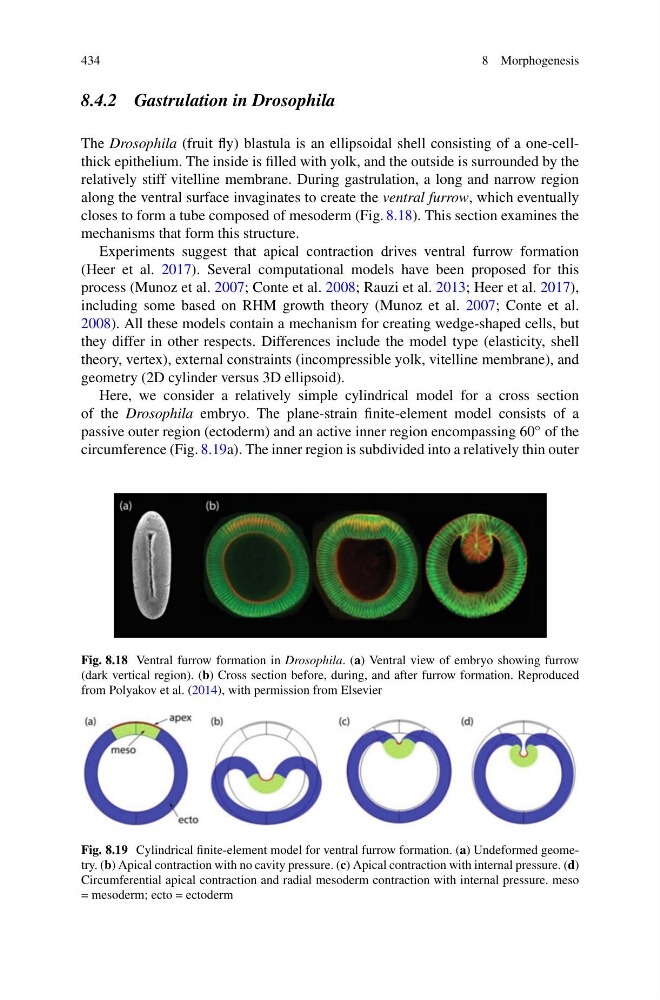
The Drosophila (fruit fly) blastula is an ellipsoidal shell consisting of a one-cellthick epithelium. The inside is filled with yolk, and the outside is surrounded by the
relatively stiff vitelline membrane. During gastrulation, a long and narrow region
along the ventral surface invaginates to create the ventral furrow, which eventually
closes to form a tube composed of mesoderm (Fig. 8.18). This section examines the
mechanisms that form this structure.
Experiments suggest that apical contraction drives ventral furrow formation
(Heer et al. 2017). Several computational models have been proposed for this
process (Munoz et al. 2007; Conte et al. 2008; Rauzi et al. 2013; Heer et al. 2017),
including some based on RHM growth theory (Munoz et al. 2007; Conte et al.
2008). All these models contain a mechanism for creating wedge-shaped cells, but
they differ in other respects. Differences include the model type (elasticity, shell
theory, vertex), external constraints (incompressible yolk, vitelline membrane), and
geometry (2D cylinder versus 3D ellipsoid).
Here, we consider a relatively simple cylindrical model for a cross section
of the Drosophila embryo. The plane-strain finite-element model consists of a
passive outer region (ectoderm) and an active inner region encompassing 60 ◦ of the
circumference (Fig. 8.19a). The inner region is subdivided into a relatively thin outer
Fig. 8.18 Ventral furrow formation in Drosophila. (a) Ventral view of embryo showing furrow
(dark vertical region). (b) Cross section before, during, and after furrow formation. Reproduced
from Polyakov et al. (2014), with permission from Elsevier
Fig. 8.19 Cylindrical finite-element model for ventral furrow formation. (a) Undeformed geometry. (b) Apical contraction with no cavity pressure. (c) Apical contraction with internal pressure. (d)
Circumferential apical contraction and radial mesoderm contraction with internal pressure. meso
= mesoderm; ecto = ectoderm
8 Morphogenesis
8.4.2 Gastrulation in Drosophila
The Drosophila (fruit fly) blastula is an ellipsoidal shell consisting of a one-cellthick epithelium. The inside is filled with yolk, and the outside is surrounded by the
relatively stiff vitelline membrane. During gastrulation, a long and narrow region
along the ventral surface invaginates to create the ventral furrow, which eventually
closes to form a tube composed of mesoderm (Fig. 8.18). This section examines the
mechanisms that form this structure.
Experiments suggest that apical contraction drives ventral furrow formation
(Heer et al. 2017). Several computational models have been proposed for this
process (Munoz et al. 2007; Conte et al. 2008; Rauzi et al. 2013; Heer et al. 2017),
including some based on RHM growth theory (Munoz et al. 2007; Conte et al.
2008). All these models contain a mechanism for creating wedge-shaped cells, but
they differ in other respects. Differences include the model type (elasticity, shell
theory, vertex), external constraints (incompressible yolk, vitelline membrane), and
geometry (2D cylinder versus 3D ellipsoid).
Here, we consider a relatively simple cylindrical model for a cross section
of the Drosophila embryo. The plane-strain finite-element model consists of a
passive outer region (ectoderm) and an active inner region encompassing 60 ◦ of the
circumference (Fig. 8.19a). The inner region is subdivided into a relatively thin outer
Fig. 8.18 Ventral furrow formation in Drosophila. (a) Ventral view of embryo showing furrow
(dark vertical region). (b) Cross section before, during, and after furrow formation. Reproduced
from Polyakov et al. (2014), with permission from Elsevier
Fig. 8.19 Cylindrical finite-element model for ventral furrow formation. (a) Undeformed geometry. (b) Apical contraction with no cavity pressure. (c) Apical contraction with internal pressure. (d)
Circumferential apical contraction and radial mesoderm contraction with internal pressure. meso
= mesoderm; ecto = ectoderm