

8.4 Gastrulation
433
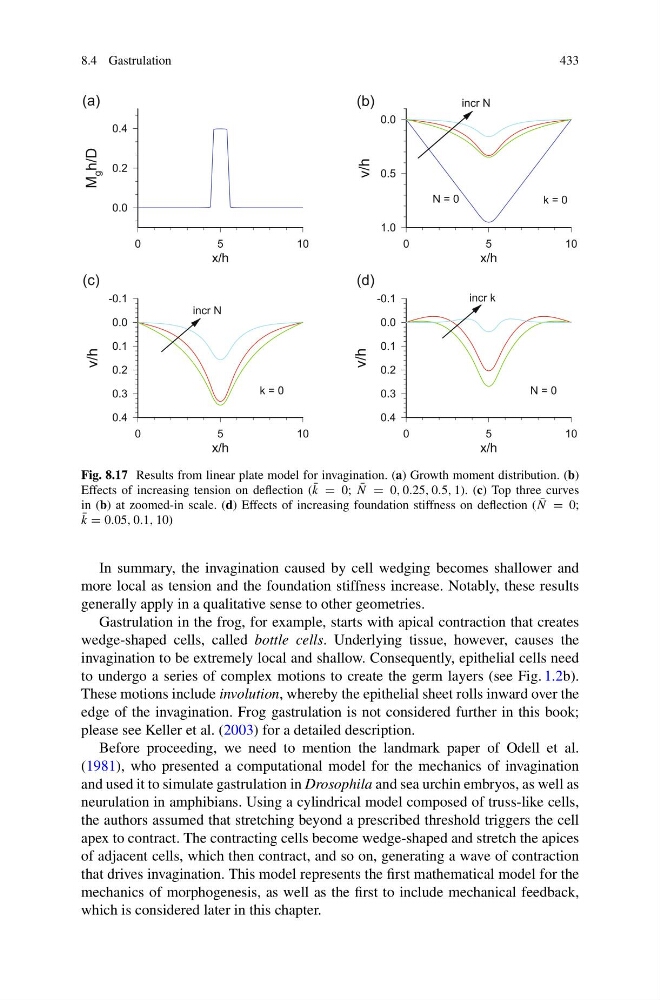
Fig. 8.17 Results from linear plate model for invagination. (a) Growth moment distribution. (b)
Effects of increasing tension on deflection ( ¯
k = 0; ¯
N = 0, 0.25, 0.5, 1). (c) Top three curves
in (b) at zoomed-in scale. (d) Effects of increasing foundation stiffness on deflection ( ¯
N = 0;
¯
k = 0.05, 0.1, 10)
In summary, the invagination caused by cell wedging becomes shallower and
more local as tension and the foundation stiffness increase. Notably, these results
generally apply in a qualitative sense to other geometries.
Gastrulation in the frog, for example, starts with apical contraction that creates
wedge-shaped cells, called bottle cells. Underlying tissue, however, causes the
invagination to be extremely local and shallow. Consequently, epithelial cells need
to undergo a series of complex motions to create the germ layers (see Fig. 1.2b).
These motions include involution, whereby the epithelial sheet rolls inward over the
edge of the invagination. Frog gastrulation is not considered further in this book;
please see Keller et al. (2003) for a detailed description.
Before proceeding, we need to mention the landmark paper of Odell et al.
(1981), who presented a computational model for the mechanics of invagination
and used it to simulate gastrulation in Drosophila and sea urchin embryos, as well as
neurulation in amphibians. Using a cylindrical model composed of truss-like cells,
the authors assumed that stretching beyond a prescribed threshold triggers the cell
apex to contract. The contracting cells become wedge-shaped and stretch the apices
of adjacent cells, which then contract, and so on, generating a wave of contraction
that drives invagination. This model represents the first mathematical model for the
mechanics of morphogenesis, as well as the first to include mechanical feedback,
which is considered later in this chapter.
433
Fig. 8.17 Results from linear plate model for invagination. (a) Growth moment distribution. (b)
Effects of increasing tension on deflection ( ¯
k = 0; ¯
N = 0, 0.25, 0.5, 1). (c) Top three curves
in (b) at zoomed-in scale. (d) Effects of increasing foundation stiffness on deflection ( ¯
N = 0;
¯
k = 0.05, 0.1, 10)
In summary, the invagination caused by cell wedging becomes shallower and
more local as tension and the foundation stiffness increase. Notably, these results
generally apply in a qualitative sense to other geometries.
Gastrulation in the frog, for example, starts with apical contraction that creates
wedge-shaped cells, called bottle cells. Underlying tissue, however, causes the
invagination to be extremely local and shallow. Consequently, epithelial cells need
to undergo a series of complex motions to create the germ layers (see Fig. 1.2b).
These motions include involution, whereby the epithelial sheet rolls inward over the
edge of the invagination. Frog gastrulation is not considered further in this book;
please see Keller et al. (2003) for a detailed description.
Before proceeding, we need to mention the landmark paper of Odell et al.
(1981), who presented a computational model for the mechanics of invagination
and used it to simulate gastrulation in Drosophila and sea urchin embryos, as well as
neurulation in amphibians. Using a cylindrical model composed of truss-like cells,
the authors assumed that stretching beyond a prescribed threshold triggers the cell
apex to contract. The contracting cells become wedge-shaped and stretch the apices
of adjacent cells, which then contract, and so on, generating a wave of contraction
that drives invagination. This model represents the first mathematical model for the
mechanics of morphogenesis, as well as the first to include mechanical feedback,
which is considered later in this chapter.