

406
8 Morphogenesis
Apex contracts
Contractile fibers
Epithelium shortens/
matrix expands
(a)
(b)
Basement membrane (matrix)
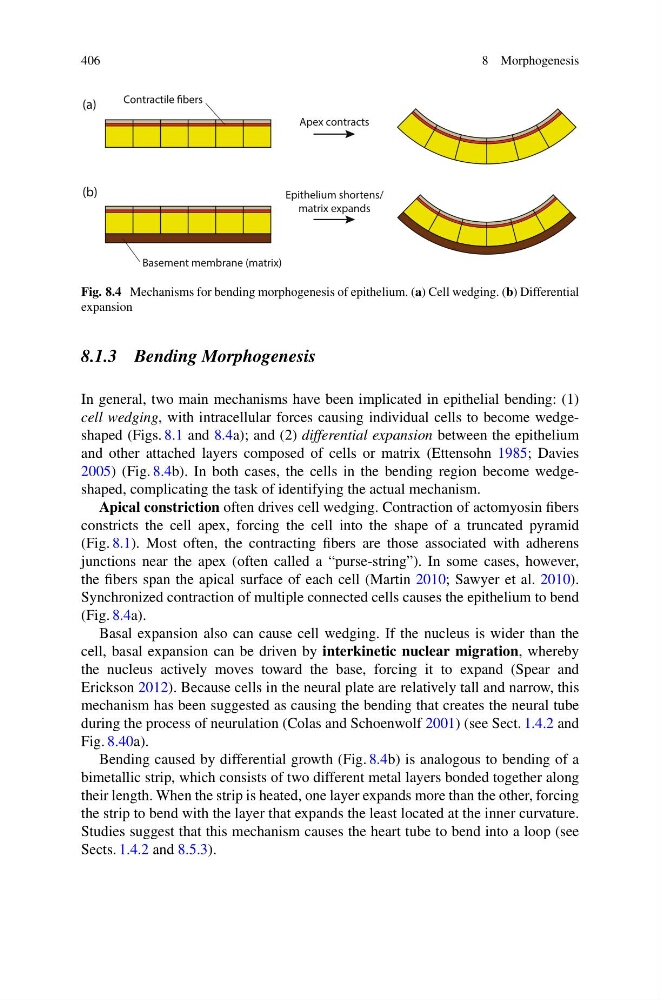
Fig. 8.4 Mechanisms for bending morphogenesis of epithelium. (a) Cell wedging. (b) Differential
expansion
8.1.3 Bending Morphogenesis
In general, two main mechanisms have been implicated in epithelial bending: (1)
cell wedging, with intracellular forces causing individual cells to become wedgeshaped (Figs. 8.1 and 8.4a); and (2) differential expansion between the epithelium
and other attached layers composed of cells or matrix (Ettensohn 1985; Davies
2005) (Fig. 8.4b). In both cases, the cells in the bending region become wedgeshaped, complicating the task of identifying the actual mechanism.
Apical constriction often drives cell wedging. Contraction of actomyosin fibers
constricts the cell apex, forcing the cell into the shape of a truncated pyramid
(Fig. 8.1). Most often, the contracting fibers are those associated with adherens
junctions near the apex (often called a “purse-string”). In some cases, however,
the fibers span the apical surface of each cell (Martin 2010; Sawyer et al. 2010).
Synchronized contraction of multiple connected cells causes the epithelium to bend
(Fig. 8.4a).
Basal expansion also can cause cell wedging. If the nucleus is wider than the
cell, basal expansion can be driven by interkinetic nuclear migration, whereby
the nucleus actively moves toward the base, forcing it to expand (Spear and
Erickson 2012). Because cells in the neural plate are relatively tall and narrow, this
mechanism has been suggested as causing the bending that creates the neural tube
during the process of neurulation (Colas and Schoenwolf 2001) (see Sect. 1.4.2 and
Fig. 8.40a).
Bending caused by differential growth (Fig. 8.4b) is analogous to bending of a
bimetallic strip, which consists of two different metal layers bonded together along
their length. When the strip is heated, one layer expands more than the other, forcing
the strip to bend with the layer that expands the least located at the inner curvature.
Studies suggest that this mechanism causes the heart tube to bend into a loop (see
Sects. 1.4.2 and 8.5.3).
8 Morphogenesis
Apex contracts
Contractile fibers
Epithelium shortens/
matrix expands
(a)
(b)
Basement membrane (matrix)
Fig. 8.4 Mechanisms for bending morphogenesis of epithelium. (a) Cell wedging. (b) Differential
expansion
8.1.3 Bending Morphogenesis
In general, two main mechanisms have been implicated in epithelial bending: (1)
cell wedging, with intracellular forces causing individual cells to become wedgeshaped (Figs. 8.1 and 8.4a); and (2) differential expansion between the epithelium
and other attached layers composed of cells or matrix (Ettensohn 1985; Davies
2005) (Fig. 8.4b). In both cases, the cells in the bending region become wedgeshaped, complicating the task of identifying the actual mechanism.
Apical constriction often drives cell wedging. Contraction of actomyosin fibers
constricts the cell apex, forcing the cell into the shape of a truncated pyramid
(Fig. 8.1). Most often, the contracting fibers are those associated with adherens
junctions near the apex (often called a “purse-string”). In some cases, however,
the fibers span the apical surface of each cell (Martin 2010; Sawyer et al. 2010).
Synchronized contraction of multiple connected cells causes the epithelium to bend
(Fig. 8.4a).
Basal expansion also can cause cell wedging. If the nucleus is wider than the
cell, basal expansion can be driven by interkinetic nuclear migration, whereby
the nucleus actively moves toward the base, forcing it to expand (Spear and
Erickson 2012). Because cells in the neural plate are relatively tall and narrow, this
mechanism has been suggested as causing the bending that creates the neural tube
during the process of neurulation (Colas and Schoenwolf 2001) (see Sect. 1.4.2 and
Fig. 8.40a).
Bending caused by differential growth (Fig. 8.4b) is analogous to bending of a
bimetallic strip, which consists of two different metal layers bonded together along
their length. When the strip is heated, one layer expands more than the other, forcing
the strip to bend with the layer that expands the least located at the inner curvature.
Studies suggest that this mechanism causes the heart tube to bend into a loop (see
Sects. 1.4.2 and 8.5.3).