

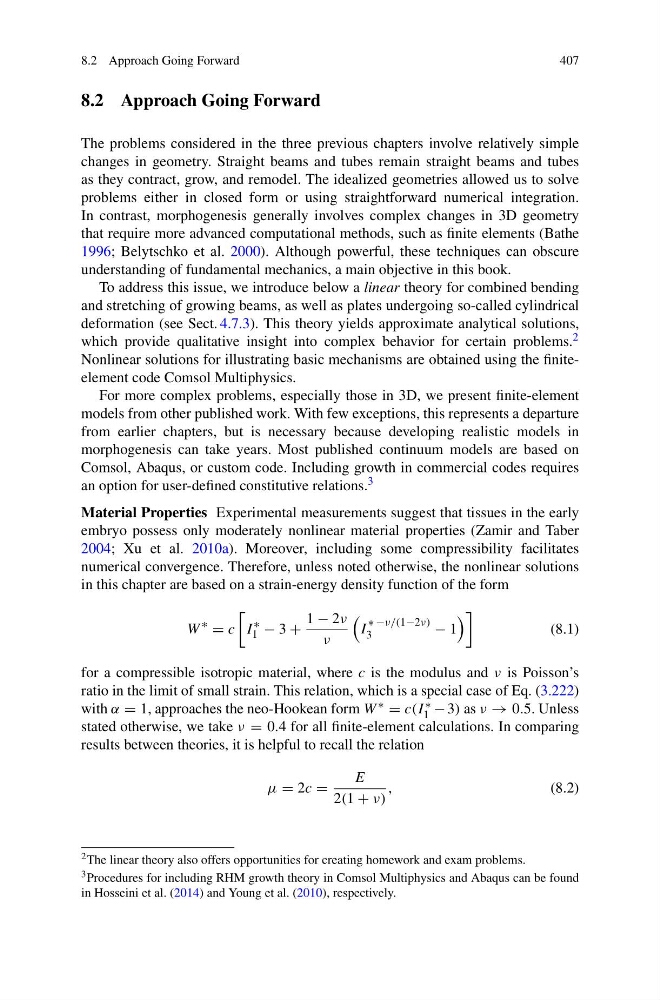
8.2 Approach Going Forward
407
8.2 Approach Going Forward
The problems considered in the three previous chapters involve relatively simple
changes in geometry. Straight beams and tubes remain straight beams and tubes
as they contract, grow, and remodel. The idealized geometries allowed us to solve
problems either in closed form or using straightforward numerical integration.
In contrast, morphogenesis generally involves complex changes in 3D geometry
that require more advanced computational methods, such as finite elements (Bathe
1996; Belytschko et al. 2000). Although powerful, these techniques can obscure
understanding of fundamental mechanics, a main objective in this book.
To address this issue, we introduce below a linear theory for combined bending
and stretching of growing beams, as well as plates undergoing so-called cylindrical
deformation (see Sect. 4.7.3). This theory yields approximate analytical solutions,
which provide qualitative insight into complex behavior for certain problems. 2
Nonlinear solutions for illustrating basic mechanisms are obtained using the finiteelement code Comsol Multiphysics.
For more complex problems, especially those in 3D, we present finite-element
models from other published work. With few exceptions, this represents a departure
from earlier chapters, but is necessary because developing realistic models in
morphogenesis can take years. Most published continuum models are based on
Comsol, Abaqus, or custom code. Including growth in commercial codes requires
an option for user-defined constitutive relations. 3
Material Properties Experimental measurements suggest that tissues in the early
embryo possess only moderately nonlinear material properties (Zamir and Taber
2004; Xu et al. 2010a). Moreover, including some compressibility facilitates
numerical convergence. Therefore, unless noted otherwise, the nonlinear solutions
in this chapter are based on a strain-energy density function of the form
W
∗
= c
I
∗
1 − 3 +
1 − 2ν
ν
I
∗ −ν/(1−2ν)
3
− 1
(8.1)
for a compressible isotropic material, where c is the modulus and ν is Poisson’s
ratio in the limit of small strain. This relation, which is a special case of Eq. (3.222)
with α = 1, approaches the neo-Hookean form W ∗ = c(I ∗
1 − 3) as ν → 0.5. Unless
stated otherwise, we take ν = 0.4 for all finite-element calculations. In comparing
results between theories, it is helpful to recall the relation
μ = 2c =
E
2(1 + ν)
,
(8.2)
2 The linear theory also offers opportunities for creating homework and exam problems.
3 Procedures for including RHM growth theory in Comsol Multiphysics and Abaqus can be found
in Hosseini et al. (2014) and Young et al. (2010), respectively.
407
8.2 Approach Going Forward
The problems considered in the three previous chapters involve relatively simple
changes in geometry. Straight beams and tubes remain straight beams and tubes
as they contract, grow, and remodel. The idealized geometries allowed us to solve
problems either in closed form or using straightforward numerical integration.
In contrast, morphogenesis generally involves complex changes in 3D geometry
that require more advanced computational methods, such as finite elements (Bathe
1996; Belytschko et al. 2000). Although powerful, these techniques can obscure
understanding of fundamental mechanics, a main objective in this book.
To address this issue, we introduce below a linear theory for combined bending
and stretching of growing beams, as well as plates undergoing so-called cylindrical
deformation (see Sect. 4.7.3). This theory yields approximate analytical solutions,
which provide qualitative insight into complex behavior for certain problems. 2
Nonlinear solutions for illustrating basic mechanisms are obtained using the finiteelement code Comsol Multiphysics.
For more complex problems, especially those in 3D, we present finite-element
models from other published work. With few exceptions, this represents a departure
from earlier chapters, but is necessary because developing realistic models in
morphogenesis can take years. Most published continuum models are based on
Comsol, Abaqus, or custom code. Including growth in commercial codes requires
an option for user-defined constitutive relations. 3
Material Properties Experimental measurements suggest that tissues in the early
embryo possess only moderately nonlinear material properties (Zamir and Taber
2004; Xu et al. 2010a). Moreover, including some compressibility facilitates
numerical convergence. Therefore, unless noted otherwise, the nonlinear solutions
in this chapter are based on a strain-energy density function of the form
W
∗
= c
I
∗
1 − 3 +
1 − 2ν
ν
I
∗ −ν/(1−2ν)
3
− 1
(8.1)
for a compressible isotropic material, where c is the modulus and ν is Poisson’s
ratio in the limit of small strain. This relation, which is a special case of Eq. (3.222)
with α = 1, approaches the neo-Hookean form W ∗ = c(I ∗
1 − 3) as ν → 0.5. Unless
stated otherwise, we take ν = 0.4 for all finite-element calculations. In comparing
results between theories, it is helpful to recall the relation
μ = 2c =
E
2(1 + ν)
,
(8.2)
2 The linear theory also offers opportunities for creating homework and exam problems.
3 Procedures for including RHM growth theory in Comsol Multiphysics and Abaqus can be found
in Hosseini et al. (2014) and Young et al. (2010), respectively.