

8.1 Cellular Mechanisms of Epithelial Morphogenesis
405
(a)
(b)
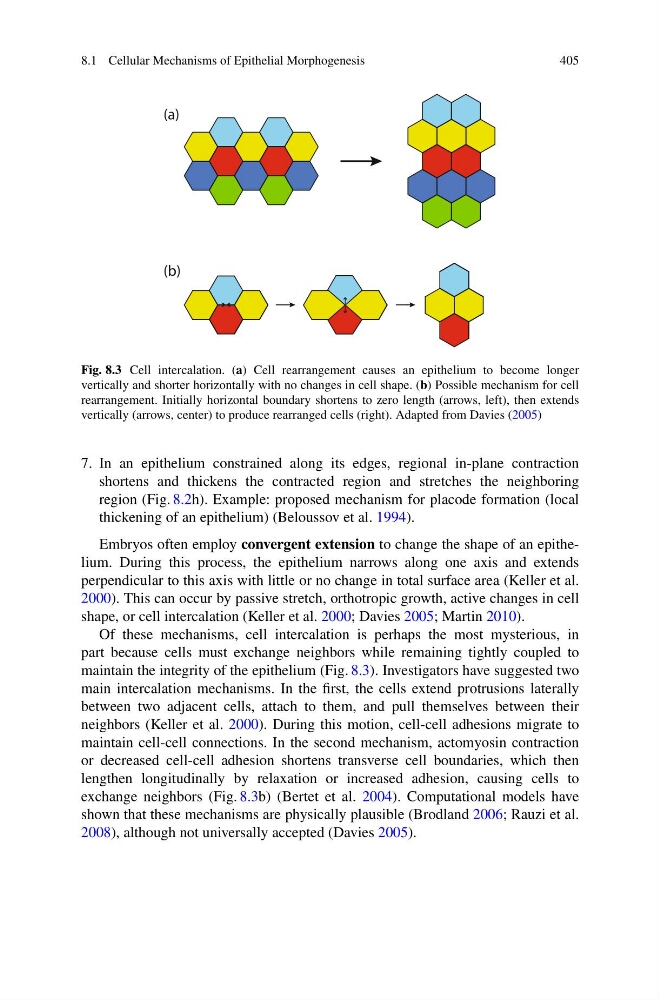
Fig. 8.3 Cell intercalation. (a) Cell rearrangement causes an epithelium to become longer
vertically and shorter horizontally with no changes in cell shape. (b) Possible mechanism for cell
rearrangement. Initially horizontal boundary shortens to zero length (arrows, left), then extends
vertically (arrows, center) to produce rearranged cells (right). Adapted from Davies (2005)
7. In an epithelium constrained along its edges, regional in-plane contraction
shortens and thickens the contracted region and stretches the neighboring
region (Fig. 8.2h). Example: proposed mechanism for placode formation (local
thickening of an epithelium) (Beloussov et al. 1994).
Embryos often employ convergent extension to change the shape of an epithelium. During this process, the epithelium narrows along one axis and extends
perpendicular to this axis with little or no change in total surface area (Keller et al.
2000). This can occur by passive stretch, orthotropic growth, active changes in cell
shape, or cell intercalation (Keller et al. 2000; Davies 2005; Martin 2010).
Of these mechanisms, cell intercalation is perhaps the most mysterious, in
part because cells must exchange neighbors while remaining tightly coupled to
maintain the integrity of the epithelium (Fig. 8.3). Investigators have suggested two
main intercalation mechanisms. In the first, the cells extend protrusions laterally
between two adjacent cells, attach to them, and pull themselves between their
neighbors (Keller et al. 2000). During this motion, cell-cell adhesions migrate to
maintain cell-cell connections. In the second mechanism, actomyosin contraction
or decreased cell-cell adhesion shortens transverse cell boundaries, which then
lengthen longitudinally by relaxation or increased adhesion, causing cells to
exchange neighbors (Fig. 8.3b) (Bertet et al. 2004). Computational models have
shown that these mechanisms are physically plausible (Brodland 2006; Rauzi et al.
2008), although not universally accepted (Davies 2005).
405
(a)
(b)
Fig. 8.3 Cell intercalation. (a) Cell rearrangement causes an epithelium to become longer
vertically and shorter horizontally with no changes in cell shape. (b) Possible mechanism for cell
rearrangement. Initially horizontal boundary shortens to zero length (arrows, left), then extends
vertically (arrows, center) to produce rearranged cells (right). Adapted from Davies (2005)
7. In an epithelium constrained along its edges, regional in-plane contraction
shortens and thickens the contracted region and stretches the neighboring
region (Fig. 8.2h). Example: proposed mechanism for placode formation (local
thickening of an epithelium) (Beloussov et al. 1994).
Embryos often employ convergent extension to change the shape of an epithelium. During this process, the epithelium narrows along one axis and extends
perpendicular to this axis with little or no change in total surface area (Keller et al.
2000). This can occur by passive stretch, orthotropic growth, active changes in cell
shape, or cell intercalation (Keller et al. 2000; Davies 2005; Martin 2010).
Of these mechanisms, cell intercalation is perhaps the most mysterious, in
part because cells must exchange neighbors while remaining tightly coupled to
maintain the integrity of the epithelium (Fig. 8.3). Investigators have suggested two
main intercalation mechanisms. In the first, the cells extend protrusions laterally
between two adjacent cells, attach to them, and pull themselves between their
neighbors (Keller et al. 2000). During this motion, cell-cell adhesions migrate to
maintain cell-cell connections. In the second mechanism, actomyosin contraction
or decreased cell-cell adhesion shortens transverse cell boundaries, which then
lengthen longitudinally by relaxation or increased adhesion, causing cells to
exchange neighbors (Fig. 8.3b) (Bertet et al. 2004). Computational models have
shown that these mechanisms are physically plausible (Brodland 2006; Rauzi et al.
2008), although not universally accepted (Davies 2005).