

404
8 Morphogenesis
- adhesion
+ adhesion
contract
contract
(a)
(b)
(c)
(d)
(e)
(f )
(g)
(h)
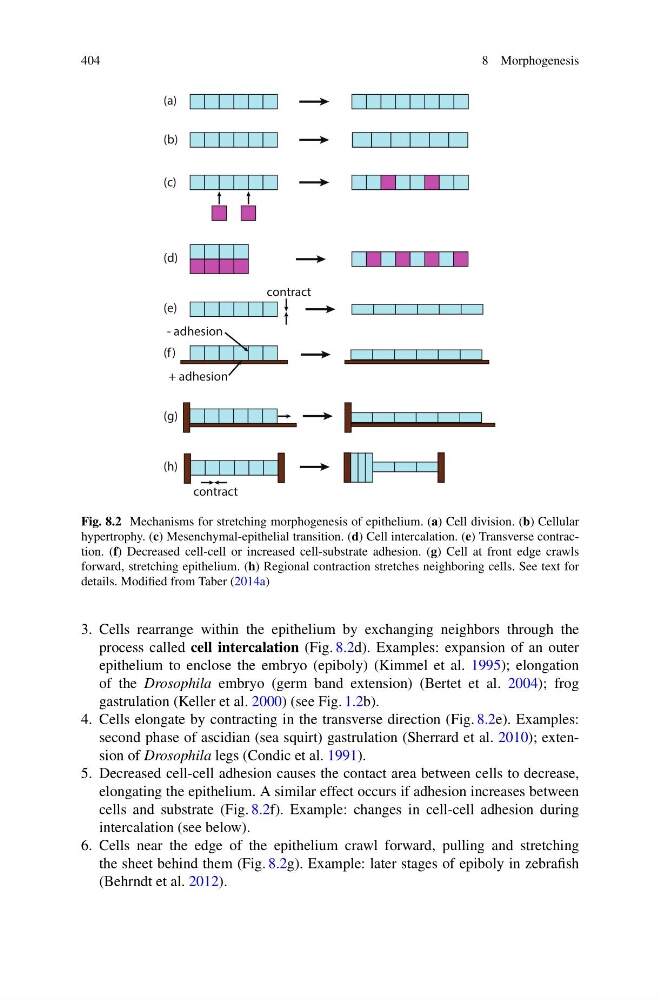
Fig. 8.2 Mechanisms for stretching morphogenesis of epithelium. (a) Cell division. (b) Cellular
hypertrophy. (c) Mesenchymal-epithelial transition. (d) Cell intercalation. (e) Transverse contraction. (f) Decreased cell-cell or increased cell-substrate adhesion. (g) Cell at front edge crawls
forward, stretching epithelium. (h) Regional contraction stretches neighboring cells. See text for
details. Modified from Taber (2014a)
3. Cells rearrange within the epithelium by exchanging neighbors through the
process called cell intercalation (Fig. 8.2d). Examples: expansion of an outer
epithelium to enclose the embryo (epiboly) (Kimmel et al. 1995); elongation
of the Drosophila embryo (germ band extension) (Bertet et al. 2004); frog
gastrulation (Keller et al. 2000) (see Fig. 1.2b).
4. Cells elongate by contracting in the transverse direction (Fig. 8.2e). Examples:
second phase of ascidian (sea squirt) gastrulation (Sherrard et al. 2010); extension of Drosophila legs (Condic et al. 1991).
5. Decreased cell-cell adhesion causes the contact area between cells to decrease,
elongating the epithelium. A similar effect occurs if adhesion increases between
cells and substrate (Fig. 8.2f). Example: changes in cell-cell adhesion during
intercalation (see below).
6. Cells near the edge of the epithelium crawl forward, pulling and stretching
the sheet behind them (Fig. 8.2g). Example: later stages of epiboly in zebrafish
(Behrndt et al. 2012).
8 Morphogenesis
- adhesion
+ adhesion
contract
contract
(a)
(b)
(c)
(d)
(e)
(f )
(g)
(h)
Fig. 8.2 Mechanisms for stretching morphogenesis of epithelium. (a) Cell division. (b) Cellular
hypertrophy. (c) Mesenchymal-epithelial transition. (d) Cell intercalation. (e) Transverse contraction. (f) Decreased cell-cell or increased cell-substrate adhesion. (g) Cell at front edge crawls
forward, stretching epithelium. (h) Regional contraction stretches neighboring cells. See text for
details. Modified from Taber (2014a)
3. Cells rearrange within the epithelium by exchanging neighbors through the
process called cell intercalation (Fig. 8.2d). Examples: expansion of an outer
epithelium to enclose the embryo (epiboly) (Kimmel et al. 1995); elongation
of the Drosophila embryo (germ band extension) (Bertet et al. 2004); frog
gastrulation (Keller et al. 2000) (see Fig. 1.2b).
4. Cells elongate by contracting in the transverse direction (Fig. 8.2e). Examples:
second phase of ascidian (sea squirt) gastrulation (Sherrard et al. 2010); extension of Drosophila legs (Condic et al. 1991).
5. Decreased cell-cell adhesion causes the contact area between cells to decrease,
elongating the epithelium. A similar effect occurs if adhesion increases between
cells and substrate (Fig. 8.2f). Example: changes in cell-cell adhesion during
intercalation (see below).
6. Cells near the edge of the epithelium crawl forward, pulling and stretching
the sheet behind them (Fig. 8.2g). Example: later stages of epiboly in zebrafish
(Behrndt et al. 2012).