

370
7 Remodeling
7.5.4 Growth and Remodeling Laws
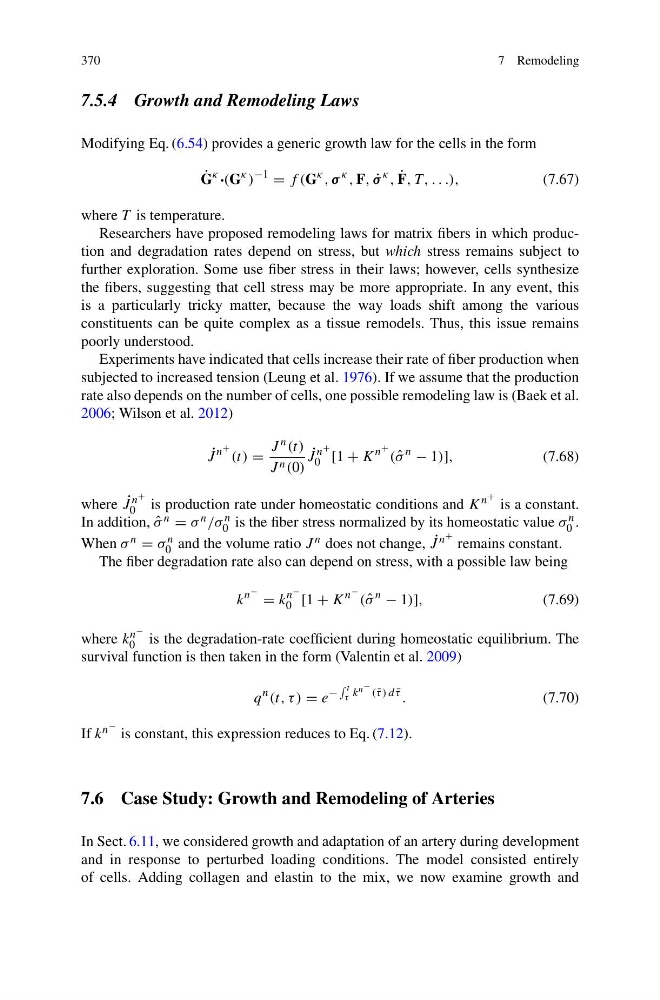
Modifying Eq. (6.54) provides a generic growth law for the cells in the form
˙
G
κ
·(G
κ )
−1
= f (G
κ , σ
κ , F, ˙
σ
κ , ˙
F, T , . . .),
(7.67)
where T is temperature.
Researchers have proposed remodeling laws for matrix fibers in which production and degradation rates depend on stress, but which stress remains subject to
further exploration. Some use fiber stress in their laws; however, cells synthesize
the fibers, suggesting that cell stress may be more appropriate. In any event, this
is a particularly tricky matter, because the way loads shift among the various
constituents can be quite complex as a tissue remodels. Thus, this issue remains
poorly understood.
Experiments have indicated that cells increase their rate of fiber production when
subjected to increased tension (Leung et al. 1976). If we assume that the production
rate also depends on the number of cells, one possible remodeling law is (Baek et al.
2006; Wilson et al. 2012)
˙
J
n + (t) =
J n (t)
J n (0)
˙
J
n +
0 [1 + K
n + ( ˆ
σ
n
− 1)],
(7.68)
where ˙
J n +
0 is production rate under homeostatic conditions and K n + is a constant.
In addition, ˆ
σ n = σ n /σ n
0 is the fiber stress normalized by its homeostatic value σ n
0 .
When σ n = σ n
0 and the volume ratio J n does not change, ˙
J n + remains constant.
The fiber degradation rate also can depend on stress, with a possible law being
k
n − = k
n −
0 [1 + K
n − ( ˆ
σ
n
− 1)],
(7.69)
where k n −
0 is the degradation-rate coefficient during homeostatic equilibrium. The
survival function is then taken in the form (Valentin et al. 2009)
q
n (t, τ ) = e
−
t
τ k n − ( ¯
τ ) d ¯
τ .
(7.70)
If k n − is constant, this expression reduces to Eq. (7.12).
7.6 Case Study: Growth and Remodeling of Arteries
In Sect. 6.11, we considered growth and adaptation of an artery during development
and in response to perturbed loading conditions. The model consisted entirely
of cells. Adding collagen and elastin to the mix, we now examine growth and
7 Remodeling
7.5.4 Growth and Remodeling Laws
Modifying Eq. (6.54) provides a generic growth law for the cells in the form
˙
G
κ
·(G
κ )
−1
= f (G
κ , σ
κ , F, ˙
σ
κ , ˙
F, T , . . .),
(7.67)
where T is temperature.
Researchers have proposed remodeling laws for matrix fibers in which production and degradation rates depend on stress, but which stress remains subject to
further exploration. Some use fiber stress in their laws; however, cells synthesize
the fibers, suggesting that cell stress may be more appropriate. In any event, this
is a particularly tricky matter, because the way loads shift among the various
constituents can be quite complex as a tissue remodels. Thus, this issue remains
poorly understood.
Experiments have indicated that cells increase their rate of fiber production when
subjected to increased tension (Leung et al. 1976). If we assume that the production
rate also depends on the number of cells, one possible remodeling law is (Baek et al.
2006; Wilson et al. 2012)
˙
J
n + (t) =
J n (t)
J n (0)
˙
J
n +
0 [1 + K
n + ( ˆ
σ
n
− 1)],
(7.68)
where ˙
J n +
0 is production rate under homeostatic conditions and K n + is a constant.
In addition, ˆ
σ n = σ n /σ n
0 is the fiber stress normalized by its homeostatic value σ n
0 .
When σ n = σ n
0 and the volume ratio J n does not change, ˙
J n + remains constant.
The fiber degradation rate also can depend on stress, with a possible law being
k
n − = k
n −
0 [1 + K
n − ( ˆ
σ
n
− 1)],
(7.69)
where k n −
0 is the degradation-rate coefficient during homeostatic equilibrium. The
survival function is then taken in the form (Valentin et al. 2009)
q
n (t, τ ) = e
−
t
τ k n − ( ¯
τ ) d ¯
τ .
(7.70)
If k n − is constant, this expression reduces to Eq. (7.12).
7.6 Case Study: Growth and Remodeling of Arteries
In Sect. 6.11, we considered growth and adaptation of an artery during development
and in response to perturbed loading conditions. The model consisted entirely
of cells. Adding collagen and elastin to the mix, we now examine growth and