

7.5 General Theory for Growth and Remodeling in 3D
369
where the second formula in Table 2.6 (page 31) has been used. In 1D, after setting
F n
0 = λ n
0 e f e f and similarly for the other tensors, the above relation reduces to
Eq. (7.20).
Since cellular growth is computed relative to the initial configuration, the elastic
deformation tensor for the cells is obtained by setting τ = 0 in (7.61). With F(0) =
F κ
0 (0) = I, we get
F κ∗ (t) = F(t)·G κ (0)·[G κ (t)] −1 .
(7.62)
If the body contains no fibers and is composed entirely of cells of one type, then
G κ (0) = I and this relation reduces to Eq. (6.48).
7.5.3 Equilibrium and Constitutive Equations
All equations in this chapter are written in terms of Cauchy stress. The equilibrium
equation is
∇ · σ + f = 0,
(7.63)
where the total stress is given by
σ = −pI +
α
σ
α .
(7.64)
Extending Eq. (7.26) to 3D yields the response functions for the partial stresses as
¯
σ
α
= F
α∗
·
∂W α∗
∂F α∗T
(7.65)
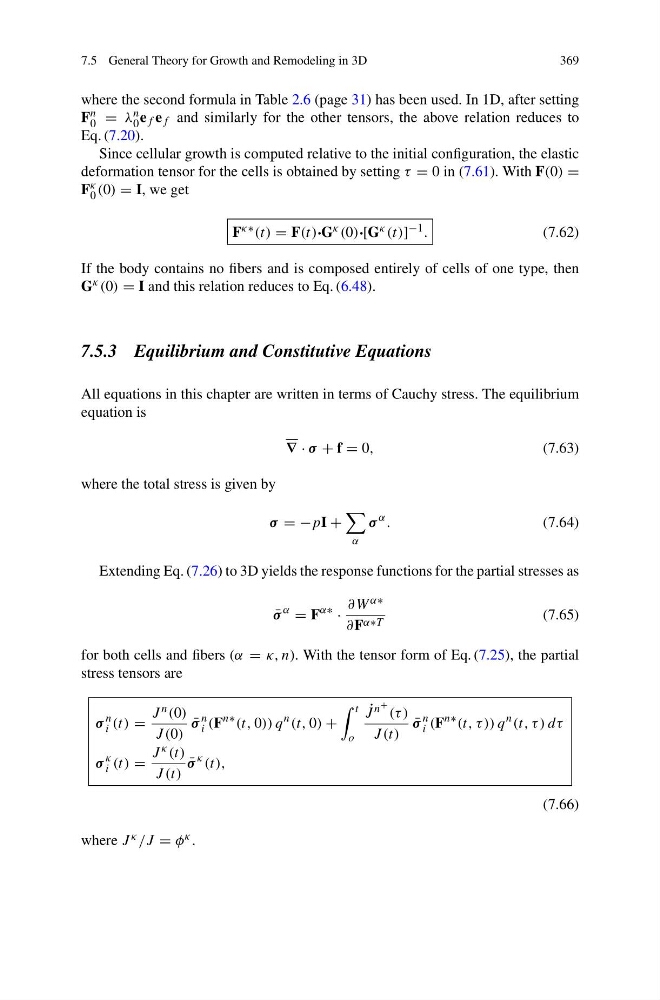
for both cells and fibers (α = κ, n). With the tensor form of Eq. (7.25), the partial
stress tensors are
σ
n
i (t) =
J n (0)
J (0)
¯
σ
n
i (F
n∗ (t, 0)) q
n (t, 0) +
t
o
˙
J n + (τ )
J (t)
¯
σ
n
i (F
n∗ (t, τ )) q
n (t, τ ) dτ
σ
κ
i (t) =
J κ (t)
J (t)
¯
σ
κ (t),
(7.66)
where J κ /J = φ κ .
369
where the second formula in Table 2.6 (page 31) has been used. In 1D, after setting
F n
0 = λ n
0 e f e f and similarly for the other tensors, the above relation reduces to
Eq. (7.20).
Since cellular growth is computed relative to the initial configuration, the elastic
deformation tensor for the cells is obtained by setting τ = 0 in (7.61). With F(0) =
F κ
0 (0) = I, we get
F κ∗ (t) = F(t)·G κ (0)·[G κ (t)] −1 .
(7.62)
If the body contains no fibers and is composed entirely of cells of one type, then
G κ (0) = I and this relation reduces to Eq. (6.48).
7.5.3 Equilibrium and Constitutive Equations
All equations in this chapter are written in terms of Cauchy stress. The equilibrium
equation is
∇ · σ + f = 0,
(7.63)
where the total stress is given by
σ = −pI +
α
σ
α .
(7.64)
Extending Eq. (7.26) to 3D yields the response functions for the partial stresses as
¯
σ
α
= F
α∗
·
∂W α∗
∂F α∗T
(7.65)
for both cells and fibers (α = κ, n). With the tensor form of Eq. (7.25), the partial
stress tensors are
σ
n
i (t) =
J n (0)
J (0)
¯
σ
n
i (F
n∗ (t, 0)) q
n (t, 0) +
t
o
˙
J n + (τ )
J (t)
¯
σ
n
i (F
n∗ (t, τ )) q
n (t, τ ) dτ
σ
κ
i (t) =
J κ (t)
J (t)
¯
σ
κ (t),
(7.66)
where J κ /J = φ κ .