

7.4 Examples: Remodeling in 1D
355
where J 0 = J (0), while k
+ and k
− are the production- and degradation-rate
coefficients, respectively.
At t = 0 − , the bar is in a homeostatic state, with both the bar and all fibers
stretched by λ x = λ 0 relative to their zero-stress states. With the homeostatic
state chosen as the reference configuration for strain, the bar then undergoes further
stretch given by
λ x (t) = ˆ
λ(1 + at),
t ≥ 0,
(7.30)
where ˆ
λ and a are constants. In other words, the bar is stretched suddenly from
λ x = 1 to λ x = ˆ
λ at t = 0 relative to the reference state, followed by continuous
deformation at a fixed rate. Determine the axial stress in the bar as a function of time
for fibers possessing the neo-Hookean strain-energy density function
W = c(I − 3)
(7.31)
and for fibers with the exponential form
W =
c
α
e
α(I −3)
− 1
,
(7.32)
where I = λ 2
x + λ 2
y + λ 2
z .
Analysis Because the bar is composed of only one type of fiber, we omit the
superscript n. Note also that the elastic deformation satisfies incompressibility
(λ ∗
x λ ∗
y λ ∗
z = 1) and symmetry (λ ∗
y = λ ∗
z ) at all times, giving λ ∗
y = λ ∗
z = λ
∗−1/2
x
.
Thus, the axial stretch ratio completely defines the elastic deformation of the bar at
any given time.
The initial step in stretch requires some thought in determining λ ∗
x (t, 0) and
λ ∗
x (t, τ ) for use in Eq. (7.28). The first term in (7.28) defines the stress in all fibers
existing at t = 0 as they subsequently stretch and degrade. Because these fibers
were created prior to this time, τ = 0 in the first term really means τ = 0 − ,
with the integral beginning at t = τ = 0. For t < 0, the bar is fixed in its
homeostatic (reference) configuration with λ x = 1 and no net growth occurring;
hence, G x (0 − ) = λ x (0 − ) = 1 and λ ∗
x (t, 0 − ) = λ 0 ˆ
λ(1 + at)/G x (t) by (7.20).
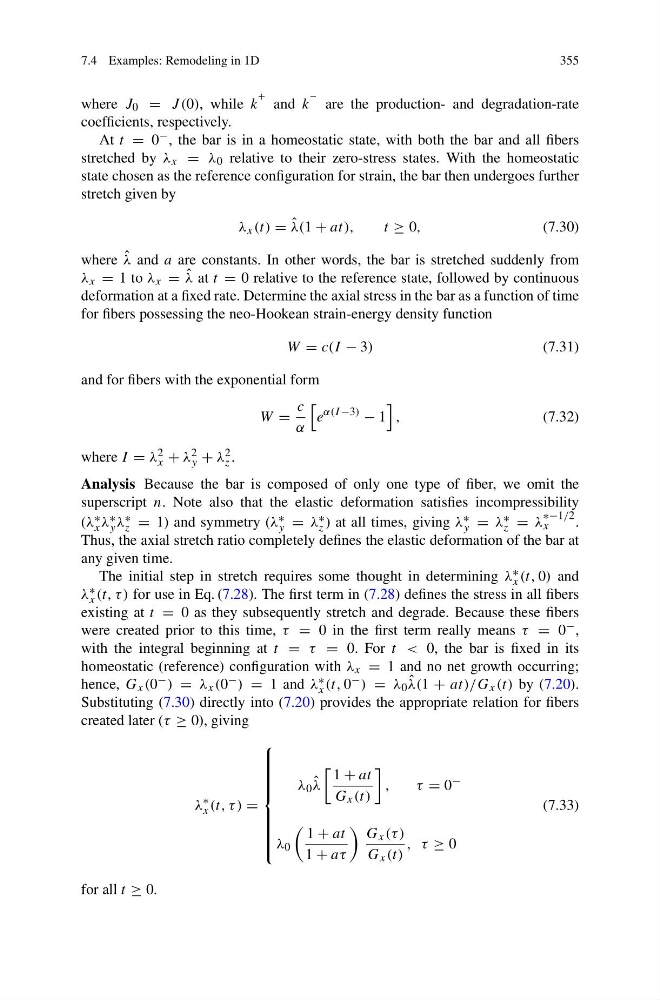
Substituting (7.30) directly into (7.20) provides the appropriate relation for fibers
created later (τ ≥ 0), giving
λ
∗
x (t, τ ) =
⎧
⎪ ⎪ ⎪ ⎪ ⎪ ⎪ ⎪ ⎨
⎪ ⎪ ⎪ ⎪ ⎪ ⎪ ⎪ ⎩
λ 0 ˆ
λ
1 + at
G x (t)
,
τ = 0 −
λ 0
1 + at
1 + aτ
G x (τ )
G x (t)
, τ ≥ 0
(7.33)
for all t ≥ 0.
355
where J 0 = J (0), while k
+ and k
− are the production- and degradation-rate
coefficients, respectively.
At t = 0 − , the bar is in a homeostatic state, with both the bar and all fibers
stretched by λ x = λ 0 relative to their zero-stress states. With the homeostatic
state chosen as the reference configuration for strain, the bar then undergoes further
stretch given by
λ x (t) = ˆ
λ(1 + at),
t ≥ 0,
(7.30)
where ˆ
λ and a are constants. In other words, the bar is stretched suddenly from
λ x = 1 to λ x = ˆ
λ at t = 0 relative to the reference state, followed by continuous
deformation at a fixed rate. Determine the axial stress in the bar as a function of time
for fibers possessing the neo-Hookean strain-energy density function
W = c(I − 3)
(7.31)
and for fibers with the exponential form
W =
c
α
e
α(I −3)
− 1
,
(7.32)
where I = λ 2
x + λ 2
y + λ 2
z .
Analysis Because the bar is composed of only one type of fiber, we omit the
superscript n. Note also that the elastic deformation satisfies incompressibility
(λ ∗
x λ ∗
y λ ∗
z = 1) and symmetry (λ ∗
y = λ ∗
z ) at all times, giving λ ∗
y = λ ∗
z = λ
∗−1/2
x
.
Thus, the axial stretch ratio completely defines the elastic deformation of the bar at
any given time.
The initial step in stretch requires some thought in determining λ ∗
x (t, 0) and
λ ∗
x (t, τ ) for use in Eq. (7.28). The first term in (7.28) defines the stress in all fibers
existing at t = 0 as they subsequently stretch and degrade. Because these fibers
were created prior to this time, τ = 0 in the first term really means τ = 0 − ,
with the integral beginning at t = τ = 0. For t < 0, the bar is fixed in its
homeostatic (reference) configuration with λ x = 1 and no net growth occurring;
hence, G x (0 − ) = λ x (0 − ) = 1 and λ ∗
x (t, 0 − ) = λ 0 ˆ
λ(1 + at)/G x (t) by (7.20).
Substituting (7.30) directly into (7.20) provides the appropriate relation for fibers
created later (τ ≥ 0), giving
λ
∗
x (t, τ ) =
⎧
⎪ ⎪ ⎪ ⎪ ⎪ ⎪ ⎪ ⎨
⎪ ⎪ ⎪ ⎪ ⎪ ⎪ ⎪ ⎩
λ 0 ˆ
λ
1 + at
G x (t)
,
τ = 0 −
λ 0
1 + at
1 + aτ
G x (τ )
G x (t)
, τ ≥ 0
(7.33)
for all t ≥ 0.