

354
7 Remodeling
σ i = −p +
N
n=1
φ
n
¯
σ
n
i ,
(7.27)
which agrees with Eqs. (5.10).
7.4 Examples: Remodeling in 1D
To help understand fundamental behavior, this section presents three problems
involving bars of tissue undergoing remodeling during uniaxial extension. The first
two examples deal with bars composed of a single family of fibers. These are
followed by a problem involving a tissue containing multiple types of constituents.
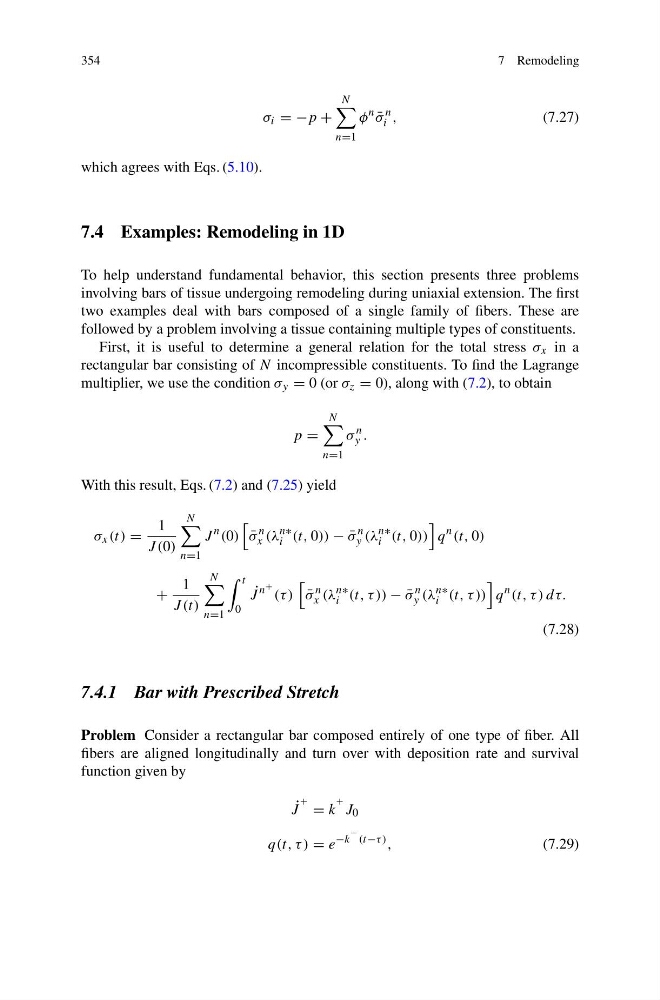
First, it is useful to determine a general relation for the total stress σ x in a
rectangular bar consisting of N incompressible constituents. To find the Lagrange
multiplier, we use the condition σ y = 0 (or σ z = 0), along with (7.2), to obtain
p =
N
n=1
σ
n
y .
With this result, Eqs. (7.2) and (7.25) yield
σ x (t) =
1
J (0)
N
n=1
J
n (0)
¯
σ
n
x (λ
n∗
i (t, 0)) − ¯
σ
n
y (λ
n∗
i (t, 0))
q
n (t, 0)
+
1
J (t)
N
n=1
t
0
˙
J
n + (τ )
¯
σ
n
x (λ
n∗
i (t, τ )) − ¯
σ
n
y (λ
n∗
i (t, τ ))
q
n (t, τ ) dτ.
(7.28)
7.4.1 Bar with Prescribed Stretch
Problem Consider a rectangular bar composed entirely of one type of fiber. All
fibers are aligned longitudinally and turn over with deposition rate and survival
function given by
˙
J
+ = k
+ J 0
q(t, τ ) = e
−k
− (t−τ ) ,
(7.29)
7 Remodeling
σ i = −p +
N
n=1
φ
n
¯
σ
n
i ,
(7.27)
which agrees with Eqs. (5.10).
7.4 Examples: Remodeling in 1D
To help understand fundamental behavior, this section presents three problems
involving bars of tissue undergoing remodeling during uniaxial extension. The first
two examples deal with bars composed of a single family of fibers. These are
followed by a problem involving a tissue containing multiple types of constituents.
First, it is useful to determine a general relation for the total stress σ x in a
rectangular bar consisting of N incompressible constituents. To find the Lagrange
multiplier, we use the condition σ y = 0 (or σ z = 0), along with (7.2), to obtain
p =
N
n=1
σ
n
y .
With this result, Eqs. (7.2) and (7.25) yield
σ x (t) =
1
J (0)
N
n=1
J
n (0)
¯
σ
n
x (λ
n∗
i (t, 0)) − ¯
σ
n
y (λ
n∗
i (t, 0))
q
n (t, 0)
+
1
J (t)
N
n=1
t
0
˙
J
n + (τ )
¯
σ
n
x (λ
n∗
i (t, τ )) − ¯
σ
n
y (λ
n∗
i (t, τ ))
q
n (t, τ ) dτ.
(7.28)
7.4.1 Bar with Prescribed Stretch
Problem Consider a rectangular bar composed entirely of one type of fiber. All
fibers are aligned longitudinally and turn over with deposition rate and survival
function given by
˙
J
+ = k
+ J 0
q(t, τ ) = e
−k
− (t−τ ) ,
(7.29)