

346
7 Remodeling
7.3 Theory for Remodeling in 1D
In Humphrey-Rajagopal remodeling theory, tissue is treated as a constrained
mixture composed of N constituents, including both cells and fibers. The following
assumptions apply to constrained mixtures:
• Each volume element contains all constituents, which are bonded together and
undergo the same deformation.
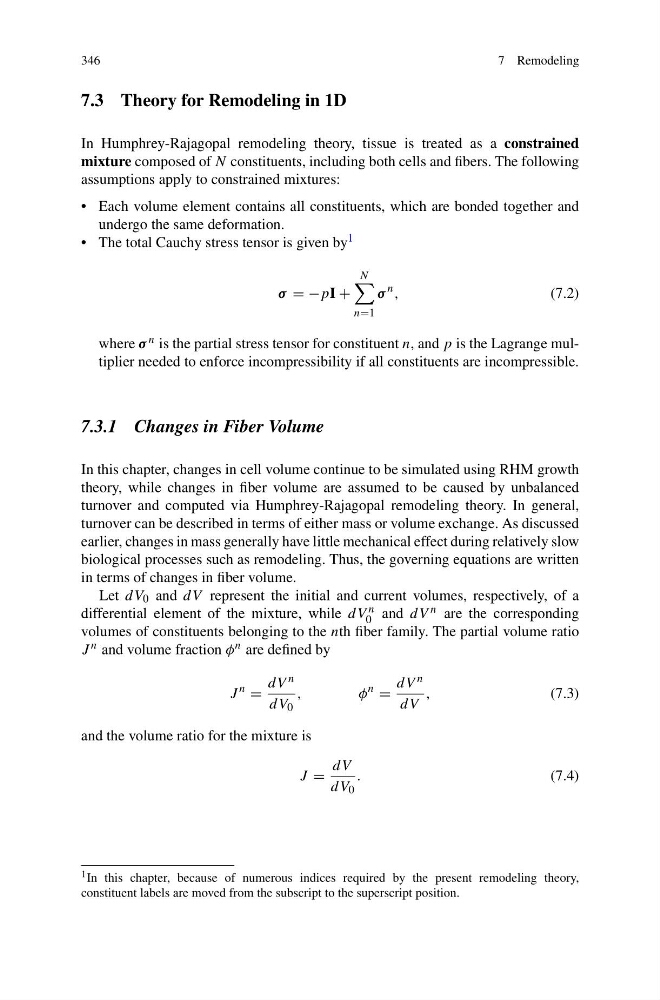
• The total Cauchy stress tensor is given by 1
σ = −pI +
N
n=1
σ
n ,
(7.2)
where σ n is the partial stress tensor for constituent n, and p is the Lagrange multiplier needed to enforce incompressibility if all constituents are incompressible.
7.3.1 Changes in Fiber Volume
In this chapter, changes in cell volume continue to be simulated using RHM growth
theory, while changes in fiber volume are assumed to be caused by unbalanced
turnover and computed via Humphrey-Rajagopal remodeling theory. In general,
turnover can be described in terms of either mass or volume exchange. As discussed
earlier, changes in mass generally have little mechanical effect during relatively slow
biological processes such as remodeling. Thus, the governing equations are written
in terms of changes in fiber volume.
Let dV 0 and dV represent the initial and current volumes, respectively, of a
differential element of the mixture, while dV n
0 and dV n are the corresponding
volumes of constituents belonging to the nth fiber family. The partial volume ratio
J n and volume fraction φ n are defined by
J
n
=
dV n
dV 0
,
φ
n
=
dV n
dV
,
(7.3)
and the volume ratio for the mixture is
J =
dV
dV 0
.
(7.4)
1 In this chapter, because of numerous indices required by the present remodeling theory,
constituent labels are moved from the subscript to the superscript position.
7 Remodeling
7.3 Theory for Remodeling in 1D
In Humphrey-Rajagopal remodeling theory, tissue is treated as a constrained
mixture composed of N constituents, including both cells and fibers. The following
assumptions apply to constrained mixtures:
• Each volume element contains all constituents, which are bonded together and
undergo the same deformation.
• The total Cauchy stress tensor is given by 1
σ = −pI +
N
n=1
σ
n ,
(7.2)
where σ n is the partial stress tensor for constituent n, and p is the Lagrange multiplier needed to enforce incompressibility if all constituents are incompressible.
7.3.1 Changes in Fiber Volume
In this chapter, changes in cell volume continue to be simulated using RHM growth
theory, while changes in fiber volume are assumed to be caused by unbalanced
turnover and computed via Humphrey-Rajagopal remodeling theory. In general,
turnover can be described in terms of either mass or volume exchange. As discussed
earlier, changes in mass generally have little mechanical effect during relatively slow
biological processes such as remodeling. Thus, the governing equations are written
in terms of changes in fiber volume.
Let dV 0 and dV represent the initial and current volumes, respectively, of a
differential element of the mixture, while dV n
0 and dV n are the corresponding
volumes of constituents belonging to the nth fiber family. The partial volume ratio
J n and volume fraction φ n are defined by
J
n
=
dV n
dV 0
,
φ
n
=
dV n
dV
,
(7.3)
and the volume ratio for the mixture is
J =
dV
dV 0
.
(7.4)
1 In this chapter, because of numerous indices required by the present remodeling theory,
constituent labels are moved from the subscript to the superscript position.