

7.3 Theory for Remodeling in 1D
347
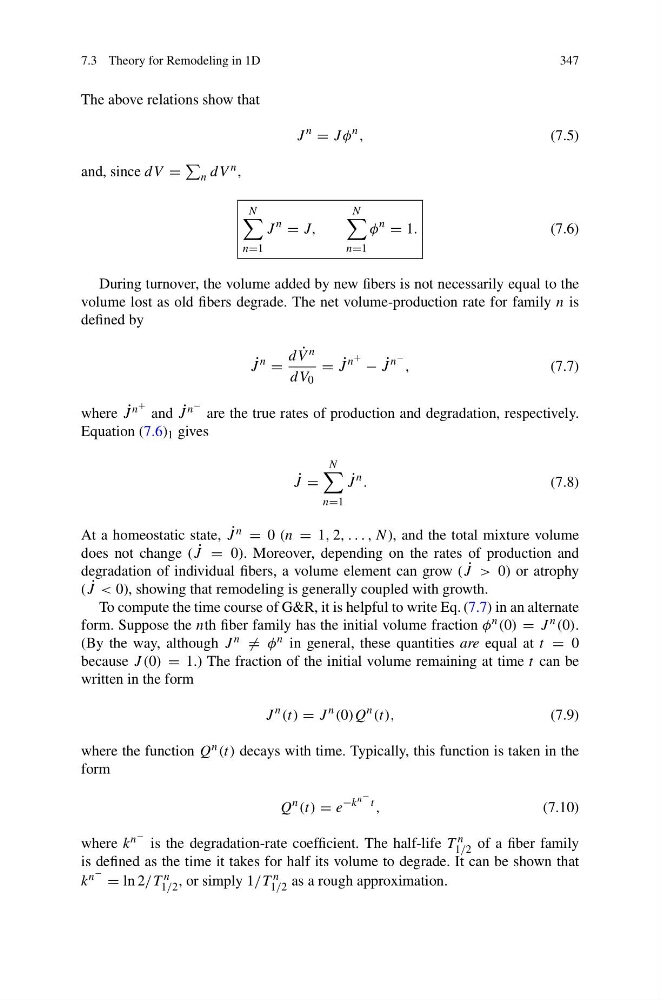
The above relations show that
J
n
= J φ
n ,
(7.5)
and, since dV =
n dV n ,
N
n=1
J
n
= J,
N
n=1
φ
n
= 1.
(7.6)
During turnover, the volume added by new fibers is not necessarily equal to the
volume lost as old fibers degrade. The net volume-production rate for family n is
defined by
˙
J
n
=
d ˙
V n
dV 0
= ˙
J
n + − ˙
J
n − ,
(7.7)
where ˙
J n + and ˙
J n − are the true rates of production and degradation, respectively.
Equation (7.6) 1 gives
˙
J =
N
n=1
˙
J
n .
(7.8)
At a homeostatic state, ˙
J n = 0 (n = 1, 2, . . . , N), and the total mixture volume
does not change ( ˙
J = 0). Moreover, depending on the rates of production and
degradation of individual fibers, a volume element can grow ( ˙
J > 0) or atrophy
( ˙
J < 0), showing that remodeling is generally coupled with growth.
To compute the time course of G&R, it is helpful to write Eq. (7.7) in an alternate
form. Suppose the nth fiber family has the initial volume fraction φ n (0) = J n (0).
(By the way, although J n = φ n in general, these quantities are equal at t = 0
because J (0) = 1.) The fraction of the initial volume remaining at time t can be
written in the form
J
n (t) = J
n (0)Q
n (t),
(7.9)
where the function Q n (t) decays with time. Typically, this function is taken in the
form
Q
n (t) = e
−k n − t ,
(7.10)
where k n − is the degradation-rate coefficient. The half-life T n
1/2 of a fiber family
is defined as the time it takes for half its volume to degrade. It can be shown that
k n − = ln 2/T n
1/2 , or simply 1/T n
1/2 as a rough approximation.
347
The above relations show that
J
n
= J φ
n ,
(7.5)
and, since dV =
n dV n ,
N
n=1
J
n
= J,
N
n=1
φ
n
= 1.
(7.6)
During turnover, the volume added by new fibers is not necessarily equal to the
volume lost as old fibers degrade. The net volume-production rate for family n is
defined by
˙
J
n
=
d ˙
V n
dV 0
= ˙
J
n + − ˙
J
n − ,
(7.7)
where ˙
J n + and ˙
J n − are the true rates of production and degradation, respectively.
Equation (7.6) 1 gives
˙
J =
N
n=1
˙
J
n .
(7.8)
At a homeostatic state, ˙
J n = 0 (n = 1, 2, . . . , N), and the total mixture volume
does not change ( ˙
J = 0). Moreover, depending on the rates of production and
degradation of individual fibers, a volume element can grow ( ˙
J > 0) or atrophy
( ˙
J < 0), showing that remodeling is generally coupled with growth.
To compute the time course of G&R, it is helpful to write Eq. (7.7) in an alternate
form. Suppose the nth fiber family has the initial volume fraction φ n (0) = J n (0).
(By the way, although J n = φ n in general, these quantities are equal at t = 0
because J (0) = 1.) The fraction of the initial volume remaining at time t can be
written in the form
J
n (t) = J
n (0)Q
n (t),
(7.9)
where the function Q n (t) decays with time. Typically, this function is taken in the
form
Q
n (t) = e
−k n − t ,
(7.10)
where k n − is the degradation-rate coefficient. The half-life T n
1/2 of a fiber family
is defined as the time it takes for half its volume to degrade. It can be shown that
k n − = ln 2/T n
1/2 , or simply 1/T n
1/2 as a rough approximation.