

7.2 Fundamental Remodeling Mechanics
345
σ = 0, λ* =1
load to
homeostatic stress
stretch (λ1 /λ0)
σ = σ0, λ* = λ0
σ = σ0, λ* = λ0
G = λ1 /λ0
σ = 0, λ* = 1
grow
unload
remodel (turnover)
λ0
λ1
G
λ0
A
B
C
D
E
σ > σ0, λ* > λ0
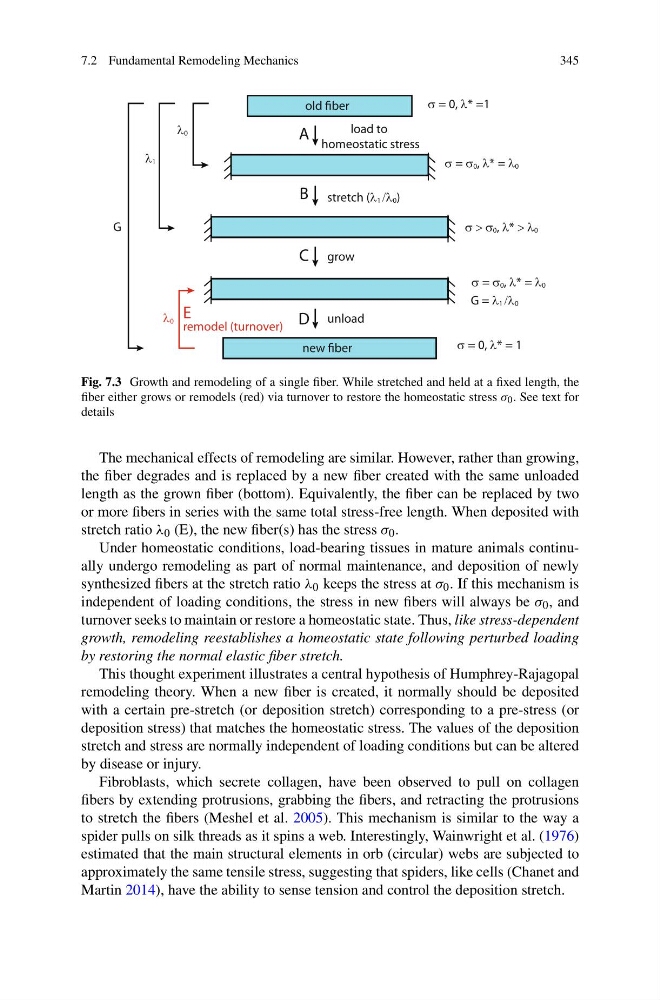
Fig. 7.3 Growth and remodeling of a single fiber. While stretched and held at a fixed length, the
fiber either grows or remodels (red) via turnover to restore the homeostatic stress σ 0 . See text for
details
The mechanical effects of remodeling are similar. However, rather than growing,
the fiber degrades and is replaced by a new fiber created with the same unloaded
length as the grown fiber (bottom). Equivalently, the fiber can be replaced by two
or more fibers in series with the same total stress-free length. When deposited with
stretch ratio λ 0 (E), the new fiber(s) has the stress σ 0 .
Under homeostatic conditions, load-bearing tissues in mature animals continually undergo remodeling as part of normal maintenance, and deposition of newly
synthesized fibers at the stretch ratio λ 0 keeps the stress at σ 0 . If this mechanism is
independent of loading conditions, the stress in new fibers will always be σ 0 , and
turnover seeks to maintain or restore a homeostatic state. Thus, like stress-dependent
growth, remodeling reestablishes a homeostatic state following perturbed loading
by restoring the normal elastic fiber stretch.
This thought experiment illustrates a central hypothesis of Humphrey-Rajagopal
remodeling theory. When a new fiber is created, it normally should be deposited
with a certain pre-stretch (or deposition stretch) corresponding to a pre-stress (or
deposition stress) that matches the homeostatic stress. The values of the deposition
stretch and stress are normally independent of loading conditions but can be altered
by disease or injury.
Fibroblasts, which secrete collagen, have been observed to pull on collagen
fibers by extending protrusions, grabbing the fibers, and retracting the protrusions
to stretch the fibers (Meshel et al. 2005). This mechanism is similar to the way a
spider pulls on silk threads as it spins a web. Interestingly, Wainwright et al. (1976)
estimated that the main structural elements in orb (circular) webs are subjected to
approximately the same tensile stress, suggesting that spiders, like cells (Chanet and
Martin 2014), have the ability to sense tension and control the deposition stretch.
345
σ = 0, λ* =1
load to
homeostatic stress
stretch (λ1 /λ0)
σ = σ0, λ* = λ0
σ = σ0, λ* = λ0
G = λ1 /λ0
σ = 0, λ* = 1
grow
unload
remodel (turnover)
λ0
λ1
G
λ0
A
B
C
D
E
σ > σ0, λ* > λ0
Fig. 7.3 Growth and remodeling of a single fiber. While stretched and held at a fixed length, the
fiber either grows or remodels (red) via turnover to restore the homeostatic stress σ 0 . See text for
details
The mechanical effects of remodeling are similar. However, rather than growing,
the fiber degrades and is replaced by a new fiber created with the same unloaded
length as the grown fiber (bottom). Equivalently, the fiber can be replaced by two
or more fibers in series with the same total stress-free length. When deposited with
stretch ratio λ 0 (E), the new fiber(s) has the stress σ 0 .
Under homeostatic conditions, load-bearing tissues in mature animals continually undergo remodeling as part of normal maintenance, and deposition of newly
synthesized fibers at the stretch ratio λ 0 keeps the stress at σ 0 . If this mechanism is
independent of loading conditions, the stress in new fibers will always be σ 0 , and
turnover seeks to maintain or restore a homeostatic state. Thus, like stress-dependent
growth, remodeling reestablishes a homeostatic state following perturbed loading
by restoring the normal elastic fiber stretch.
This thought experiment illustrates a central hypothesis of Humphrey-Rajagopal
remodeling theory. When a new fiber is created, it normally should be deposited
with a certain pre-stretch (or deposition stretch) corresponding to a pre-stress (or
deposition stress) that matches the homeostatic stress. The values of the deposition
stretch and stress are normally independent of loading conditions but can be altered
by disease or injury.
Fibroblasts, which secrete collagen, have been observed to pull on collagen
fibers by extending protrusions, grabbing the fibers, and retracting the protrusions
to stretch the fibers (Meshel et al. 2005). This mechanism is similar to the way a
spider pulls on silk threads as it spins a web. Interestingly, Wainwright et al. (1976)
estimated that the main structural elements in orb (circular) webs are subjected to
approximately the same tensile stress, suggesting that spiders, like cells (Chanet and
Martin 2014), have the ability to sense tension and control the deposition stretch.