

6.11 Case Study: Functional Adaptation in Arteries
331
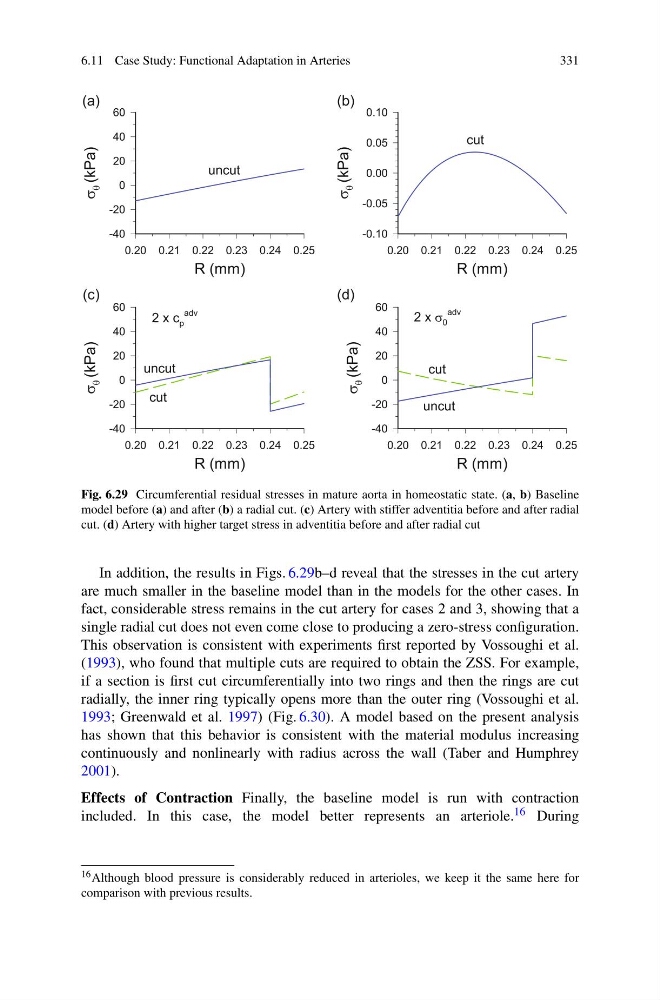
Fig. 6.29 Circumferential residual stresses in mature aorta in homeostatic state. (a, b) Baseline
model before (a) and after (b) a radial cut. (c) Artery with stiffer adventitia before and after radial
cut. (d) Artery with higher target stress in adventitia before and after radial cut
In addition, the results in Figs. 6.29b–d reveal that the stresses in the cut artery
are much smaller in the baseline model than in the models for the other cases. In
fact, considerable stress remains in the cut artery for cases 2 and 3, showing that a
single radial cut does not even come close to producing a zero-stress configuration.
This observation is consistent with experiments first reported by Vossoughi et al.
(1993), who found that multiple cuts are required to obtain the ZSS. For example,
if a section is first cut circumferentially into two rings and then the rings are cut
radially, the inner ring typically opens more than the outer ring (Vossoughi et al.
1993; Greenwald et al. 1997) (Fig. 6.30). A model based on the present analysis
has shown that this behavior is consistent with the material modulus increasing
continuously and nonlinearly with radius across the wall (Taber and Humphrey
2001).
Effects of Contraction Finally, the baseline model is run with contraction
included. In this case, the model better represents an arteriole. 16 During
16 Although blood pressure is considerably reduced in arterioles, we keep it the same here for
comparison with previous results.
331
Fig. 6.29 Circumferential residual stresses in mature aorta in homeostatic state. (a, b) Baseline
model before (a) and after (b) a radial cut. (c) Artery with stiffer adventitia before and after radial
cut. (d) Artery with higher target stress in adventitia before and after radial cut
In addition, the results in Figs. 6.29b–d reveal that the stresses in the cut artery
are much smaller in the baseline model than in the models for the other cases. In
fact, considerable stress remains in the cut artery for cases 2 and 3, showing that a
single radial cut does not even come close to producing a zero-stress configuration.
This observation is consistent with experiments first reported by Vossoughi et al.
(1993), who found that multiple cuts are required to obtain the ZSS. For example,
if a section is first cut circumferentially into two rings and then the rings are cut
radially, the inner ring typically opens more than the outer ring (Vossoughi et al.
1993; Greenwald et al. 1997) (Fig. 6.30). A model based on the present analysis
has shown that this behavior is consistent with the material modulus increasing
continuously and nonlinearly with radius across the wall (Taber and Humphrey
2001).
Effects of Contraction Finally, the baseline model is run with contraction
included. In this case, the model better represents an arteriole. 16 During
16 Although blood pressure is considerably reduced in arterioles, we keep it the same here for
comparison with previous results.