

308
6 Growth
t = 0: σ P = σ P0
t > 0: σ P > σ P0
t ∞: σ P σ P0
Passive:
Active:
bone grows
longer
muscle grows
longer
muscle contracts
muscle grows
thicker
t = 0: σ A = σ A0
t > 0: σ A > σ A0
t ∞: σ A σ A0
(a)
(b)
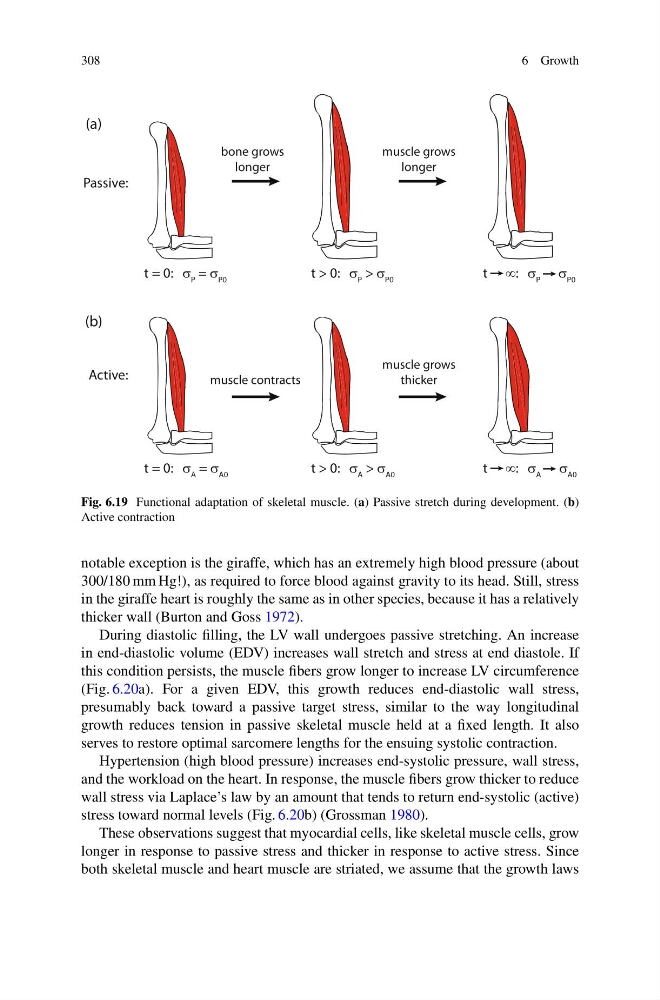
Fig. 6.19 Functional adaptation of skeletal muscle. (a) Passive stretch during development. (b)
Active contraction
notable exception is the giraffe, which has an extremely high blood pressure (about
300/180 mm Hg!), as required to force blood against gravity to its head. Still, stress
in the giraffe heart is roughly the same as in other species, because it has a relatively
thicker wall (Burton and Goss 1972).
During diastolic filling, the LV wall undergoes passive stretching. An increase
in end-diastolic volume (EDV) increases wall stretch and stress at end diastole. If
this condition persists, the muscle fibers grow longer to increase LV circumference
(Fig. 6.20a). For a given EDV, this growth reduces end-diastolic wall stress,
presumably back toward a passive target stress, similar to the way longitudinal
growth reduces tension in passive skeletal muscle held at a fixed length. It also
serves to restore optimal sarcomere lengths for the ensuing systolic contraction.
Hypertension (high blood pressure) increases end-systolic pressure, wall stress,
and the workload on the heart. In response, the muscle fibers grow thicker to reduce
wall stress via Laplace’s law by an amount that tends to return end-systolic (active)
stress toward normal levels (Fig. 6.20b) (Grossman 1980).
These observations suggest that myocardial cells, like skeletal muscle cells, grow
longer in response to passive stress and thicker in response to active stress. Since
both skeletal muscle and heart muscle are striated, we assume that the growth laws
6 Growth
t = 0: σ P = σ P0
t > 0: σ P > σ P0
t ∞: σ P σ P0
Passive:
Active:
bone grows
longer
muscle grows
longer
muscle contracts
muscle grows
thicker
t = 0: σ A = σ A0
t > 0: σ A > σ A0
t ∞: σ A σ A0
(a)
(b)
Fig. 6.19 Functional adaptation of skeletal muscle. (a) Passive stretch during development. (b)
Active contraction
notable exception is the giraffe, which has an extremely high blood pressure (about
300/180 mm Hg!), as required to force blood against gravity to its head. Still, stress
in the giraffe heart is roughly the same as in other species, because it has a relatively
thicker wall (Burton and Goss 1972).
During diastolic filling, the LV wall undergoes passive stretching. An increase
in end-diastolic volume (EDV) increases wall stretch and stress at end diastole. If
this condition persists, the muscle fibers grow longer to increase LV circumference
(Fig. 6.20a). For a given EDV, this growth reduces end-diastolic wall stress,
presumably back toward a passive target stress, similar to the way longitudinal
growth reduces tension in passive skeletal muscle held at a fixed length. It also
serves to restore optimal sarcomere lengths for the ensuing systolic contraction.
Hypertension (high blood pressure) increases end-systolic pressure, wall stress,
and the workload on the heart. In response, the muscle fibers grow thicker to reduce
wall stress via Laplace’s law by an amount that tends to return end-systolic (active)
stress toward normal levels (Fig. 6.20b) (Grossman 1980).
These observations suggest that myocardial cells, like skeletal muscle cells, grow
longer in response to passive stress and thicker in response to active stress. Since
both skeletal muscle and heart muscle are striated, we assume that the growth laws