

6.10 Theory for Combined Growth and Contraction
309
t = 0: V P = V P0
t > 0: V P > V P0
t f: V P V P0
Passive:
Active:
incr EDV
longer
incr ESP
thicker
t = 0: V A = V A0
t > 0: V A > V A0
t f: V A V A0
(a)
(b)
a 0
a 1
a 1
(a 1 > a 0 )
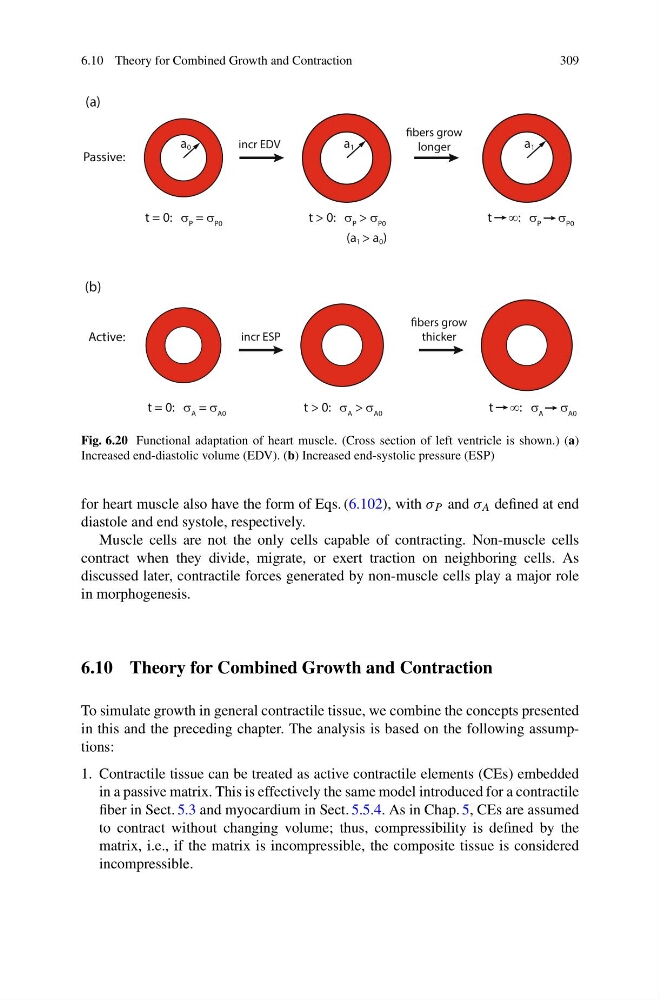
Fig. 6.20 Functional adaptation of heart muscle. (Cross section of left ventricle is shown.) (a)
Increased end-diastolic volume (EDV). (b) Increased end-systolic pressure (ESP)
for heart muscle also have the form of Eqs. (6.102), with σ P and σ A defined at end
diastole and end systole, respectively.
Muscle cells are not the only cells capable of contracting. Non-muscle cells
contract when they divide, migrate, or exert traction on neighboring cells. As
discussed later, contractile forces generated by non-muscle cells play a major role
in morphogenesis.
6.10 Theory for Combined Growth and Contraction
To simulate growth in general contractile tissue, we combine the concepts presented
in this and the preceding chapter. The analysis is based on the following assumptions:
1. Contractile tissue can be treated as active contractile elements (CEs) embedded
in a passive matrix. This is effectively the same model introduced for a contractile
fiber in Sect. 5.3 and myocardium in Sect. 5.5.4. As in Chap. 5, CEs are assumed
to contract without changing volume; thus, compressibility is defined by the
matrix, i.e., if the matrix is incompressible, the composite tissue is considered
incompressible.
309
t = 0: V P = V P0
t > 0: V P > V P0
t f: V P V P0
Passive:
Active:
incr EDV
longer
incr ESP
thicker
t = 0: V A = V A0
t > 0: V A > V A0
t f: V A V A0
(a)
(b)
a 0
a 1
a 1
(a 1 > a 0 )
Fig. 6.20 Functional adaptation of heart muscle. (Cross section of left ventricle is shown.) (a)
Increased end-diastolic volume (EDV). (b) Increased end-systolic pressure (ESP)
for heart muscle also have the form of Eqs. (6.102), with σ P and σ A defined at end
diastole and end systole, respectively.
Muscle cells are not the only cells capable of contracting. Non-muscle cells
contract when they divide, migrate, or exert traction on neighboring cells. As
discussed later, contractile forces generated by non-muscle cells play a major role
in morphogenesis.
6.10 Theory for Combined Growth and Contraction
To simulate growth in general contractile tissue, we combine the concepts presented
in this and the preceding chapter. The analysis is based on the following assumptions:
1. Contractile tissue can be treated as active contractile elements (CEs) embedded
in a passive matrix. This is effectively the same model introduced for a contractile
fiber in Sect. 5.3 and myocardium in Sect. 5.5.4. As in Chap. 5, CEs are assumed
to contract without changing volume; thus, compressibility is defined by the
matrix, i.e., if the matrix is incompressible, the composite tissue is considered
incompressible.