

6.9 Mechanical Feedback
307
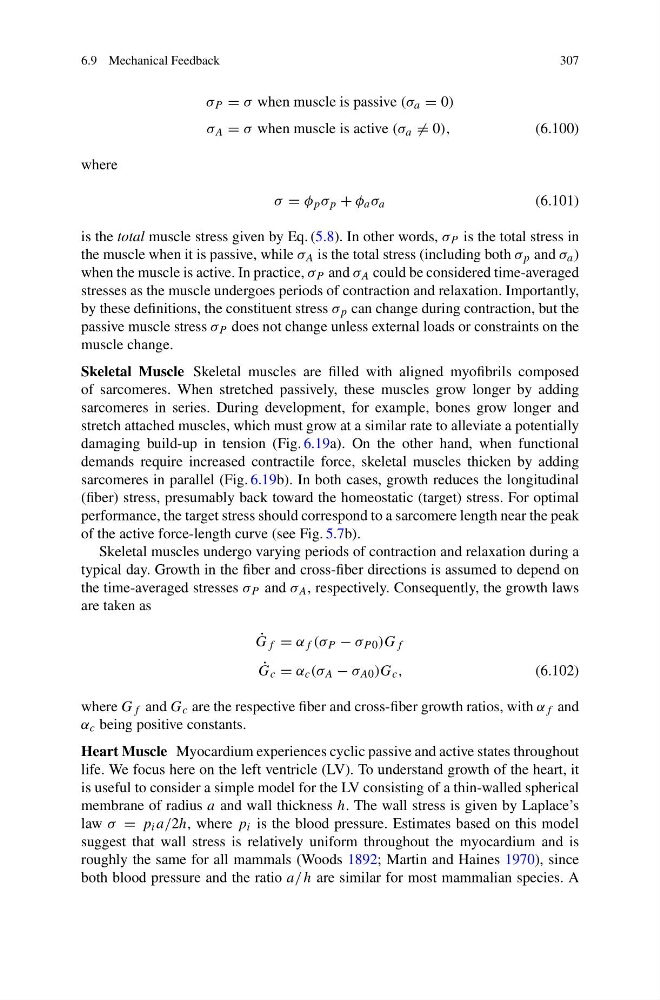
σ P = σ when muscle is passive (σ a = 0)
σ A = σ when muscle is active (σ a = 0),
(6.100)
where
σ = φ p σ p + φ a σ a
(6.101)
is the total muscle stress given by Eq. (5.8). In other words, σ P is the total stress in
the muscle when it is passive, while σ A is the total stress (including both σ p and σ a )
when the muscle is active. In practice, σ P and σ A could be considered time-averaged
stresses as the muscle undergoes periods of contraction and relaxation. Importantly,
by these definitions, the constituent stress σ p can change during contraction, but the
passive muscle stress σ P does not change unless external loads or constraints on the
muscle change.
Skeletal Muscle Skeletal muscles are filled with aligned myofibrils composed
of sarcomeres. When stretched passively, these muscles grow longer by adding
sarcomeres in series. During development, for example, bones grow longer and
stretch attached muscles, which must grow at a similar rate to alleviate a potentially
damaging build-up in tension (Fig. 6.19a). On the other hand, when functional
demands require increased contractile force, skeletal muscles thicken by adding
sarcomeres in parallel (Fig. 6.19b). In both cases, growth reduces the longitudinal
(fiber) stress, presumably back toward the homeostatic (target) stress. For optimal
performance, the target stress should correspond to a sarcomere length near the peak
of the active force-length curve (see Fig. 5.7b).
Skeletal muscles undergo varying periods of contraction and relaxation during a
typical day. Growth in the fiber and cross-fiber directions is assumed to depend on
the time-averaged stresses σ P and σ A , respectively. Consequently, the growth laws
are taken as
˙
G f = α f (σ P − σ P 0 )G f
˙
G c = α c (σ A − σ A0 )G c ,
(6.102)
where G f and G c are the respective fiber and cross-fiber growth ratios, with α f and
α c being positive constants.
Heart Muscle Myocardium experiences cyclic passive and active states throughout
life. We focus here on the left ventricle (LV). To understand growth of the heart, it
is useful to consider a simple model for the LV consisting of a thin-walled spherical
membrane of radius a and wall thickness h. The wall stress is given by Laplace’s
law σ = p i a/2h, where p i is the blood pressure. Estimates based on this model
suggest that wall stress is relatively uniform throughout the myocardium and is
roughly the same for all mammals (Woods 1892; Martin and Haines 1970), since
both blood pressure and the ratio a/ h are similar for most mammalian species. A
307
σ P = σ when muscle is passive (σ a = 0)
σ A = σ when muscle is active (σ a = 0),
(6.100)
where
σ = φ p σ p + φ a σ a
(6.101)
is the total muscle stress given by Eq. (5.8). In other words, σ P is the total stress in
the muscle when it is passive, while σ A is the total stress (including both σ p and σ a )
when the muscle is active. In practice, σ P and σ A could be considered time-averaged
stresses as the muscle undergoes periods of contraction and relaxation. Importantly,
by these definitions, the constituent stress σ p can change during contraction, but the
passive muscle stress σ P does not change unless external loads or constraints on the
muscle change.
Skeletal Muscle Skeletal muscles are filled with aligned myofibrils composed
of sarcomeres. When stretched passively, these muscles grow longer by adding
sarcomeres in series. During development, for example, bones grow longer and
stretch attached muscles, which must grow at a similar rate to alleviate a potentially
damaging build-up in tension (Fig. 6.19a). On the other hand, when functional
demands require increased contractile force, skeletal muscles thicken by adding
sarcomeres in parallel (Fig. 6.19b). In both cases, growth reduces the longitudinal
(fiber) stress, presumably back toward the homeostatic (target) stress. For optimal
performance, the target stress should correspond to a sarcomere length near the peak
of the active force-length curve (see Fig. 5.7b).
Skeletal muscles undergo varying periods of contraction and relaxation during a
typical day. Growth in the fiber and cross-fiber directions is assumed to depend on
the time-averaged stresses σ P and σ A , respectively. Consequently, the growth laws
are taken as
˙
G f = α f (σ P − σ P 0 )G f
˙
G c = α c (σ A − σ A0 )G c ,
(6.102)
where G f and G c are the respective fiber and cross-fiber growth ratios, with α f and
α c being positive constants.
Heart Muscle Myocardium experiences cyclic passive and active states throughout
life. We focus here on the left ventricle (LV). To understand growth of the heart, it
is useful to consider a simple model for the LV consisting of a thin-walled spherical
membrane of radius a and wall thickness h. The wall stress is given by Laplace’s
law σ = p i a/2h, where p i is the blood pressure. Estimates based on this model
suggest that wall stress is relatively uniform throughout the myocardium and is
roughly the same for all mammals (Woods 1892; Martin and Haines 1970), since
both blood pressure and the ratio a/ h are similar for most mammalian species. A