

306
6 Growth
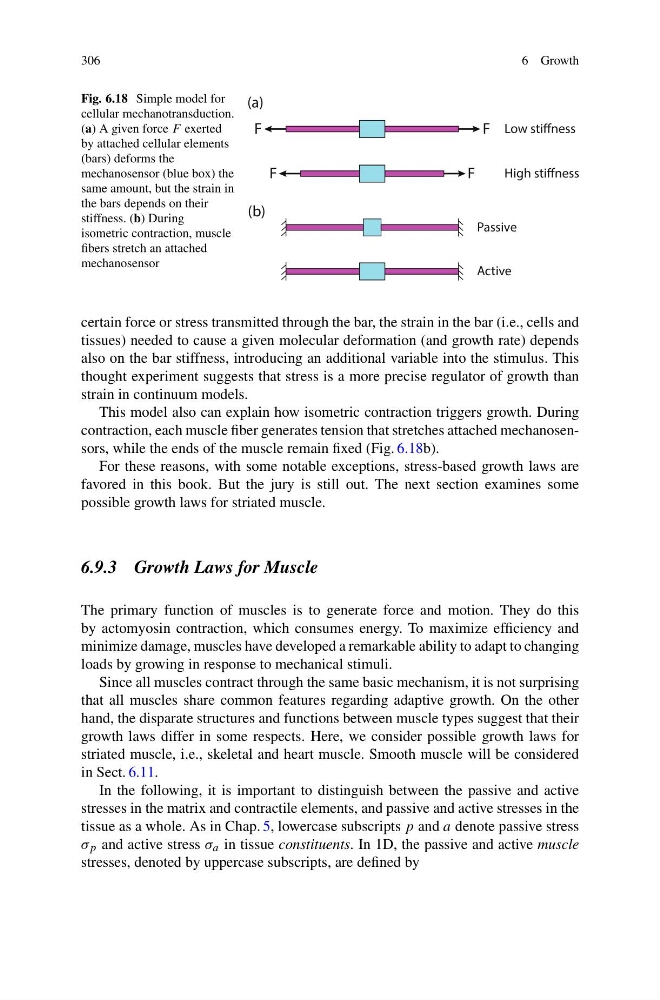
Fig. 6.18 Simple model for
cellular mechanotransduction.
(a) A given force F exerted
by attached cellular elements
(bars) deforms the
mechanosensor (blue box) the
same amount, but the strain in
the bars depends on their
stiffness. (b) During
isometric contraction, muscle
fibers stretch an attached
mechanosensor
F
F
F
F
Passive
Active
(b)
(a)
certain force or stress transmitted through the bar, the strain in the bar (i.e., cells and
tissues) needed to cause a given molecular deformation (and growth rate) depends
also on the bar stiffness, introducing an additional variable into the stimulus. This
thought experiment suggests that stress is a more precise regulator of growth than
strain in continuum models.
This model also can explain how isometric contraction triggers growth. During
contraction, each muscle fiber generates tension that stretches attached mechanosensors, while the ends of the muscle remain fixed (Fig. 6.18b).
For these reasons, with some notable exceptions, stress-based growth laws are
favored in this book. But the jury is still out. The next section examines some
possible growth laws for striated muscle.
6.9.3 Growth Laws for Muscle
The primary function of muscles is to generate force and motion. They do this
by actomyosin contraction, which consumes energy. To maximize efficiency and
minimize damage, muscles have developed a remarkable ability to adapt to changing
loads by growing in response to mechanical stimuli.
Since all muscles contract through the same basic mechanism, it is not surprising
that all muscles share common features regarding adaptive growth. On the other
hand, the disparate structures and functions between muscle types suggest that their
growth laws differ in some respects. Here, we consider possible growth laws for
striated muscle, i.e., skeletal and heart muscle. Smooth muscle will be considered
in Sect. 6.11.
In the following, it is important to distinguish between the passive and active
stresses in the matrix and contractile elements, and passive and active stresses in the
tissue as a whole. As in Chap. 5, lowercase subscripts p and a denote passive stress
σ p and active stress σ a in tissue constituents. In 1D, the passive and active muscle
stresses, denoted by uppercase subscripts, are defined by
6 Growth
Fig. 6.18 Simple model for
cellular mechanotransduction.
(a) A given force F exerted
by attached cellular elements
(bars) deforms the
mechanosensor (blue box) the
same amount, but the strain in
the bars depends on their
stiffness. (b) During
isometric contraction, muscle
fibers stretch an attached
mechanosensor
F
F
F
F
Passive
Active
(b)
(a)
certain force or stress transmitted through the bar, the strain in the bar (i.e., cells and
tissues) needed to cause a given molecular deformation (and growth rate) depends
also on the bar stiffness, introducing an additional variable into the stimulus. This
thought experiment suggests that stress is a more precise regulator of growth than
strain in continuum models.
This model also can explain how isometric contraction triggers growth. During
contraction, each muscle fiber generates tension that stretches attached mechanosensors, while the ends of the muscle remain fixed (Fig. 6.18b).
For these reasons, with some notable exceptions, stress-based growth laws are
favored in this book. But the jury is still out. The next section examines some
possible growth laws for striated muscle.
6.9.3 Growth Laws for Muscle
The primary function of muscles is to generate force and motion. They do this
by actomyosin contraction, which consumes energy. To maximize efficiency and
minimize damage, muscles have developed a remarkable ability to adapt to changing
loads by growing in response to mechanical stimuli.
Since all muscles contract through the same basic mechanism, it is not surprising
that all muscles share common features regarding adaptive growth. On the other
hand, the disparate structures and functions between muscle types suggest that their
growth laws differ in some respects. Here, we consider possible growth laws for
striated muscle, i.e., skeletal and heart muscle. Smooth muscle will be considered
in Sect. 6.11.
In the following, it is important to distinguish between the passive and active
stresses in the matrix and contractile elements, and passive and active stresses in the
tissue as a whole. As in Chap. 5, lowercase subscripts p and a denote passive stress
σ p and active stress σ a in tissue constituents. In 1D, the passive and active muscle
stresses, denoted by uppercase subscripts, are defined by