

5.5 Case Study: Cardiac Mechanics
243
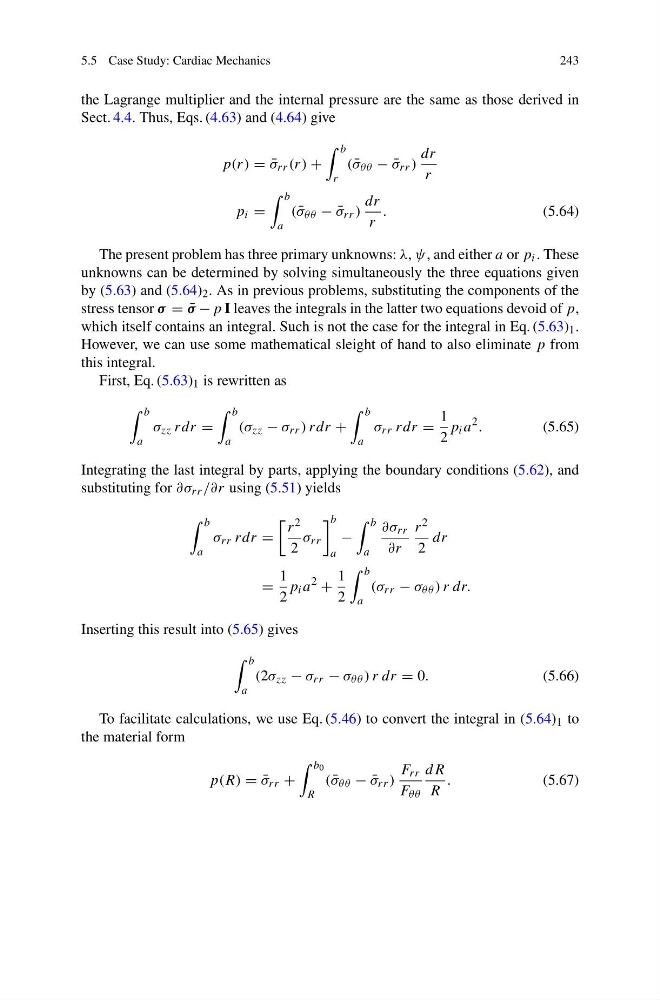
the Lagrange multiplier and the internal pressure are the same as those derived in
Sect. 4.4. Thus, Eqs. (4.63) and (4.64) give
p(r) = ¯
σ rr (r) +
b
r
( ¯
σ θθ − ¯
σ rr )
dr
r
p i =
b
a
( ¯
σ θθ − ¯
σ rr )
dr
r
.
(5.64)
The present problem has three primary unknowns: λ, ψ, and either a or p i . These
unknowns can be determined by solving simultaneously the three equations given
by (5.63) and (5.64) 2 . As in previous problems, substituting the components of the
stress tensor σ = ¯
σ − p I leaves the integrals in the latter two equations devoid of p,
which itself contains an integral. Such is not the case for the integral in Eq. (5.63) 1 .
However, we can use some mathematical sleight of hand to also eliminate p from
this integral.
First, Eq. (5.63) 1 is rewritten as
b
a
σ zz rdr =
b
a
(σ zz − σ rr ) rdr +
b
a
σ rr rdr =
1
2
p i a
2 .
(5.65)
Integrating the last integral by parts, applying the boundary conditions (5.62), and
substituting for ∂σ rr /∂r using (5.51) yields
b
a
σ rr rdr =
r 2
2
σ rr
b
a
−
b
a
∂σ rr
∂r
r 2
2
dr
=
1
2
p i a
2
+
1
2
b
a
(σ rr − σ θθ ) r dr.
Inserting this result into (5.65) gives
b
a
(2σ zz − σ rr − σ θθ ) r dr = 0.
(5.66)
To facilitate calculations, we use Eq. (5.46) to convert the integral in (5.64) 1 to
the material form
p(R) = ¯
σ rr +
b 0
R
( ¯
σ θθ − ¯
σ rr )
F rr
F θθ
dR
R
.
(5.67)
243
the Lagrange multiplier and the internal pressure are the same as those derived in
Sect. 4.4. Thus, Eqs. (4.63) and (4.64) give
p(r) = ¯
σ rr (r) +
b
r
( ¯
σ θθ − ¯
σ rr )
dr
r
p i =
b
a
( ¯
σ θθ − ¯
σ rr )
dr
r
.
(5.64)
The present problem has three primary unknowns: λ, ψ, and either a or p i . These
unknowns can be determined by solving simultaneously the three equations given
by (5.63) and (5.64) 2 . As in previous problems, substituting the components of the
stress tensor σ = ¯
σ − p I leaves the integrals in the latter two equations devoid of p,
which itself contains an integral. Such is not the case for the integral in Eq. (5.63) 1 .
However, we can use some mathematical sleight of hand to also eliminate p from
this integral.
First, Eq. (5.63) 1 is rewritten as
b
a
σ zz rdr =
b
a
(σ zz − σ rr ) rdr +
b
a
σ rr rdr =
1
2
p i a
2 .
(5.65)
Integrating the last integral by parts, applying the boundary conditions (5.62), and
substituting for ∂σ rr /∂r using (5.51) yields
b
a
σ rr rdr =
r 2
2
σ rr
b
a
−
b
a
∂σ rr
∂r
r 2
2
dr
=
1
2
p i a
2
+
1
2
b
a
(σ rr − σ θθ ) r dr.
Inserting this result into (5.65) gives
b
a
(2σ zz − σ rr − σ θθ ) r dr = 0.
(5.66)
To facilitate calculations, we use Eq. (5.46) to convert the integral in (5.64) 1 to
the material form
p(R) = ¯
σ rr +
b 0
R
( ¯
σ θθ − ¯
σ rr )
F rr
F θθ
dR
R
.
(5.67)