

5.2 Kinematics of Contraction
213
which satisfy the relation
λ = Kλ ∗ .
(5.3)
Stress depends only on the elastic stretch ratio λ ∗ .
Often K is taken as a specified function of time. During a single contractionrelaxation cycle (twitch), for example, an unconstrained muscle fiber contracts to a
minimum length and then relaxes back to its passive length, as K decreases from
one to K min and then increases back to one. This behavior can be approximated by
K(t) = 1 − (1 − K min ) sin
πt
T
,
(5.4)
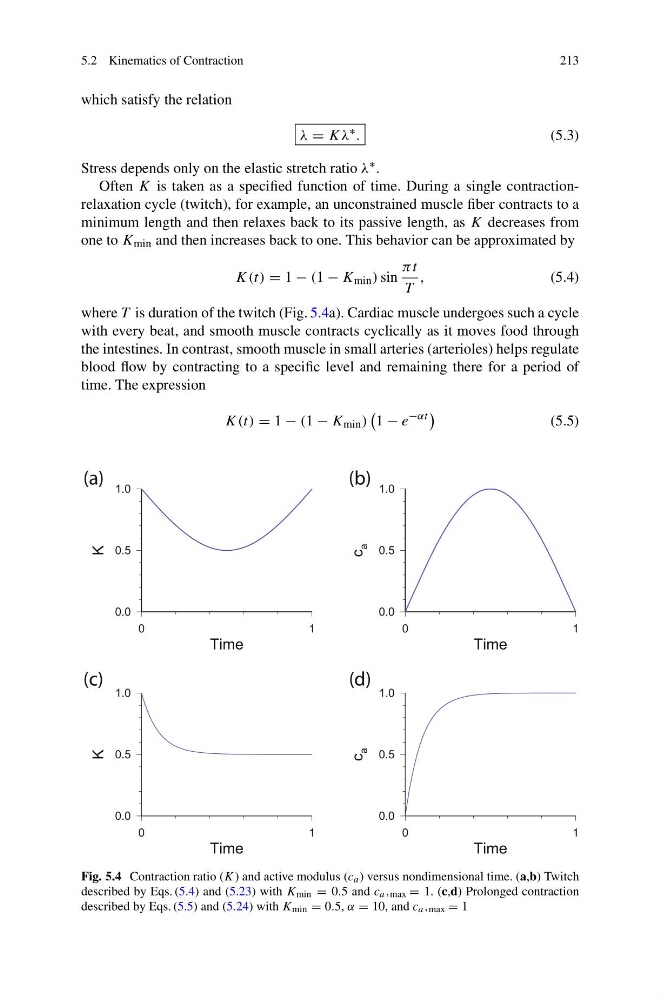
where T is duration of the twitch (Fig. 5.4a). Cardiac muscle undergoes such a cycle
with every beat, and smooth muscle contracts cyclically as it moves food through
the intestines. In contrast, smooth muscle in small arteries (arterioles) helps regulate
blood flow by contracting to a specific level and remaining there for a period of
time. The expression
K(t) = 1 − (1 − K min )
1 − e
−αt
(5.5)
(a)
(b)
(c)
(d)
Fig. 5.4 Contraction ratio (K) and active modulus (c a ) versus nondimensional time. (a,b) Twitch
described by Eqs. (5.4) and (5.23) with K min = 0.5 and c a , max = 1. (c,d) Prolonged contraction
described by Eqs. (5.5) and (5.24) with K min = 0.5, α = 10, and c a , max = 1
213
which satisfy the relation
λ = Kλ ∗ .
(5.3)
Stress depends only on the elastic stretch ratio λ ∗ .
Often K is taken as a specified function of time. During a single contractionrelaxation cycle (twitch), for example, an unconstrained muscle fiber contracts to a
minimum length and then relaxes back to its passive length, as K decreases from
one to K min and then increases back to one. This behavior can be approximated by
K(t) = 1 − (1 − K min ) sin
πt
T
,
(5.4)
where T is duration of the twitch (Fig. 5.4a). Cardiac muscle undergoes such a cycle
with every beat, and smooth muscle contracts cyclically as it moves food through
the intestines. In contrast, smooth muscle in small arteries (arterioles) helps regulate
blood flow by contracting to a specific level and remaining there for a period of
time. The expression
K(t) = 1 − (1 − K min )
1 − e
−αt
(5.5)
(a)
(b)
(c)
(d)
Fig. 5.4 Contraction ratio (K) and active modulus (c a ) versus nondimensional time. (a,b) Twitch
described by Eqs. (5.4) and (5.23) with K min = 0.5 and c a , max = 1. (c,d) Prolonged contraction
described by Eqs. (5.5) and (5.24) with K min = 0.5, α = 10, and c a , max = 1