

212
5 Contraction
the CE from shortening. During isometric contraction, therefore, the element
generates active stress in the absence of strain. If the end constraints are released,
the element rapidly shortens to its active zero-stress length L a (Fig. 5.2a). 2
Clearly, the terms “contraction” and “shortening” are not synonymous. Contraction is an active process that may or may not result in shortening. The magnitude
of contraction is characterized by the value of K, which defines the ZSS of a CE
regardless of its actual physical length.
To better understand how isometric tension develops, it is useful to imagine
that the CE transforms from the initial to the final state via an alternative pathway
(Fig. 5.2b). First, with one end of the passive CE free, the element contracts and
shortens from the passive length L p to the active zero-stress length L a . Then, with
contraction maintained, the CE is stretched back to length L p , putting the structure
into a state of active tension. Notably, the active stress depends on the stretch ratio
L p /L a = 1/K > 1.
5.2.3 Configurations for a Contractile Element
Consistent with the above discussion, we define three states (configurations) for a
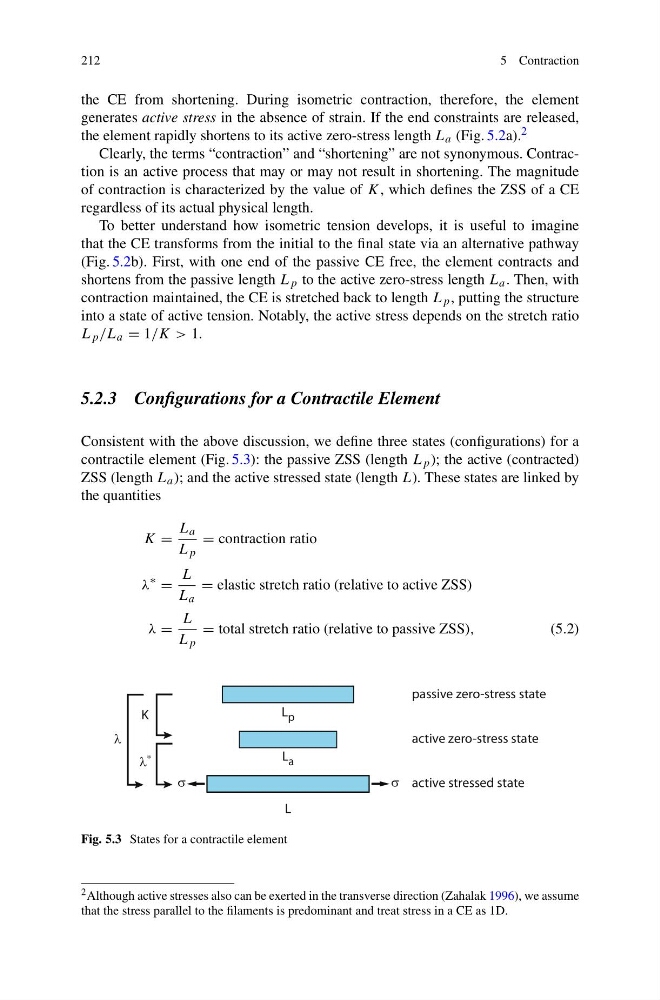
contractile element (Fig. 5.3): the passive ZSS (length L p ); the active (contracted)
ZSS (length L a ); and the active stressed state (length L). These states are linked by
the quantities
K =
L a
L p
= contraction ratio
λ
∗
=
L
L a
= elastic stretch ratio (relative to active ZSS)
λ =
L
L p
= total stretch ratio (relative to passive ZSS),
(5.2)
passive zero-stress state
active zero-stress state
active stressed state
K
λ
λ
*
L p
L a
L
σ
σ
Fig. 5.3 States for a contractile element
2 Although active stresses also can be exerted in the transverse direction (Zahalak 1996), we assume
that the stress parallel to the filaments is predominant and treat stress in a CE as 1D.
5 Contraction
the CE from shortening. During isometric contraction, therefore, the element
generates active stress in the absence of strain. If the end constraints are released,
the element rapidly shortens to its active zero-stress length L a (Fig. 5.2a). 2
Clearly, the terms “contraction” and “shortening” are not synonymous. Contraction is an active process that may or may not result in shortening. The magnitude
of contraction is characterized by the value of K, which defines the ZSS of a CE
regardless of its actual physical length.
To better understand how isometric tension develops, it is useful to imagine
that the CE transforms from the initial to the final state via an alternative pathway
(Fig. 5.2b). First, with one end of the passive CE free, the element contracts and
shortens from the passive length L p to the active zero-stress length L a . Then, with
contraction maintained, the CE is stretched back to length L p , putting the structure
into a state of active tension. Notably, the active stress depends on the stretch ratio
L p /L a = 1/K > 1.
5.2.3 Configurations for a Contractile Element
Consistent with the above discussion, we define three states (configurations) for a
contractile element (Fig. 5.3): the passive ZSS (length L p ); the active (contracted)
ZSS (length L a ); and the active stressed state (length L). These states are linked by
the quantities
K =
L a
L p
= contraction ratio
λ
∗
=
L
L a
= elastic stretch ratio (relative to active ZSS)
λ =
L
L p
= total stretch ratio (relative to passive ZSS),
(5.2)
passive zero-stress state
active zero-stress state
active stressed state
K
λ
λ
*
L p
L a
L
σ
σ
Fig. 5.3 States for a contractile element
2 Although active stresses also can be exerted in the transverse direction (Zahalak 1996), we assume
that the stress parallel to the filaments is predominant and treat stress in a CE as 1D.