

5.2 Kinematics of Contraction
211
assume that the filaments can slide freely past each other. Stretching a passive CE,
therefore, produces no significant stress.
In response to an electrical, chemical, or mechanical stimulus, myosin crossbridges attach to actin filaments and pull them together, causing the unloaded
element to shorten (Fig. 5.1b). Since equilibrium demands that the stress remain
zero, the CE experiences negative strain without stress. This behavior is like the
shortening of an unconstrained metal bar as it cools. In this sense, contractile strain
is analogous to thermal strain during cooling.
The contraction ratio is defined as 1
K(t) = L a (t)/L p ,
(5.1)
where L p and L a are the passive and active lengths, respectively, of the CE under
stress-free conditions. This quantity is unity for a passive CE and decreases with
time as the element contracts, with 0 < K ≤ 1. Since the element remains stress
free, K(t) defines a change in ZSS.
5.2.2 Constrained Contraction of a Contractile Element
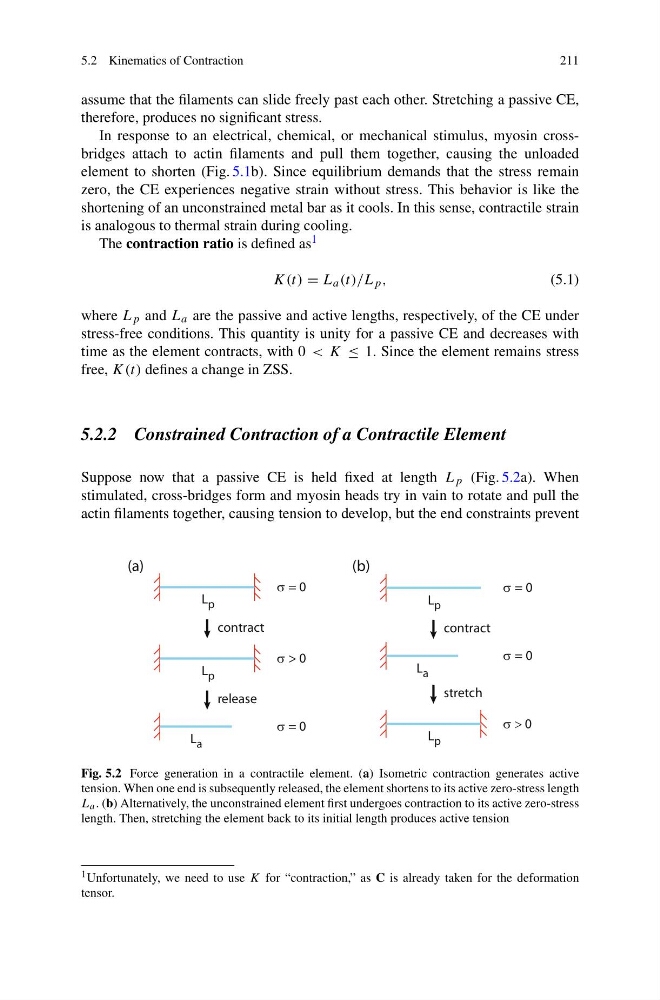
Suppose now that a passive CE is held fixed at length L p (Fig. 5.2a). When
stimulated, cross-bridges form and myosin heads try in vain to rotate and pull the
actin filaments together, causing tension to develop, but the end constraints prevent
σ = 0
L p
contract
σ > 0
L p
release
σ = 0
L a
(a)
σ = 0
L p
contract
σ = 0
L a
(b)
stretch
σ > 0
L p
Fig. 5.2 Force generation in a contractile element. (a) Isometric contraction generates active
tension. When one end is subsequently released, the element shortens to its active zero-stress length
L a . (b) Alternatively, the unconstrained element first undergoes contraction to its active zero-stress
length. Then, stretching the element back to its initial length produces active tension
1 Unfortunately, we need to use K for “contraction,” as C is already taken for the deformation
tensor.
211
assume that the filaments can slide freely past each other. Stretching a passive CE,
therefore, produces no significant stress.
In response to an electrical, chemical, or mechanical stimulus, myosin crossbridges attach to actin filaments and pull them together, causing the unloaded
element to shorten (Fig. 5.1b). Since equilibrium demands that the stress remain
zero, the CE experiences negative strain without stress. This behavior is like the
shortening of an unconstrained metal bar as it cools. In this sense, contractile strain
is analogous to thermal strain during cooling.
The contraction ratio is defined as 1
K(t) = L a (t)/L p ,
(5.1)
where L p and L a are the passive and active lengths, respectively, of the CE under
stress-free conditions. This quantity is unity for a passive CE and decreases with
time as the element contracts, with 0 < K ≤ 1. Since the element remains stress
free, K(t) defines a change in ZSS.
5.2.2 Constrained Contraction of a Contractile Element
Suppose now that a passive CE is held fixed at length L p (Fig. 5.2a). When
stimulated, cross-bridges form and myosin heads try in vain to rotate and pull the
actin filaments together, causing tension to develop, but the end constraints prevent
σ = 0
L p
contract
σ > 0
L p
release
σ = 0
L a
(a)
σ = 0
L p
contract
σ = 0
L a
(b)
stretch
σ > 0
L p
Fig. 5.2 Force generation in a contractile element. (a) Isometric contraction generates active
tension. When one end is subsequently released, the element shortens to its active zero-stress length
L a . (b) Alternatively, the unconstrained element first undergoes contraction to its active zero-stress
length. Then, stretching the element back to its initial length produces active tension
1 Unfortunately, we need to use K for “contraction,” as C is already taken for the deformation
tensor.