

210
5 Contraction
actin
myosin
cross-bridges
contraction
(a)
(b)
actin
myosin
passive
active
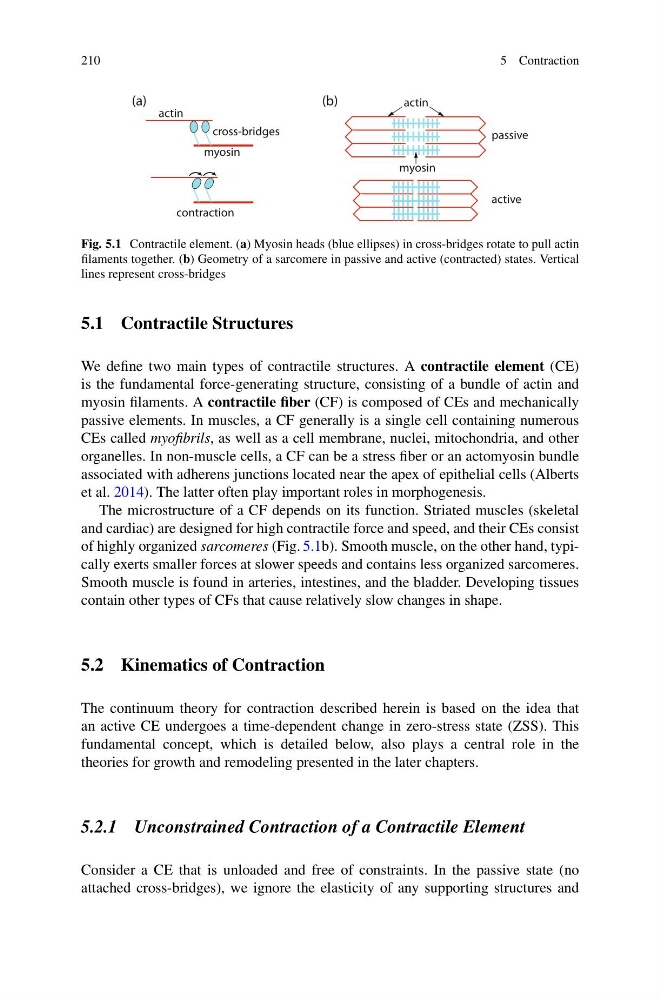
Fig. 5.1 Contractile element. (a) Myosin heads (blue ellipses) in cross-bridges rotate to pull actin
filaments together. (b) Geometry of a sarcomere in passive and active (contracted) states. Vertical
lines represent cross-bridges
5.1 Contractile Structures
We define two main types of contractile structures. A contractile element (CE)
is the fundamental force-generating structure, consisting of a bundle of actin and
myosin filaments. A contractile fiber (CF) is composed of CEs and mechanically
passive elements. In muscles, a CF generally is a single cell containing numerous
CEs called myofibrils, as well as a cell membrane, nuclei, mitochondria, and other
organelles. In non-muscle cells, a CF can be a stress fiber or an actomyosin bundle
associated with adherens junctions located near the apex of epithelial cells (Alberts
et al. 2014). The latter often play important roles in morphogenesis.
The microstructure of a CF depends on its function. Striated muscles (skeletal
and cardiac) are designed for high contractile force and speed, and their CEs consist
of highly organized sarcomeres (Fig. 5.1b). Smooth muscle, on the other hand, typically exerts smaller forces at slower speeds and contains less organized sarcomeres.
Smooth muscle is found in arteries, intestines, and the bladder. Developing tissues
contain other types of CFs that cause relatively slow changes in shape.
5.2 Kinematics of Contraction
The continuum theory for contraction described herein is based on the idea that
an active CE undergoes a time-dependent change in zero-stress state (ZSS). This
fundamental concept, which is detailed below, also plays a central role in the
theories for growth and remodeling presented in the later chapters.
5.2.1 Unconstrained Contraction of a Contractile Element
Consider a CE that is unloaded and free of constraints. In the passive state (no
attached cross-bridges), we ignore the elasticity of any supporting structures and
5 Contraction
actin
myosin
cross-bridges
contraction
(a)
(b)
actin
myosin
passive
active
Fig. 5.1 Contractile element. (a) Myosin heads (blue ellipses) in cross-bridges rotate to pull actin
filaments together. (b) Geometry of a sarcomere in passive and active (contracted) states. Vertical
lines represent cross-bridges
5.1 Contractile Structures
We define two main types of contractile structures. A contractile element (CE)
is the fundamental force-generating structure, consisting of a bundle of actin and
myosin filaments. A contractile fiber (CF) is composed of CEs and mechanically
passive elements. In muscles, a CF generally is a single cell containing numerous
CEs called myofibrils, as well as a cell membrane, nuclei, mitochondria, and other
organelles. In non-muscle cells, a CF can be a stress fiber or an actomyosin bundle
associated with adherens junctions located near the apex of epithelial cells (Alberts
et al. 2014). The latter often play important roles in morphogenesis.
The microstructure of a CF depends on its function. Striated muscles (skeletal
and cardiac) are designed for high contractile force and speed, and their CEs consist
of highly organized sarcomeres (Fig. 5.1b). Smooth muscle, on the other hand, typically exerts smaller forces at slower speeds and contains less organized sarcomeres.
Smooth muscle is found in arteries, intestines, and the bladder. Developing tissues
contain other types of CFs that cause relatively slow changes in shape.
5.2 Kinematics of Contraction
The continuum theory for contraction described herein is based on the idea that
an active CE undergoes a time-dependent change in zero-stress state (ZSS). This
fundamental concept, which is detailed below, also plays a central role in the
theories for growth and remodeling presented in the later chapters.
5.2.1 Unconstrained Contraction of a Contractile Element
Consider a CE that is unloaded and free of constraints. In the passive state (no
attached cross-bridges), we ignore the elasticity of any supporting structures and