

214
5 Contraction
simulates this behavior, with α being a positive rate constant (Fig. 5.4c). Circumferential contraction decreases vessel radius, thereby increasing resistance to
flow, while relaxation has the opposite effect. Contraction during morphogenesis is
similar to that of smooth muscle.
More generally, K is a function of both position and time. It also can depend on
mechanical or chemical factors such as stress or calcium concentration.
5.3 Model for a Contractile Fiber
To a first approximation, a CF can be modeled as a cylindrical bar consisting of
longitudinally aligned CEs embedded in a passive matrix. For material properties,
we could simply modify a transversely isotropic strain-energy function such as
Eq. (3.230) to include contraction in the fiber term. Here, however, we use a
somewhat different approach based on the rule-of-mixtures, whereby the relative
contributions of passive and active constituents are weighted by their volume
fractions. This approach is used in the remodeling theory to be introduced in
Chap. 7, where fiber content changes with time.
In a general CF, each material element contains both passive and active constituents. In the current configuration, volume fractions are defined by
φ p =
dv p
dv
,
φ a =
dv a
dv
,
(5.6)
where dv is the total element volume, and dv p and dv a are the volumes of the
passive and active constituents, respectively. If we assume that the constituents are
incompressible, then the volumes and volume fractions are the same as those in the
undeformed CF. Since dv = dv p + dv a , we have
φ p + φ a = 1.
(5.7)
The present theory is based on two main assumptions: (1) stress in the passive
component (σ p ) depends on deformation (λ) relative to the passive ZSS, while stress
in the active component (σ a ) depends on deformation (λ ∗ ) relative to the active ZSS;
and (2) the total stretch ratios (λ) of the active and passive components are equal. 3
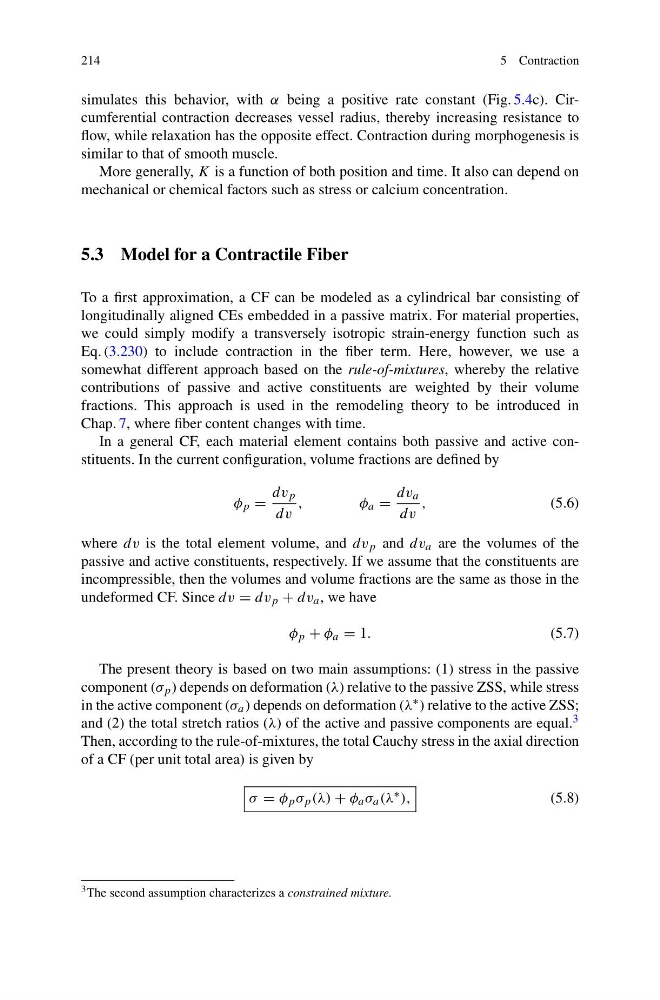
Then, according to the rule-of-mixtures, the total Cauchy stress in the axial direction
of a CF (per unit total area) is given by
σ = φ p σ p (λ) + φ a σ a (λ ∗ ),
(5.8)
3 The second assumption characterizes a constrained mixture.
5 Contraction
simulates this behavior, with α being a positive rate constant (Fig. 5.4c). Circumferential contraction decreases vessel radius, thereby increasing resistance to
flow, while relaxation has the opposite effect. Contraction during morphogenesis is
similar to that of smooth muscle.
More generally, K is a function of both position and time. It also can depend on
mechanical or chemical factors such as stress or calcium concentration.
5.3 Model for a Contractile Fiber
To a first approximation, a CF can be modeled as a cylindrical bar consisting of
longitudinally aligned CEs embedded in a passive matrix. For material properties,
we could simply modify a transversely isotropic strain-energy function such as
Eq. (3.230) to include contraction in the fiber term. Here, however, we use a
somewhat different approach based on the rule-of-mixtures, whereby the relative
contributions of passive and active constituents are weighted by their volume
fractions. This approach is used in the remodeling theory to be introduced in
Chap. 7, where fiber content changes with time.
In a general CF, each material element contains both passive and active constituents. In the current configuration, volume fractions are defined by
φ p =
dv p
dv
,
φ a =
dv a
dv
,
(5.6)
where dv is the total element volume, and dv p and dv a are the volumes of the
passive and active constituents, respectively. If we assume that the constituents are
incompressible, then the volumes and volume fractions are the same as those in the
undeformed CF. Since dv = dv p + dv a , we have
φ p + φ a = 1.
(5.7)
The present theory is based on two main assumptions: (1) stress in the passive
component (σ p ) depends on deformation (λ) relative to the passive ZSS, while stress
in the active component (σ a ) depends on deformation (λ ∗ ) relative to the active ZSS;
and (2) the total stretch ratios (λ) of the active and passive components are equal. 3
Then, according to the rule-of-mixtures, the total Cauchy stress in the axial direction
of a CF (per unit total area) is given by
σ = φ p σ p (λ) + φ a σ a (λ ∗ ),
(5.8)
3 The second assumption characterizes a constrained mixture.