

186
4 Problems in Soft Tissue Biomechanics
into the above relations and integrating over θ yield
N = 2π e z
b
0
σ zz r dr ≡ N e z
M = 2π e z
b
0
σ zθ r
2 dr ≡ Me z ,
(4.87)
since Eqs. (2.2) give
2π
0 e r dθ =
2π
0 e θ dθ = 0.
Solution The solution procedure follows that in the previous section for the tube
inflation problem. With λ and ψ given, Eq. (4.76) provides F at each grid point R,
and then Eqs. (4.82) and (4.83) give the ¯
σ ij . Next, substituting Eq. (4.79) into (4.78)
leads to
p(r) = ¯
σ rr (r) +
b
r
( ¯
σ θθ − ¯
σ rr )
dr
r
,
(4.88)
and then Eq. (4.79) provides σ at each R. Finally, Eqs. (4.87) give the applied end
loads N and M.
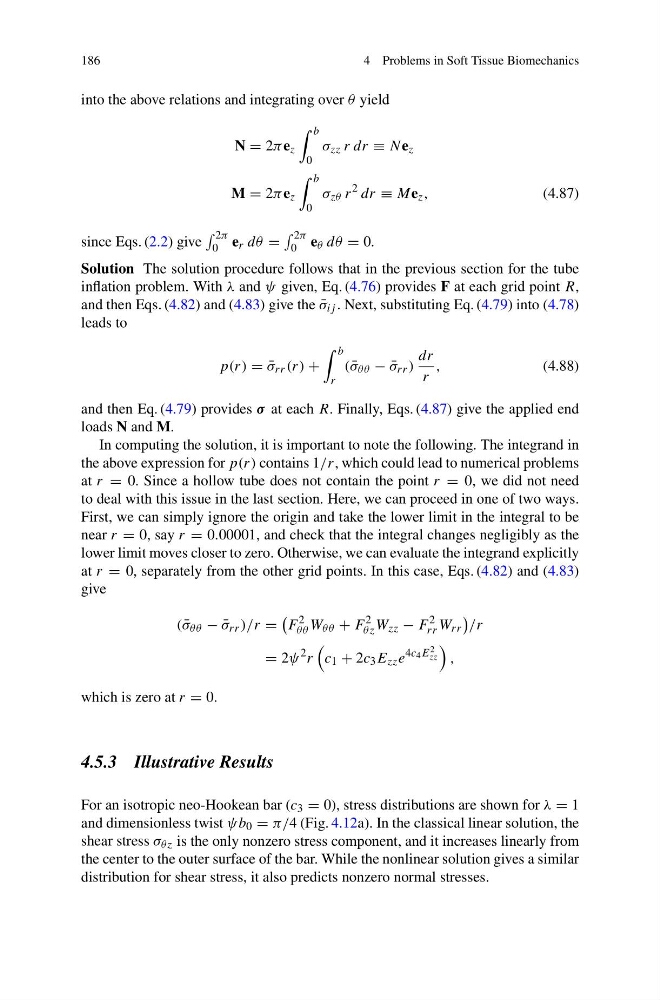
In computing the solution, it is important to note the following. The integrand in
the above expression for p(r) contains 1/r, which could lead to numerical problems
at r = 0. Since a hollow tube does not contain the point r = 0, we did not need
to deal with this issue in the last section. Here, we can proceed in one of two ways.
First, we can simply ignore the origin and take the lower limit in the integral to be
near r = 0, say r = 0.00001, and check that the integral changes negligibly as the
lower limit moves closer to zero. Otherwise, we can evaluate the integrand explicitly
at r = 0, separately from the other grid points. In this case, Eqs. (4.82) and (4.83)
give
( ¯
σ θθ − ¯
σ rr )/r =
F
2
θθ W θθ + F
2
θz W zz − F
2
rr W rr
/r
= 2ψ
2 r
c 1 + 2c 3 E zz e
4c 4 E 2
zz
,
which is zero at r = 0.
4.5.3 Illustrative Results
For an isotropic neo-Hookean bar (c 3 = 0), stress distributions are shown for λ = 1
and dimensionless twist ψb 0 = π/4 (Fig. 4.12a). In the classical linear solution, the
shear stress σ θz is the only nonzero stress component, and it increases linearly from
the center to the outer surface of the bar. While the nonlinear solution gives a similar
distribution for shear stress, it also predicts nonzero normal stresses.
4 Problems in Soft Tissue Biomechanics
into the above relations and integrating over θ yield
N = 2π e z
b
0
σ zz r dr ≡ N e z
M = 2π e z
b
0
σ zθ r
2 dr ≡ Me z ,
(4.87)
since Eqs. (2.2) give
2π
0 e r dθ =
2π
0 e θ dθ = 0.
Solution The solution procedure follows that in the previous section for the tube
inflation problem. With λ and ψ given, Eq. (4.76) provides F at each grid point R,
and then Eqs. (4.82) and (4.83) give the ¯
σ ij . Next, substituting Eq. (4.79) into (4.78)
leads to
p(r) = ¯
σ rr (r) +
b
r
( ¯
σ θθ − ¯
σ rr )
dr
r
,
(4.88)
and then Eq. (4.79) provides σ at each R. Finally, Eqs. (4.87) give the applied end
loads N and M.
In computing the solution, it is important to note the following. The integrand in
the above expression for p(r) contains 1/r, which could lead to numerical problems
at r = 0. Since a hollow tube does not contain the point r = 0, we did not need
to deal with this issue in the last section. Here, we can proceed in one of two ways.
First, we can simply ignore the origin and take the lower limit in the integral to be
near r = 0, say r = 0.00001, and check that the integral changes negligibly as the
lower limit moves closer to zero. Otherwise, we can evaluate the integrand explicitly
at r = 0, separately from the other grid points. In this case, Eqs. (4.82) and (4.83)
give
( ¯
σ θθ − ¯
σ rr )/r =
F
2
θθ W θθ + F
2
θz W zz − F
2
rr W rr
/r
= 2ψ
2 r
c 1 + 2c 3 E zz e
4c 4 E 2
zz
,
which is zero at r = 0.
4.5.3 Illustrative Results
For an isotropic neo-Hookean bar (c 3 = 0), stress distributions are shown for λ = 1
and dimensionless twist ψb 0 = π/4 (Fig. 4.12a). In the classical linear solution, the
shear stress σ θz is the only nonzero stress component, and it increases linearly from
the center to the outer surface of the bar. While the nonlinear solution gives a similar
distribution for shear stress, it also predicts nonzero normal stresses.